Blog
Climate and Its Effect on Pickle Making: Heat, Humidity and Timing

In Lucknow, according to India Meteorological Department figures cited by the kitchenware brand InstaCuppa, the daily highest humidity reaches about 90 percent by the end of June and stays there until the end of September. That one fact explains why a family on the Gangetic plain has about three months, roughly March to June, in which a pickle can be made and sun-cured, and a very different three months in which the same jar has to be protected from the air around it.
Climate decides when a pickle is made, how it is dried, what vessel holds it and even which fruit goes in. This guide follows the calendar through its three phases: the pickling window, the sun-curing weeks and the monsoon defence.
The short answer
In short
In north India the pickling season opens in spring and peaks before the monsoon, when raw mangoes are on the tree and the sun is strong enough to dry them in days. Heat and dry air help the pickle; humidity and rain threaten it, because moisture lets mould grow. Late or erratic rains can shift the whole season, and wetter regions use different methods because sun-drying is harder there.
The pickling window: spring into summer
Raw mango is the anchor of the season. The Deccan Herald’s recent piece on how pickles tell stories of climate notes that in northern India, where mango trees flourish during hot summers, raw mangoes became one of the country’s favourite pickle ingredients. Because the fruit has to be picked green and sour, the pickling window is set by the tree and the weather together.
Calendars vary by region, and some are tight. A Deccan Chronicle report on avakaya, the Andhra mango pickle, says the season to prepare it ends with a traditional date on June 8, and that late and deficient rain and unexpected showers had damaged the pickle mango crop in that year. The principle holds anywhere: the window closes when the rains begin.
The preparation starts before the fruit arrives. A household needs clean, dry jars, spices, salt and oil ready, since the season does not wait. The raw mango ritual of summer describes the Banaras version of that preparation, and the seasonal pantry calendar places pickling among the year’s other jobs.
The sun does the heavy lifting
Heat is a working tool in the pickle, not just the weather. An Al Jazeera feature on India’s pickle people records the logic in one line: to preserve anything, first, all water needs to be removed, and that is where sun-drying comes in. Salty environments are hostile to bacteria and fungi, and acids help kill microbes. Its simple lemon pickle method is to wash, dry, slice and toss the fruit with salt in proportion to its weight, followed by sun-drying and mixing with additional ingredients before bottling.
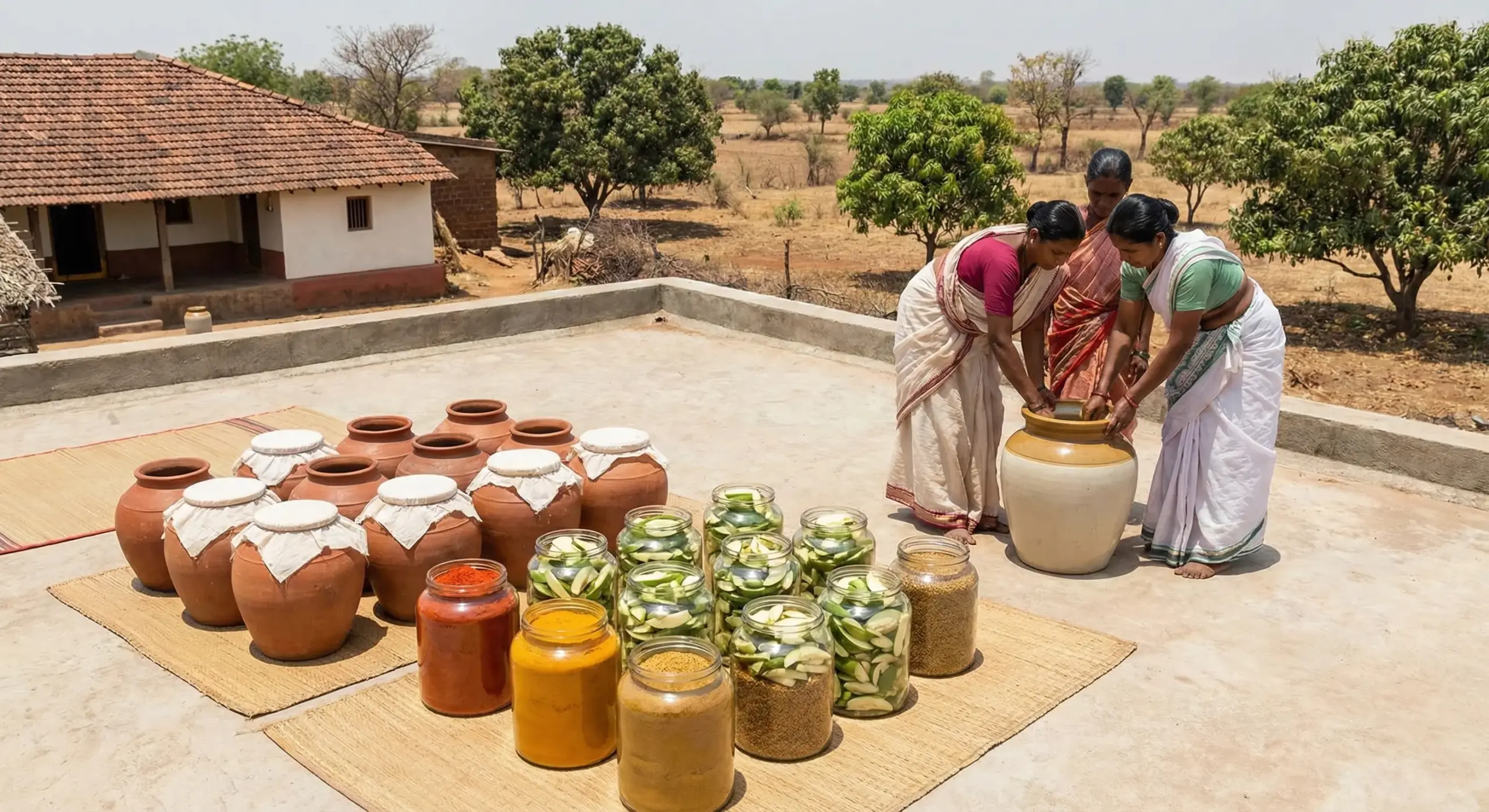
A Masterclass guide to achar describes pickles as traditionally prepared in summertime, making the most of the broiling heat of the pre-monsoon season, with spiced fruit or vegetables left to mature in the sun for three to four days in a muslin-covered jar. The Deccan Herald adds that many traditional pickles are placed in sunlight for several days, and that families may carefully move the jars into the sun each morning and bring them indoors every evening. Why that routine works, and how long it runs, is covered in why sun-drying is essential for Indian pickles and the sun-curing guide for achar.
Notice the range in the sources, three to four days in one, several days in another, five to seven in a recipe site, and about fifteen days of sun maturation in a producer’s description of a Uttar Pradesh family mango pickle. These are practices, not standards, and the right duration depends on the fruit, the cut, the sun and the household.
Humidity: the season’s antagonist
Moisture is the opposite of what a pickle needs. A Slurrp explainer on fungus in pickles puts it plainly: fungi thrive in warm, moist and humid environments, which are typical of the monsoon, and the air carries more moisture that can seep into jars that are not sealed properly. A guide to white fungus on homemade pickle from InstaCuppa lists the usual causes: too little salt, since salt pulls water out of the pieces, a wet spoon, and monsoon air that enters every time the lid is opened and condenses inside the jar.
The traditional defences all aim at keeping water out or taking it back out:
- Salt and oil. Enough salt to draw moisture, and an oil layer to keep air off. Why the oil layer matters explains the second.
- Dry jars. The Deccan Herald says traditional recipes insist that jars be completely dry before use.
- Sunning during breaks. A Slurrp monsoon guide advises using the periodic sunshine of an overcast season to dry pickles in the sun, an old way of recharging the jar.
- Smaller containers. Another Slurrp guide suggests keeping pickle in smaller containers when you have a lot, since the jar is then opened less often.
For the full monsoon routine, our guide to preventing fungus in achar during the monsoon goes step by step, and the best jar for achar covers the vessel.
Why the same recipe differs from one region to another
The Deccan Herald piece makes a point that applies across India: hot, dry and humid regions each use different preservation methods, and in wetter regions, constant humidity can make sun-drying difficult. It also notes that a mango pickle from Andhra Pradesh is often much hotter than one from Punjab because chilli varieties and spice blends reflect local tastes and agricultural conditions.
A Scroll feature captures the same variety from the fruit side: mangoes are turned into a chutney with sugar in Gujarat, pickled with saunf (aniseed) in Uttar Pradesh and Bihar, and in Andhra Pradesh are often pickled with fiery chillies. The Banarasi tradition of fennel in mango pickle is the Uttar Pradesh case in that sentence, and we follow it in hing, methi and saunf in Banarasi achar.
A changing climate, a changing season
The climate story is not only historical. A Slurrp feature on mango pickle as a survival system says that climate change, through erratic rains, heatwaves and pests, is already altering mango harvests across India. The Deccan Chronicle report mentioned earlier is an example of how a delayed or deficient monsoon can ruin a pickle season.
For a household, that means the calendar is a guide and not a timetable. A family that waits for fixed dates can find the fruit early or late, and a sudden shower during sun-curing can undo days of work.
Where chilli fits in
We are aware that chilli reached India after 1500, so any older pickle recipe that names chilli is a later form of a dish that originally used black pepper and other pungent spices.
What this means for a home pickle-maker
A few practical points follow from the climate.
- Make long-keeping oil pickles in the dry weeks, not in the rains.
- Check the forecast before you start sun-curing, and have a plan for an indoor fallback.
- Dry every jar and utensil completely, and use a dry spoon at every opening.
- Expect the monsoon to be the hardest test. Inspect jars after the first rains, and top up the oil if the fruit shows above it.
- Treat any promised shelf life with caution. We make none.
Frequently asked questions
When is the best time to make pickle in north India?
From spring to early summer, roughly March to June, while raw mango is available and the sun is strong. The window closes as the monsoon begins.
Why do pickles get fungus in the rainy season?
High humidity gives mould the moisture it needs. Contributing causes are too little salt, a wet spoon and humid air entering when the lid is opened.
How long should pickle be kept in the sun?
Sources range from three to four days to two weeks or more, depending on the recipe and the sun. There is no single standard.
Does humidity affect how long a pickle lasts?
Yes. Moisture is the main enemy, which is why traditional methods remove water first and keep it out afterwards.
Why do mango pickles differ across India?
Local fruit, chillies, spices and climate differ. Uttar Pradesh and Bihar use saunf in mango pickle, while Andhra Pradesh often uses fiery chillies.
Can pickles be made in the monsoon?
Some are, but the sun-dried, oil-sealed type depends on dry weather, so it is usually made earlier.
Is climate change affecting pickle making?
Reports say erratic rains, heatwaves and pests are altering mango harvests, which can shift or shorten the pickling season.
Sources used for this post:
– Deccan Herald, “How India’s pickles tell stories of climate”
– InstaCuppa, “How to Store Pickles in Monsoon” (IMD Lucknow humidity)
– InstaCuppa, “White fungus on homemade pickle”
– Deccan Chronicle, “No avakaya? Blame it on changing climate”
– Al Jazeera, “India’s pickle people”
– Masterclass, “All About Achaar”
– Slurrp, “Can pickles acquire fungus during monsoon?”
– Slurrp, “Monsoon Tip: Preserving Your Pickles From Spoilage”
– Slurrp, “5 Tips to Keep the Pickles Stay Fresh Even During Monsoons”
– Slurrp, “The Long Summer of Achaar”
– Scroll.in, pickles feature
– InstaCuppa, grandmother’s mango achaar method
– Producer description of a UP mango pickle (Masala Monk listing)