Blog
How Climate Shaped Banaras Food Habits: Heat, Humidity and the Fried Breakfast

Varanasi has recorded air temperatures of 47 degrees Celsius, in May 1998 and again in June 2005, according to Climates to Travel, and the city sits on a plain where the rains then turn the same air thick and wet. A kitchen that has to feed a family through both conditions without a refrigerator ends up with very particular habits.
This guide connects the climate of Banaras to the way it cooks and eats: why breakfast is fried, why sweets are so sweet, why summer food is cooked as little as possible, and why the rains bring a pause in leafy vegetables.
The short answer
In short
Banaras has hot, dry summers that pass 40 degrees Celsius, a humid monsoon from about late June to September, and a short, foggy winter. Fried and sugar-heavy foods last longer in that heat than boiled ones, so they became the city’s standard for breakfast, travel and festivals. Sattu, thandai and curd cool the summer table, a pause in leafy greens suits the rains, and oil-cured pickles carry flavour through every season.
The climate in numbers
Varanasi lies near 25 degrees north latitude in the Indo-Gangetic plain. Its year divides roughly into three parts.
| Period | Months | What the sources say |
|---|---|---|
| Hot, dry summer | March to June | Peaks can pass 45 degrees Celsius; records of 47 degrees in 1998 and 2005 (Climates to Travel) |
| Monsoon | July to September | Heavy intermittent rain, wet and humid (Native Planet) |
| Winter | December to February | Mild days of about 12 to 20 degrees, with severe fog in January (Native Planet) |
Annual rainfall is about 900 to 1,050 millimetres depending on the source, and weather records from the India Meteorological Department show average daily maximums near 40.7 degrees Celsius in May at the Varanasi airport station, against about 22 degrees in January. Those two months sit nearly 20 degrees apart, and the range matters for food. [Figures vary between stations and datasets, so we quote ranges and not a single number.]
Heat and the logic of fried food
The most visible effect of the climate is the fried breakfast. In Banaras households, as we explain in morning food habits of Banaras households, cooked food falls into two groups. Kachcha food is boiled in water: rice, dal, plain roti. Pucca (or pakka) food is cooked in ghee or oil: puri, kachori, jalebi.
Anthropologists usually explain the division through caste and ritual purity, and that is a real part of it. A practical reading runs alongside. Food cooked in water spoils fast in the heat of a North Indian afternoon, and food cooked in fat holds longer. A kachori fried in the morning could be eaten hours later on a road, a boat or a pilgrimage, which is not something you could say of a bowl of plain rice. The idea is an inference and not a documented rule, but it fits the pattern: pucca food is what a traveller, a festival or a deity’s offering requires, and it is also what keeps.
Sugar, milk and the logic of the Banaras sweet
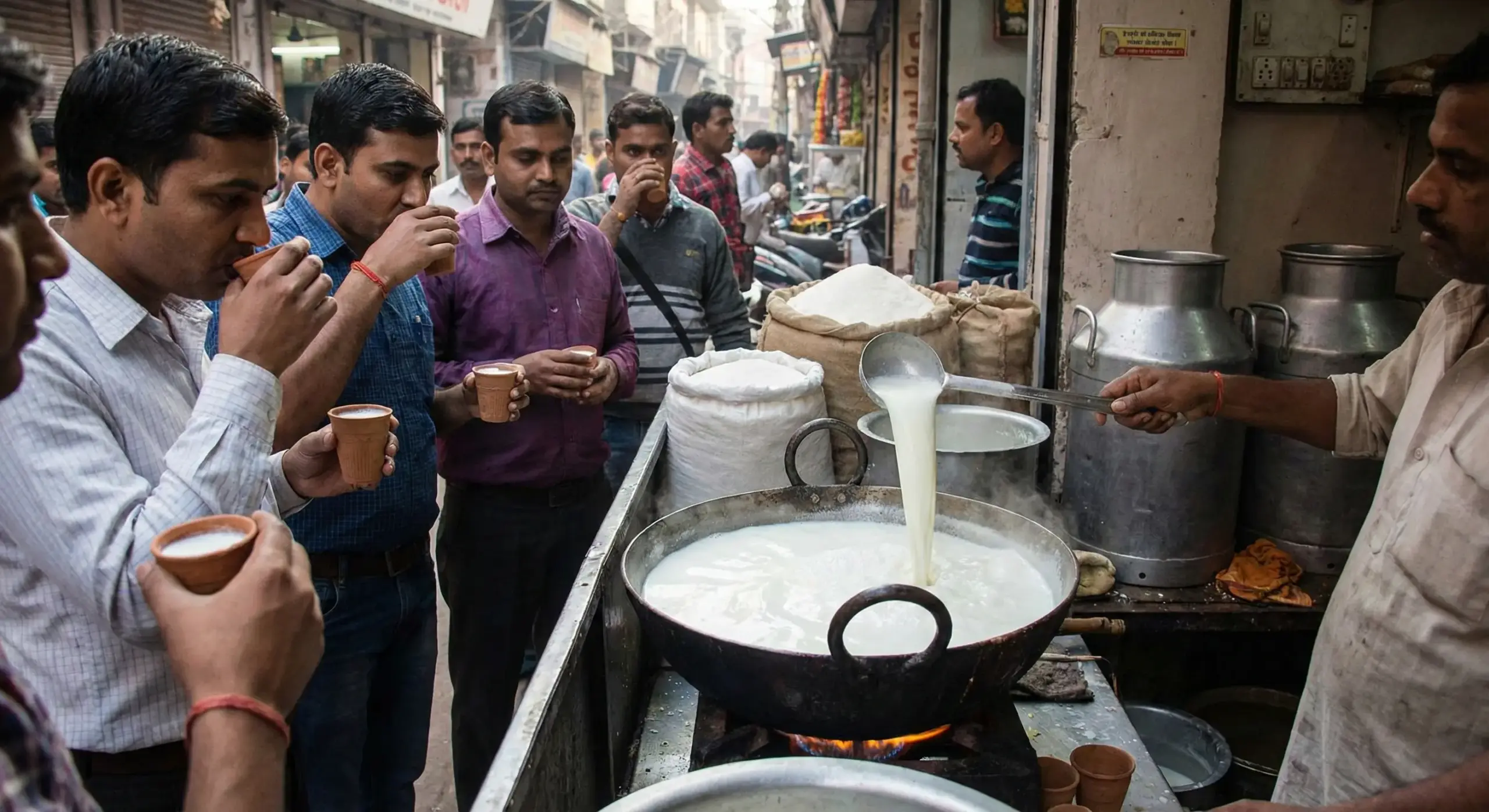
The Gangetic plain is a sugarcane and dairy region, and the two meet in the sweet shop. Fresh milk is hard to keep in hot weather. Boiling it down into khoya, rabri or paneer concentrates the solids and drives out water, and adding sugar binds much of what remains. The result is a family of sweets (peda, malpua, rabri, jalebi) that last longer than milk itself.
This is food-science reasoning and our interpretation, not a claim from the sources, but it explains why the city’s sweets are so dense and sweet. It also explains why a halwai’s shop does so much of the city’s cooking, as described in Banaras as a living city through its kitchens.
Cooling the summer: sattu, thandai and curd
When the loo blows and the afternoon sun is at its worst, lighting a stove is a cost. The answer in Banaras is food that needs little or no cooking.
- Sattu, roasted gram flour, is mixed with water, roasted cumin and black salt into a drink. Lonely Planet calls it Bihar’s hero and notes it is eaten all year as litti and as a sherbet, sweetened with jaggery in some places.
- Thandai, a milk drink with almonds, melon seeds, fennel, rose petals and cardamom, is cooling in name and in custom. Local guides point to Godowlia for the best shops.
- Curd and lassi appear on tables and at stalls, served in clay cups.
- Raw mango drinks such as aam panna use the season’s fruit.
We treat their cooling reputation as traditional belief. What we can say is that each is taken cold or cool, and that none needs the kitchen fire. Our post on seasonal eating practices in Kashi covers the full cycle.
The rains: dampness, mould and the pause in greens
Monsoon humidity speeds up mould and spoilage, and traditional Banaras households respond in several ways at once.
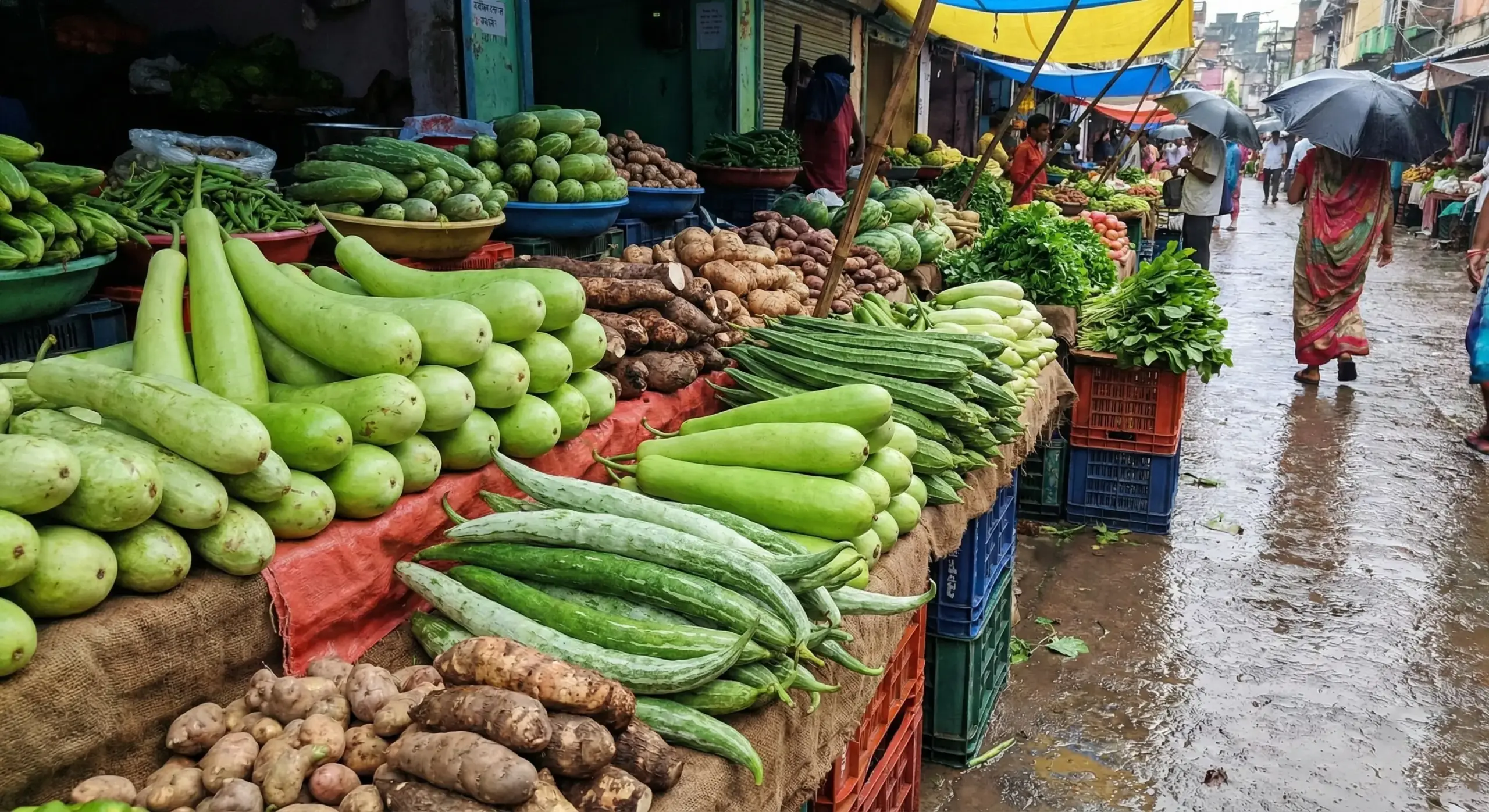
- Leafy greens are avoided. The explanation given is that leaves in the rains carry mud and insects. The custom overlaps with Chaturmas, the four months of religious restraint, so it is both practical and devotional.
- Cooking is plain and thorough. Gourds and roots are cooked well through, and heavy fried food is taken sparingly.
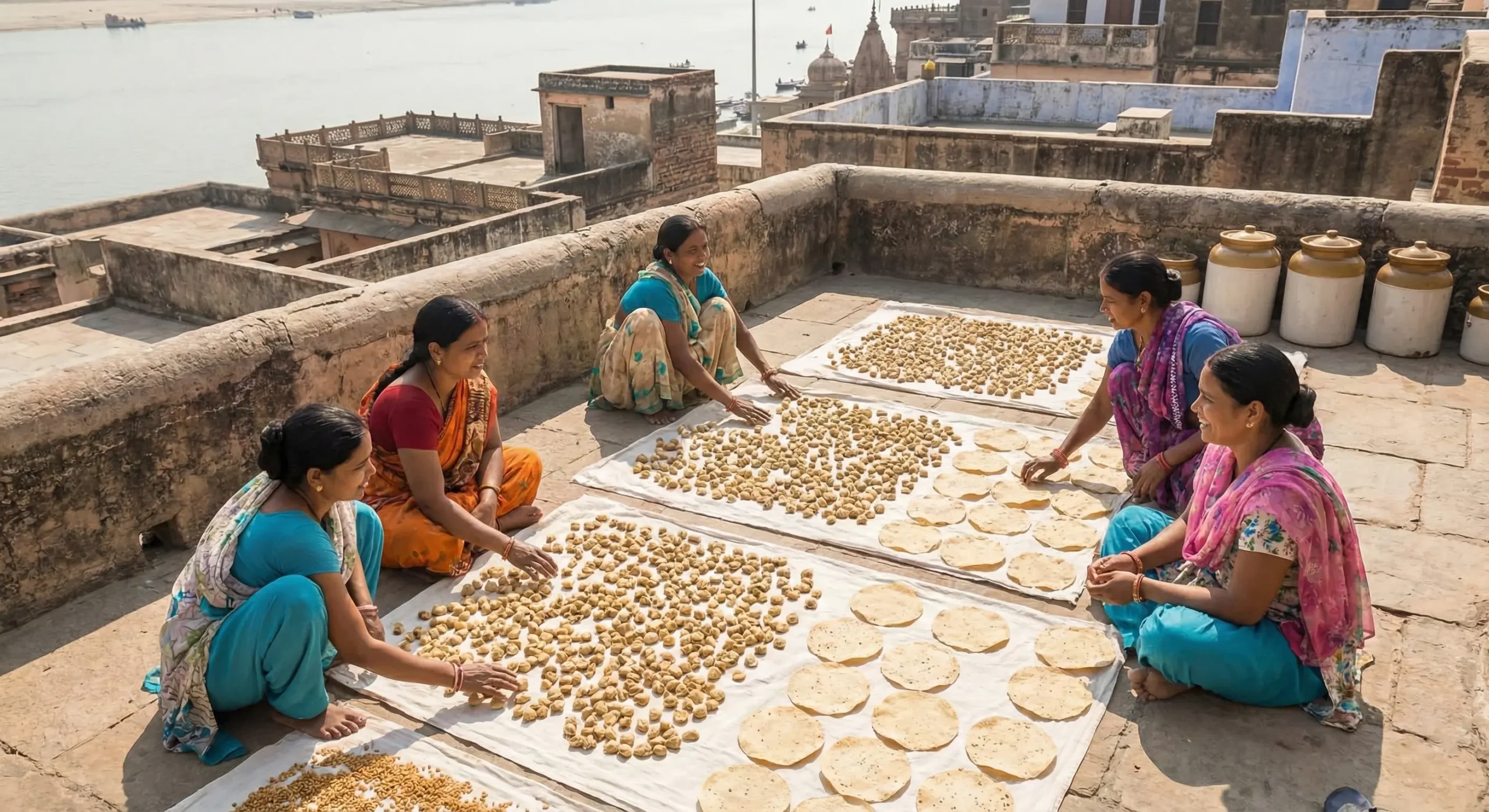
- Stored food takes over. Dried lentil wadi, papad, grains and pickles carry the table.
- Jars stay sealed. A pickle jar is opened as little as possible, with a dry spoon, as we explain in traditional storage methods for pickles.
None of this is a health claim from Salteen. It is how households describe the habit, and it fits a damp season in which fresh produce is harder to keep clean.
Winter: fog, dew and calories
Winter is shorter and gentler, but the mornings are cold and foggy. Food shifts towards ghee, milk, sesame, jaggery and peas. The specialty that depends most directly on the weather is malaiyo, the milk foam set out overnight in the dew. Our description is in morning food habits of Banaras households, and the same dish shows how a city’s microclimate becomes a menu item. It cannot be made in a hot week, which is why it vanishes in spring.
Winter is also when peas, carrots, radish and amla come in, and when the strongest sun-curing weather for pickles arrives, bright but not scorching.
Pickle: the climate’s answer to scarcity
A hot, wet climate with a pulse-and-grain diet has a clear need for something sharp that keeps. Pickles meet that need for three reasons:
- Salt and sun remove water from raw fruit and vegetables.
- Oil covers them and keeps air out.
- Acid from lemon, mango and amla, along with spices, adds flavour and a sharp taste that carries a plain meal.
The result lasts through the monsoon, when fresh variety is thinnest. For the process behind it, see how oil preserves food in Indian kitchens and why sun-drying is essential for Indian pickles.
Climate is not the whole story
A climate explanation is useful, but it can be stretched too far. Religion, caste, trade routes and family habit shaped Banaras food as much as the weather did, and many customs have more than one reason. The no-onion, no-garlic satvik tradition has nothing to do with the climate, and the same goes for the temple offerings and fast-day menus. The honest view is that weather set the problems and culture chose and shaped the answers.
What to take from this
- Heat favours fried, sugared and dried foods that keep.
- Humidity favours caution with fresh produce and a reliance on stored food.
- Cold favours ghee, sesame, jaggery and dairy.
- A cuisine that follows these patterns tends to look seasonal without effort.
Frequently asked questions
How hot does Varanasi get?
Peaks can pass 45 degrees Celsius in the hot months, and 47 degrees was recorded in May 1998 and June 2005 according to Climates to Travel.
Why is Banarasi breakfast fried?
Fried food keeps better in the heat and travels well, and it is considered pucca food in the household’s classification. This is our reading of the pattern, not a documented rule.
Why are Banaras sweets so sweet and milk-based?
Milk is concentrated into khoya and rabri and combined with sugar, which makes sweets that last longer than fresh milk. This is a reasonable food-science explanation.
What do people drink in Banaras summers?
Sattu drinks, thandai, lassi and raw mango drinks.
Why are leafy greens avoided in the rainy season?
Households say leaves in the monsoon carry mud and insects, and the custom overlaps with Chaturmas. It is a tradition, not medical advice.
Why is malaiyo only a winter dish?
It is set out in the cold overnight dew, so it can be made only in the colder months.
How do pickles relate to the climate?
They store seasonal produce through months of heat and humidity, using salt, sun, oil and spice.
Sources used for this post: Climates to Travel and Native Planet (Varanasi climate); India Meteorological Department station data for Varanasi; Lonely Planet (sattu and Varanasi food); local food guides on thandai. Interpretive explanations are marked, and health claims from the old draft were removed.