Blog
History of Banaras Food Culture: Traditions of Kashi Cuisine

The city of Banaras, often referred to as Kashi or Varanasi, holds a distinct place in India’s cultural history. It is frequently cited as one of the oldest continuously inhabited cities in the world, a claim that brings with it a tremendous weight of history. While the city is globally recognized for its ghats, temples, and the eternal cycle of life and death played out along the Ganges, there is another narrative that runs parallel to the spiritual one: the history of its food.
The cuisine of Banaras is not merely a collection of recipes passed down through generations. It is a cultural byproduct of the city’s geography, its complex religious framework, and the daily rhythms of its people. To understand what is eaten in Banaras is to understand the history of the Gangetic plain itself. The Banaras food culture here has developed slowly, over thousands of years, unaffected by the rapid industrialization of food found in newer metropolises. It remains rooted in the soil, the river, and the ritual.
Ancient Origins of Kashi and the City of Annapurna
The history of food in Banaras begins with the city’s mythological foundation. In Hindu theology, Kashi is the domain of Shiva, the ascetic destroyer. However, the city is equally the domain of Annapurna, the goddess of food and nourishment. There is a prevalent belief that while Shiva provides liberation (Moksha), it is Annapurna who provides the sustenance required to live long enough to seek it. This duality—the ascetic and the sustainer—forms the bedrock of the local food philosophy.
Historically, the settlement of Kashi grew along the banks of the Ganges, a river that ensured the land was fertile. In the Vedic period, the diet was likely simple, relying on barley, sesame, and dairy. As the city transitioned into a major pilgrimage site, the influx of travelers from different corners of the subcontinent began to influence the local palate, though the core remained strictly adhering to dietary laws found in ancient texts.
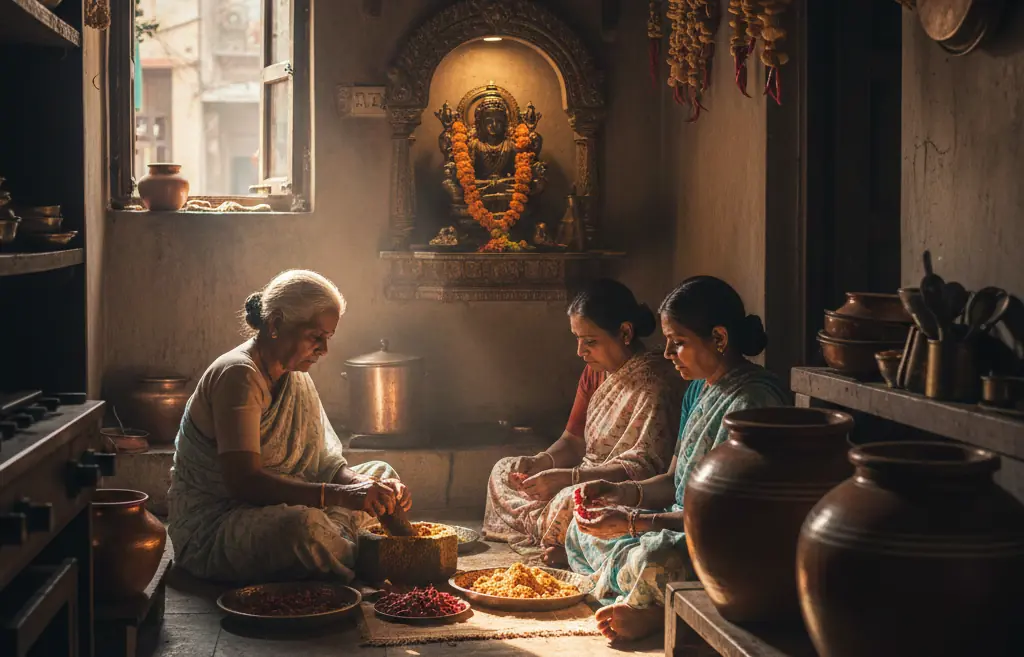
The theological importance of food in Kashi cannot be overstated. In ancient times, food was not seen as a source of pleasure but as a biological necessity and a ritual offering. The kitchen was, and in many traditional homes still is, treated with the same sanctity as a temple. Shoes are often removed before entering, and the purity of the cook is paramount. This ancient reverence for the preparation process has preserved specific cooking methods that have vanished elsewhere.

The ancient riverfront of Kashi, where geography and spirituality have historically influenced local life and diet.
Geographic and Climatic Influence on Food
Banaras sits in the heart of the Indo-Gangetic plain. This is a region defined by alluvial soil, which is exceptionally conducive to agriculture. The availability of produce has historically dictated the menu. Unlike the arid regions of Rajasthan or the coastal belts of the south, Banaras has always had access to an abundance of water and fresh vegetables.
The climate of the region is extreme. Summers are intensely hot, often reaching temperatures that make heavy digestion difficult. Winters are foggy and cold, requiring calorie-dense foods for warmth. The monsoons bring humidity and a distinct set of cravings and dietary restrictions. The food culture evolved as a direct response to these seasonal shifts.
For instance, the abundance of grazing land in the surrounding rural districts historically supported a massive population of livestock, specifically cows and buffaloes. This led to a dairy-centric diet. Milk, curd (dahi), ghee, and paneer are not additives in Banaras; they are staples. The dominance of the Yadav community, traditionally cowherds, in the demographic makeup of the region further cemented dairy as a primary source of nutrition.
The seasonality is perhaps most visible in the availability of specific delicacies. Malaiyyo, a frothy, saffron-infused milk dessert, is exclusively available in the winter. It relies on the morning dew and the cold night air to achieve its delicate texture. In the summer, the diet shifts to cooling foods like sattu (roasted gram flour) and thandai, a drink often prepared with fennel, seeds, and rose petals to combat heatstroke. The geography provides the ingredients, but the climate dictates the menu.
Religious and Ritual-Based Eating Practices
Religion is the primary architect of the Banarasi diet. A significant portion of the population adheres to Vaishnavism or Shaivism, both of which strongly advocate vegetarianism. Consequently, the food history of Banaras is largely a history of vegetarian cuisine. However, it is more nuanced than simply avoiding meat.
The concept of Sattvic food is central here. Traditional households often avoid onions and garlic, as these ingredients are believed to induce heat and passion (tamas), which are considered distinct from the calm required for spiritual pursuits. This restriction forced cooks to innovate. Without the base of onion and garlic, flavor had to be extracted from a sophisticated use of spices like asafoetida (hing), cumin, ginger, and green chilies. The resulting profile is distinct—lighter on the stomach but high in aromatic complexity.
Fasting (Vrat) is another pillar of the food culture. With a calendar full of festivals—Shivratri, Navratri, Ekadashi—there are many days when grains are forbidden. This led to the development of a parallel cuisine known as Phalahar (fruit diet), which utilizes ingredients like buckwheat flour (kuttu), water chestnut flour (singhara), and tapioca pearls (sabudana).
Furthermore, the presence of widows in Varanasi, who historically moved to the holy city to spend their final years in devotion, created a specific sub-genre of cooking. Their diet was strictly regulated—bland, devoid of heating spices, and simple. Yet, over centuries, this limitation bred creativity, leading to subtle vegetable preparations that rely on the natural sweetness of the produce rather than heavy spicing.

Inside a domestic kitchen, where cooking is often treated with ritual sanctity and traditional methods like manual spice grinding are preserved.
Differences Between Home Food and Street Food
There is a stark contrast between what is eaten inside a Banarasi home and what is consumed in its narrow lanes (galis).
Home Cooking
Inside the home, the food is often medicinal in nature. A standard meal consists of pulses (dal), rice, roti, and seasonal vegetables (sabzi). The emphasis is on digestion and balance. Lunch is usually the main meal, heavy and complete, while dinners are lighter. There is a rhythm to the domestic kitchen that revolves around fresh procurement. Refrigerators are used, of course, but the cultural preference remains for vegetables bought that morning from the local vendor.
The domestic kitchen is also where the nuances of caste and community become visible. A Bengali household in Banaras might use mustard oil and panch phoron spices, while a local Brahmin household might prefer pure ghee and cumin. Despite living in the same city for generations, these distinct culinary identities remain preserved within the four walls of the home.
Street Food Culture The street food of Banaras, however, serves a different purpose. It is communal, calorie-dense, and deeply social. The history of street food here is tied to the lifestyle of the residents.
Morning begins early in Banaras, often before sunrise. The breakfast culture is robust. It is not a light affair. The staple is Kachori-Sabzi—fried bread stuffed with lentils, served with a spicy potato curry. This is often followed by Jalebi, eaten with curd or hot milk. This heavy breakfast was historically necessary for the working class and the wrestlers (pehalwans) practicing in the riverbank arenas (akhadas), providing the energy needed for a day of physical labor.
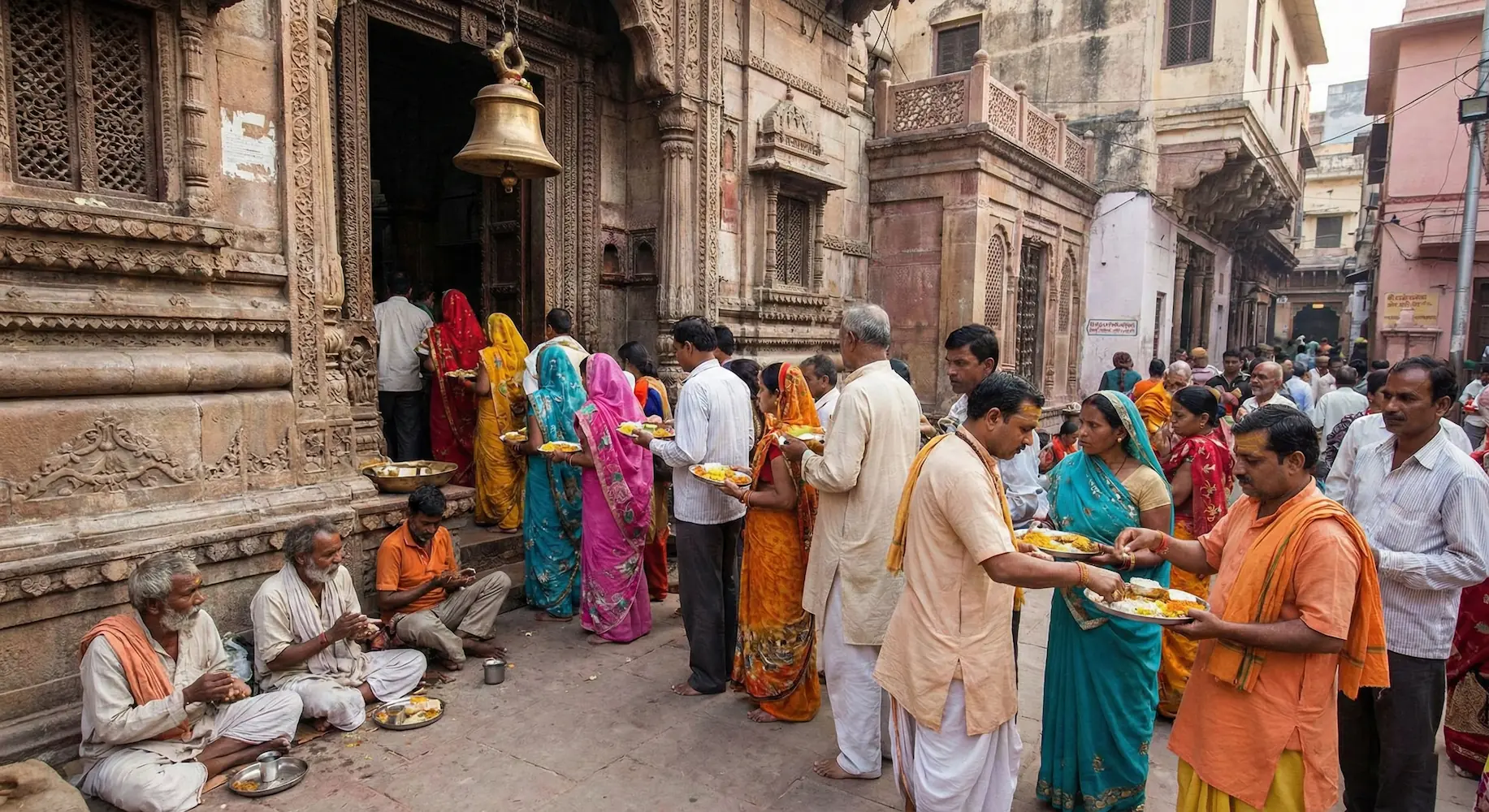
Eating on the street is a ritual. It involves standing at small, often centuries-old shops, engaging in conversation. There is little concept of “take-away” in the traditional sense; the food is meant to be consumed fresh, on the spot, often served in pattal (leaf plates) or kullhads (clay cups).
Another element of the street culture is Paan (betel leaf). In Banaras, paan is not just a mouth freshener; it is a digestif and a social lubricant. The history of paan in the city is extensive, with specific ways of folding and preparing the leaf that signify respect or hospitality. It marks the end of a meal and the continuation of conversation.

The communal and calorie-dense street food culture of Banaras, featuring popular morning staples like kachori-sabzi served in leaf plates.
Role of Food Preservation in Banaras Households
While fresh food is prized, the harsh climate of the Gangetic plain historically necessitated robust methods of food preservation. Before the advent of modern refrigeration, households had to ensure that the abundance of one season could sustain the family through the scarcity of the next. This necessity gave rise to a sophisticated culture of pickling and sun-drying.
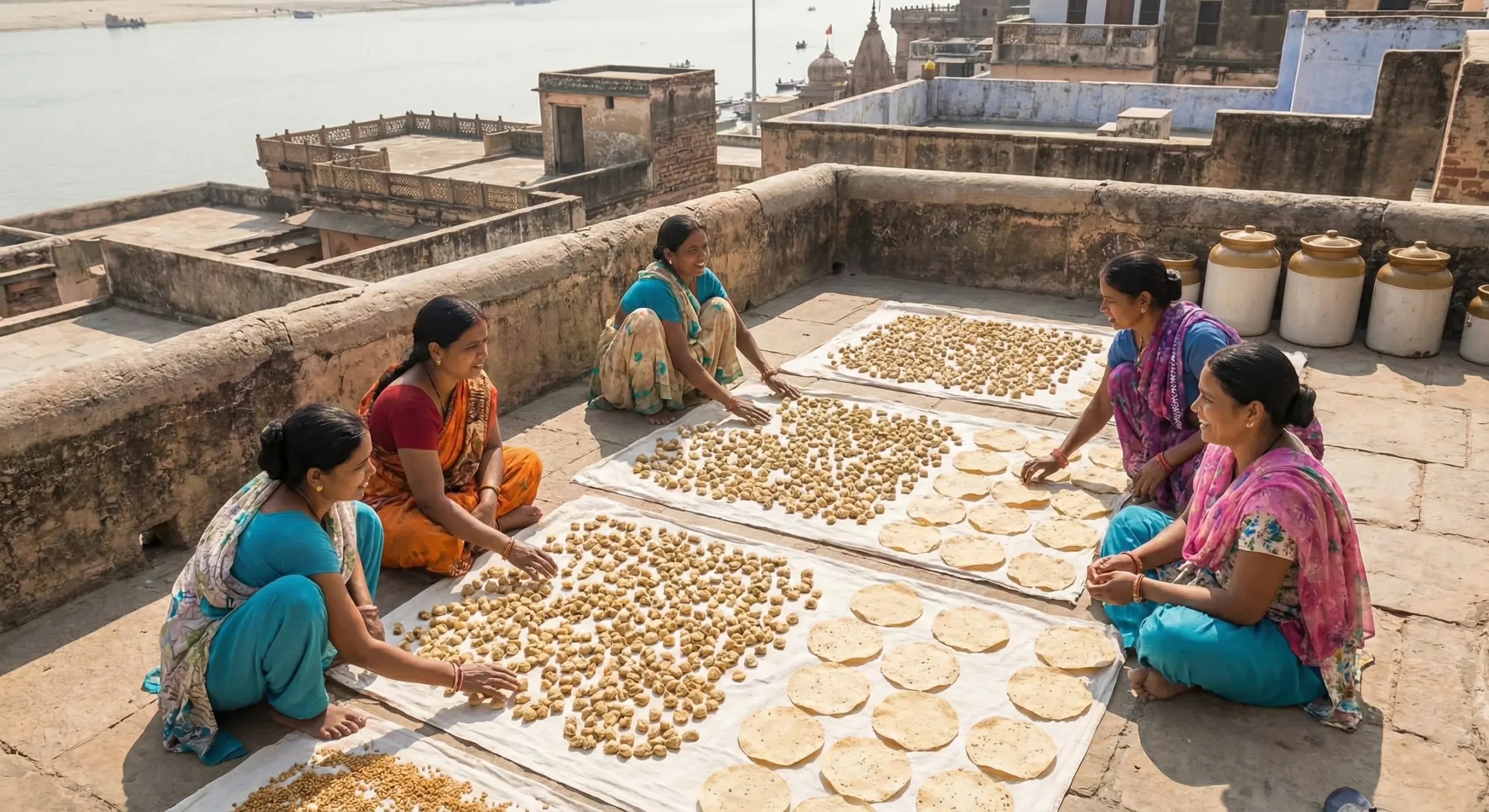
The terraces and courtyards of Banaras play a crucial role here. During the summer, one can observe varying items spread out on cotton sheets or in large ceramic jars (martabans) basking in the sun. This is the domain of the women of the household.
Pickling (Achar) Pickling in Banaras is an art form that relies heavily on mustard oil and sunlight. The mustard oil, pungent and raw, acts as a natural preservative. Almost anything can be pickled: mangoes in the summer, chilies, lemon, jackfruit, and even certain roots. The recipes for the spice mixes used in these pickles are often closely guarded family secrets, passed down from mother-in-law to daughter-in-law.
The science behind this is fermentation. The heat of the Banaras sun allows the ingredients to break down and mature, creating complex flavors while ensuring the food remains safe to eat for a year or more. A meal in a Banarasi home is rarely considered complete without a small spoonful of achar on the side of the thali.
Sun-Drying (Wadi and Papad) Beyond pickles, dehydration is a key preservation technique. Lentils are ground, spiced, and dropped in small nuggets onto sheets to dry in the sun. These dried lentil dumplings, called Wadi or Badi, are stored in jars. In the monsoon months, when fresh vegetables might be scarce or expensive, these wadis are rehydrated and cooked in gravies. They provide a concentrated source of protein and flavor.
Similarly, papads made from potatoes, rice, or lentils are rolled out by hand and sun-dried. This activity is communal. It is common to see women from neighboring houses gathering on a terrace, rolling papads while exchanging news, turning a laborious chore into a social gathering.
The Continuity of Tradition
The food culture of Banaras is a testament to continuity. While the city has modernized, the core tenets of what, how, and why people eat remain remarkably stable. The reliance on the seasons, the strict demarcation between satvik home food and indulgent street food, and the ritualistic approach to preservation are threads that connect the modern resident to their ancestors.
In the winding lanes of the city, where sunlight struggles to reach the ground, the aroma of roasting spices or boiling milk serves as a sensory marker of history. It is a cuisine that does not seek to be inventive for the sake of novelty. Instead, it seeks perfection through repetition. The recipes are not written in cookbooks as much as they are ingrained in the muscle memory of the cooks and the collective palate of the city.
Food in Banaras is a serious affair, inextricably linked to the spiritual and social identity of the place. It is a cuisine of the riverbank, born of the soil, dedicated to the gods, and sustained by the people.