Blog
Reading a Mustard Oil Label: Kachi Ghani, Cold-Pressed and Hexane-Free Decoded

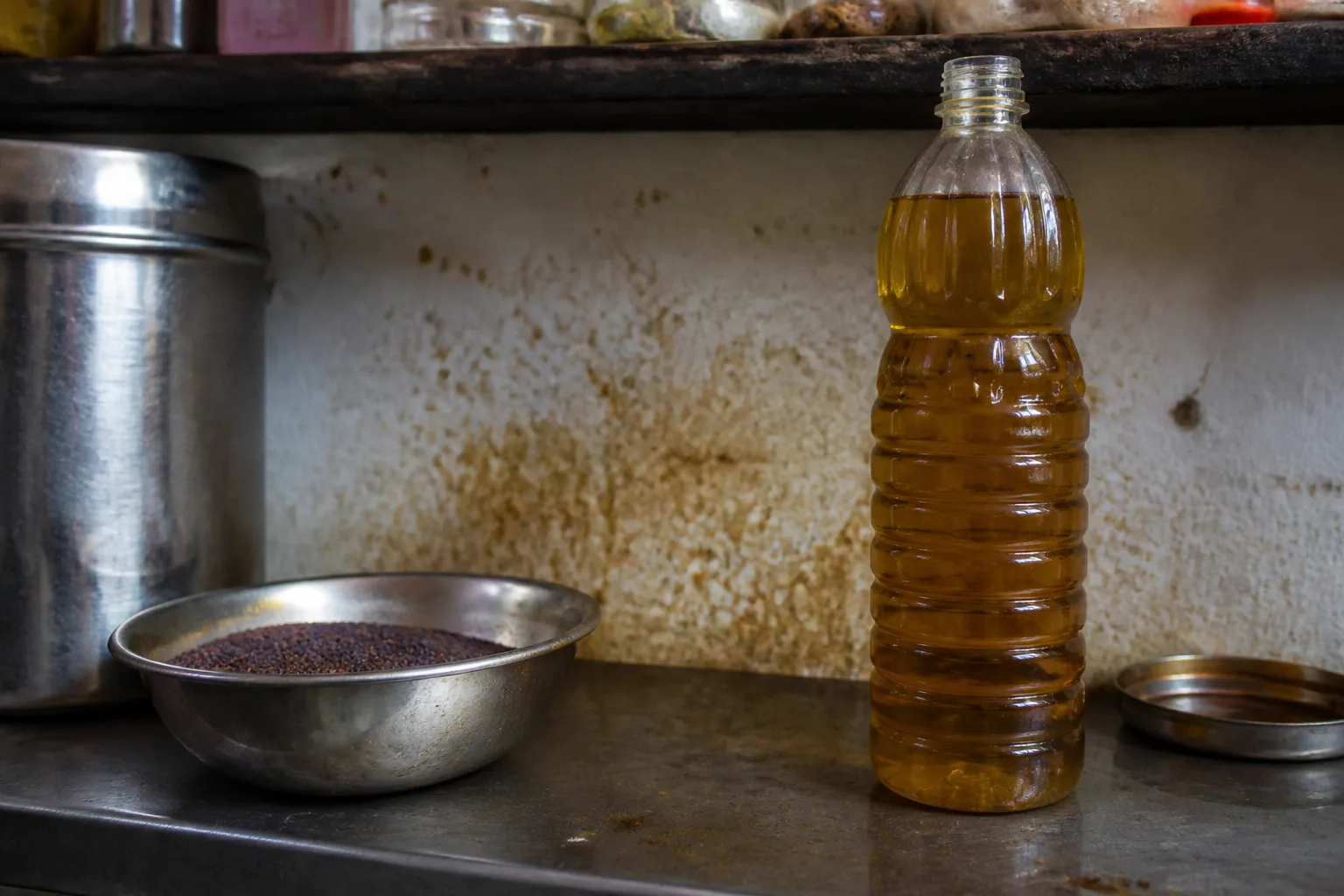
The FSSAI standard for mustard oil carries a note that most label readers never see. In the compendium’s text on rapeseed and mustard oil, Note 2 says the oil may be labelled as Kachi Ghani or Cold Pressed if the content of natural allyl isothiocyanate in the oil is not less than 0.20 percent by weight.
So kachi ghani is not only a word about pressing. The standard attaches a measurable pungency compound to it.
The short answer
In short
Under FSSAI’s standard, mustard oil may be labelled Kachi Ghani or Cold Pressed if its natural allyl isothiocyanate (AITC) is at least 0.20 percent by weight. Pressed oil must be free from hexane residues, and solvent extracted oil must be refined with hexane at 5.0 ppm or less.
What the standard says
The FSSAI text defines rapeseed oil (toria oil) or mustard oil (sarson ka tel) as the oil expressed from clean and sound mustard seeds of the campestris, juncea or napus varieties of Brassica. Two further points in the same extract are useful to a label reader:
- Argemone. The test for argemone oil must be negative.
- Hexane. The oil obtained by the expelled pressed method shall be free from solvent extracted oils and hexane residues. Where hexane is used, the oil must be refined before sale for human consumption, and the refined oil shall not contain hexane above 5.0 ppm.
An Agmark amendment of 2023, hosted by the Warehousing Development and Regulatory Authority, repeats the same idea: the oil by the expelled pressed method must be free from solvent extracted oils and hexane residues, and the special condition for labelling mustard oil as Kachi Ghani is stated there too. A draft 2026 amendment, as reported by a compliance site, again says solvent extracted oils must be refined before human consumption and pressed oils must be free from hexane residues.
Decoding the words
- Kachi ghani. The traditional name for oil pressed in a ghani, in one pass. Our post on kacchi ghani mustard oil explains it. In the standard, the label is tied to the AITC level.
- Cold pressed. Allowed under the same condition as Kachi Ghani, according to Note 2.
- Hexane free. Hexane is a solvent used to extract oil. Consumer Voice puts the principle simply: cold pressed mustard oil, better known as kachchi ghani oil, should also be free from the solvent hexane. A pressed oil must be free from hexane residues by the standard. A refined, solvent extracted oil may carry a small permitted amount, so the claim has a different meaning on each.
- Pure or 100 percent mustard. The compendium lists a prohibition on any multi source edible vegetable oil containing mustard oil manufactured on or after 8 June 2021, so a blend with mustard oil is not permitted.
- Variety. Down To Earth reports that the label on most mustard oil bottles does not mention the exact variety of mustard used, and that FSSAI said the oil may come from any of the three Brassica species.
What a label cannot tell you
A label states what the maker claims. It does not show the pressing, the temperature or the age of the oil. You can read the AITC claim, the pressing method, the batch number and the FSSAI licence number, and judge the rest by smell and use. For how pungency is perceived, see mustard oil pungency and aroma.
How do I know a mustard oil is really kachi ghani
You cannot know it from the word alone. Look for the full label, a batch number, an FSSAI number and a maker who explains the process.

Frequently asked questions
What does hexane free mean?
No hexane solvent residue. FSSAI’s standard requires this of pressed mustard oil.
How do I know a mustard oil is really kachi ghani?
The label may use the term only if natural AITC is at least 0.20 percent. Check the batch and licence details too.
Can mustard oil be blended?
FSSAI’s compendium lists a prohibition on multi source edible vegetable oil containing mustard oil, from 8 June 2021.
Sources used for this post: FSSAI, Food Safety and Standards (Food Products Standards and Food Additives) Regulations, fats and oils chapter (extract); FSSAI, Compendium of Prohibition and Restriction Regulations; Warehousing Development and Regulatory Authority, Vegetable Oils Grading and Marking (Amendment) Rules, 2023; Consumer Voice, mustard oil (kachchi ghani); Down To Earth, what’s in a botanical name; TeamLease RegTech, draft 2026 amendment. Verify all against fssai.gov.in.