Blog
Kacchi Ghani Mustard Oil Explained: How the Press Works and What It Leaves in the Oil

Walk down the oil aisle of any big store and you will find a dozen bottles that say kacchi ghani, at very different prices, with labels that read almost the same. That gap is the reason this guide exists. The words kacchi ghani are used by village mills, by big packaged brands and by small online sellers, and they do not always describe the same process. Knowing what the phrase means, and what a press actually does to a mustard seed, makes it much easier to choose an oil and to cook with it.
We wrote this as the main reference for the ingredient posts on this blog.
What kacchi ghani means
In short
Kacchi ghani means raw press. Mustard seed is crushed slowly in a wooden, stone or steel press, then settled and filtered. Nothing is bleached or deodorised afterwards, which is why the oil smells sharp and stays deep golden.
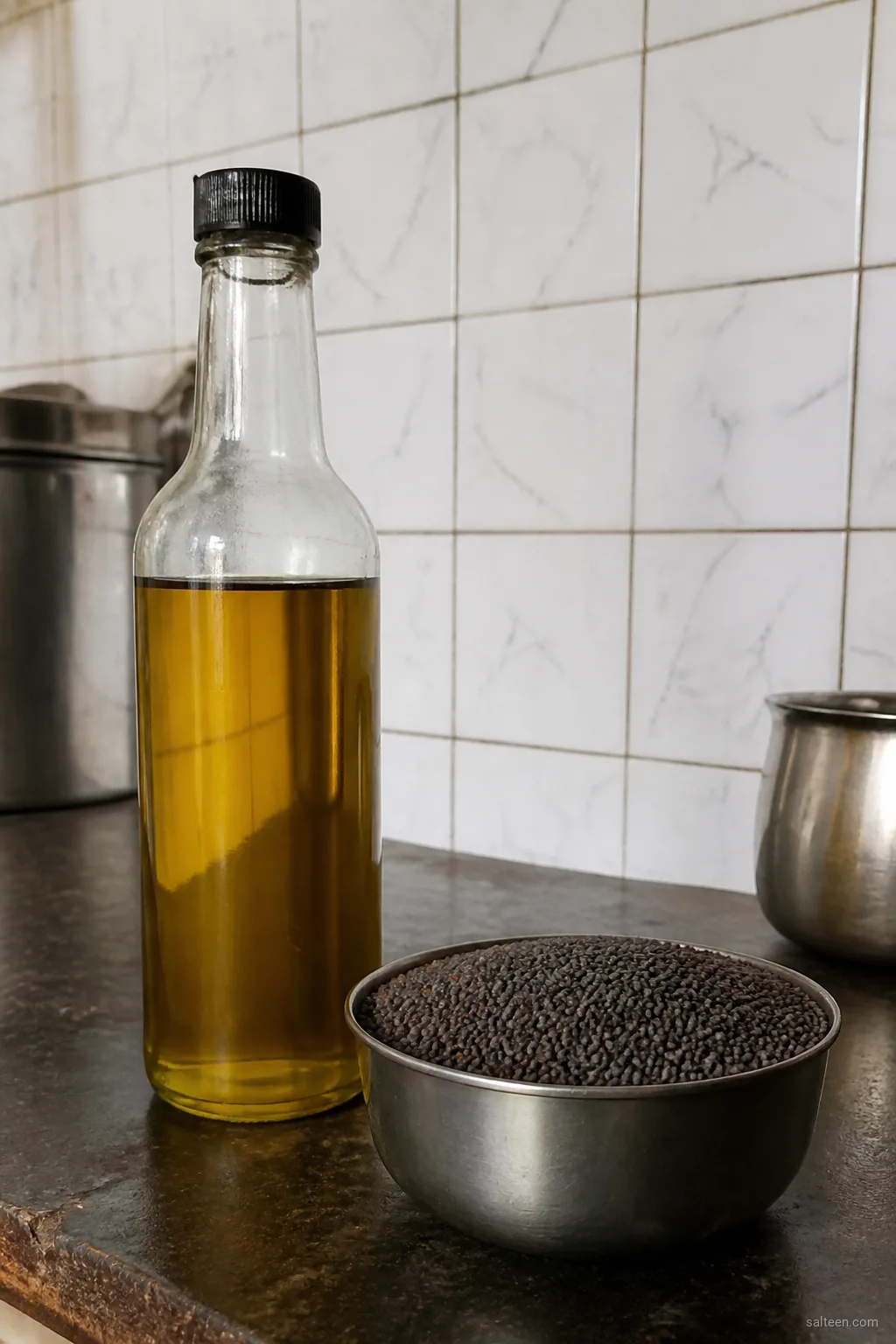
Kacchi means raw or unheated, and ghani means the press or mill. Together the words mean raw press The spellings differ across the country (kachi ghani, kachchi ghani, kacchi ghani) but the idea is the same: seeds are crushed slowly in a press, without chemical solvents and without cooking the seed first, and the oil that runs out is filtered and bottled without the refining steps that big plants use.
You will also see regional names for the same family of methods. In Tamil Nadu a wooden press is called a marachekku, in Telangana ganuga, and in Hindi speaking states you will hear ghani, kolhu or lakdi ki ghani. English labels usually say cold pressed or wood pressed. Wood pressed oil is generally treated as a subset of cold pressed oil, since a wooden press is one way of doing a cold press, while steel presses are another.
You may also come across the term pakki ghani. It usually refers to seed that is heated or cooked before it goes into the press, which gives more oil from the same seed but changes the flavour. Sellers do not always use the term the same way, so it is worth asking.
How a ghani works
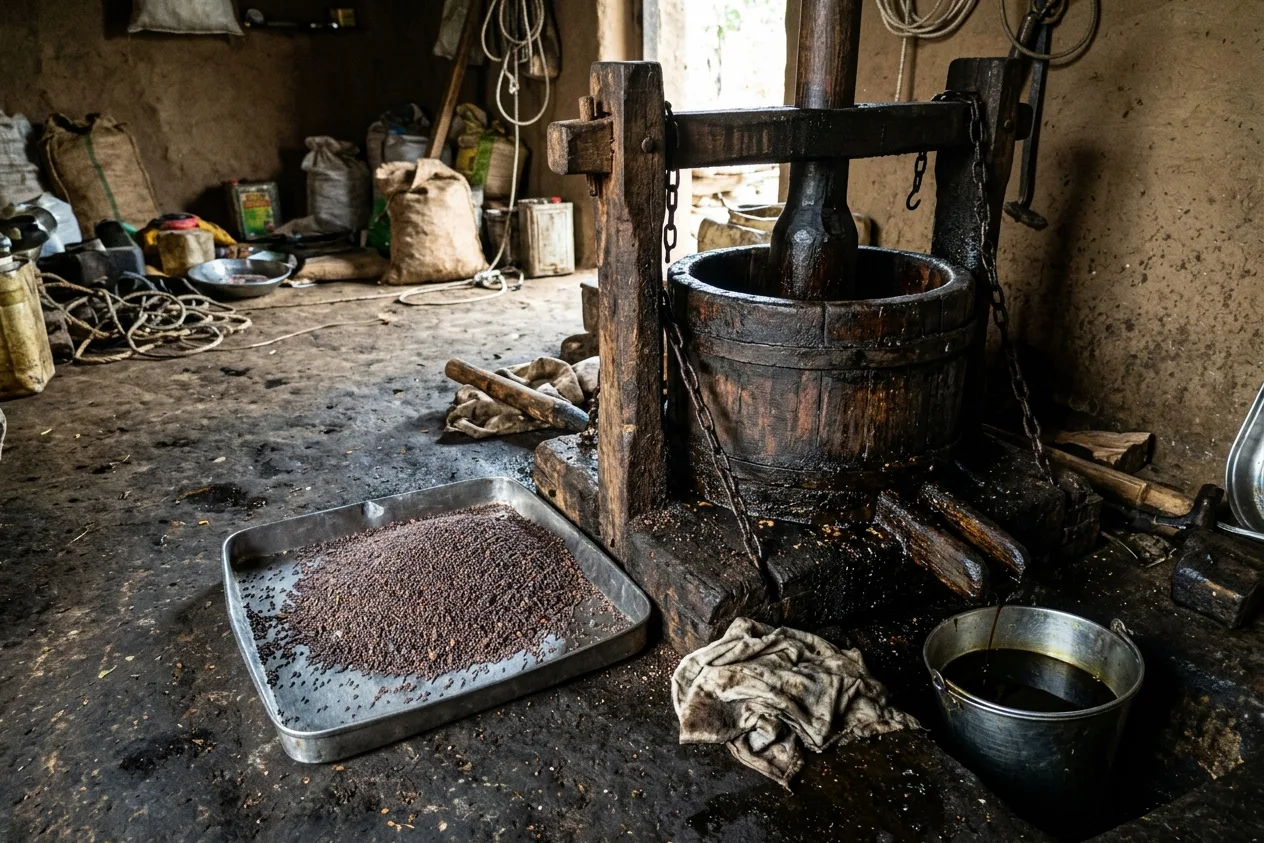
A traditional ghani is a heavy wooden or stone mortar with a long pestle that turns inside it. In the older version the pestle was turned by a bullock walking in a circle. Today most are driven by an electric motor, and many mills use a steel unit built on the same principle. The seed goes in at the top, the pestle grinds and squeezes it against the walls of the mortar, and oil seeps out through a channel at the bottom while the dry pressed seed, called khal or oil cake, is pushed out separately.
The steps in a small mill go roughly like this.
- Cleaning the seed. Mustard seed arrives with dust, small stones and bits of stalk. It is sieved and cleaned before pressing, because anything left in the seed ends up in the oil or damages the press.
- Drying to the right level. Seed that holds too much moisture gives cloudy oil that spoils faster, so some mills check the seed and sun dry it if needed.
- Pressing. The seed is fed into the ghani and pressed at low speed. The slow movement is the whole point. A fast press creates friction, and friction creates heat.
- Settling and filtering. The raw oil is left to settle so that fine particles sink. It is then passed through cloth or a filter press. This is the only step after pressing. There is no bleaching, no deodorising and no chemical treatment.
- Bottling. The oil goes into tins, glass or food grade plastic. Many mills let it rest for a few days before packing so that it clears further.
What comes out is a dark golden oil with a sharp smell that makes your nose tingle.
A sharp smell is normal for this oil, and it is the clearest sign that nothing has been stripped out of it.
Why mustard oil smells and stings
When mustard seed is crushed, a compound in the seed called allyl isothiocyanate (AITC) is formed. It is the same family of compound that gives wasabi and horseradish their sting, and it is the reason a spoonful of fresh mustard oil makes you sneeze or your eyes water for a moment. Refining removes most of this. Heating the oil to a high smoke point before cooking drives off much of the rawness as well, which is why recipes from Bengal, Bihar and eastern Uttar Pradesh tell you to heat mustard oil until it just begins to smoke and then let it cool before using it.
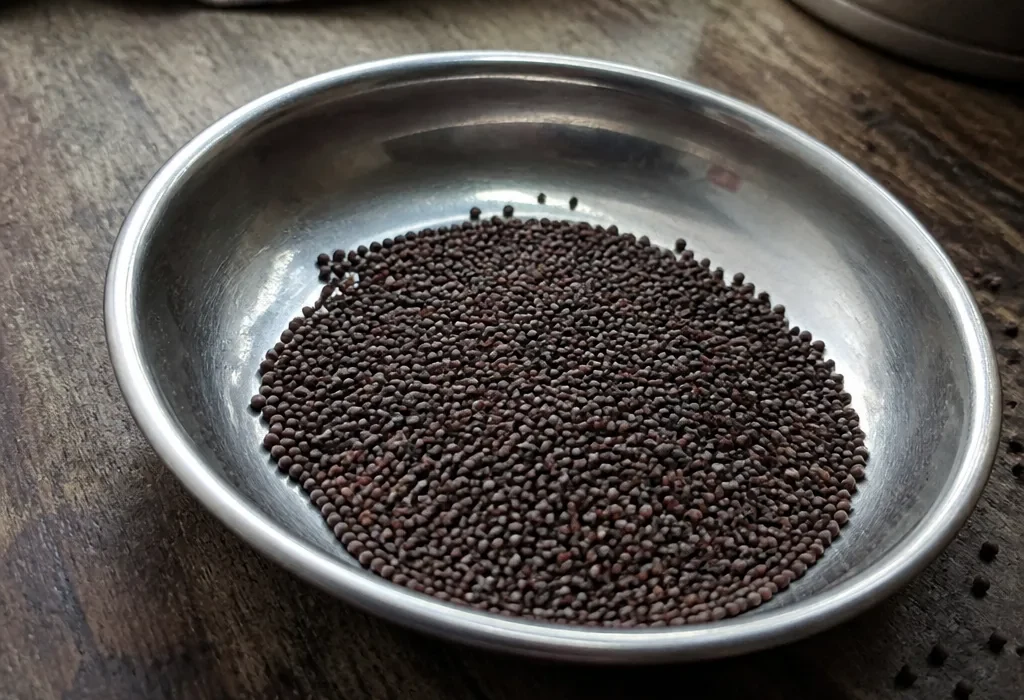
The same sharpness is what makes mustard oil so useful for pickles. Pungency, together with salt and the layer of oil on top, is a large part of why mustard oil has long been the default for preserving vegetables and fruit in north India. We go through that in our guide to Banarasi achar.
How hot does a kacchi ghani press get
This is the point where labels differ most, so it helps to be careful. Different sellers quote different limits. Some say their oil is pressed below 40 degrees Celsius, some say below 45, and some say below 60. Brands that publish these numbers measure them in their own way, and we are not aware of one single legal temperature that applies to every bottle sold as kacchi ghani. A number on the label tells you what the seller claims. It does not tell you how it was measured.
What you can say with confidence is the direction. A slow ghani with no added heat keeps the oil far cooler than a high speed expeller or a refinery, where oil can reach 150 degrees or more during processing. If a seller can describe the press, the speed and the seed source in plain words, that is more useful than a temperature figure on its own.
Kacchi ghani versus refined mustard oil
The difference between the two comes down to what happens after the seed is pressed.
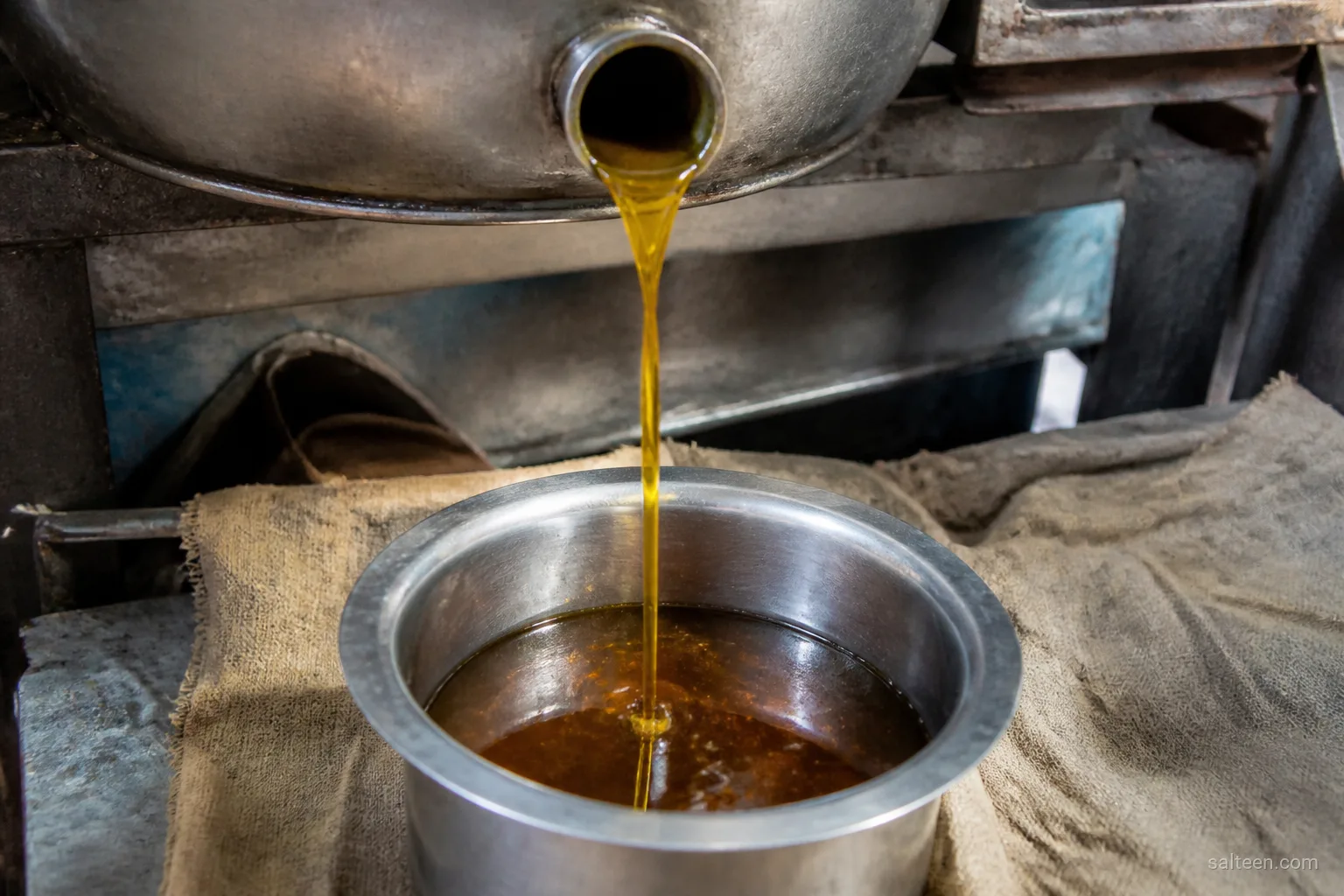
- Kacchi ghani oil is pressed once, settled and filtered. It keeps its deep colour, its sharp smell and its natural taste. It is usually a little cloudy when fresh and may leave a fine sediment at the bottom of the bottle over time.
- Refined mustard oil is typically extracted with more heat, and sometimes with a solvent, and then bleached, deodorised and filtered until it is pale and mild. It keeps longer on the shelf and has little smell, and much of the flavour that people look for in a traditional kitchen is gone.
Neither type is illegal or unsafe by default. They suit different jobs. A mild refined oil works for someone who finds the sharp smell too strong. Kacchi ghani is the one that Banarasi and Bihari cooking is built around, and it is the one that pickles are traditionally made with.
How to read a label
A label can give you a lot if you know where to look.
Label check in 30 seconds
- Ingredients say mustard oil and nothing else
- A packing date and an FSSAI licence number are printed
- The smell is sharp when you open the bottle
- The seller can name the press in one line
- Ingredients. It should say mustard oil and nothing else. Oils blended with soya, palm or rice bran are common in cheaper bottles, and the label should state the blend openly if there is one.
- Process words. Kacchi ghani, cold pressed and wood pressed are the three you will see. Ask the seller what press they use. A seller who knows will answer in one line.
- Date of packing and best before. Fresh oil tastes sharper. An older date is acceptable if the oil was stored well, while a missing date is a reason to skip the bottle.
- FSSAI licence number. Every packaged edible oil sold in India should carry one. It is printed on the label, and you can check the number on the FSSAI website.
- Smell and sting. Real mustard oil smells sharp. If you open a bottle and the smell is faint, the oil is probably refined or diluted. Consumer testing bodies in India have published studies of kachi ghani brands, including one covering 13 brands that checked for adulteration with other oils, which shows that the label alone is not always enough.
- Colour and sediment. A deep golden to amber colour and a little sediment are normal for oil that has only been filtered.
What the press leaves in the oil
A press that does not heat, bleach or strip the oil leaves several things behind. The oil keeps its colour, which comes from the seed. It keeps the sharp AITC smell. It keeps small amounts of natural plant compounds that a refinery removes, and it keeps its own fatty acid profile, which is high in monounsaturated fat and has some omega 3 in the form of ALA. One of the sources we read puts the omega 3 share at 6 to 12 percent. We have not tested this ourselves, and fatty acid figures vary with seed variety and region, so please treat it as a rough guide. We make no medical claims about mustard oil. If you have a health condition, your doctor is the right person to ask how much of any oil suits you.
What happens to the rest of the seed
The dry cake left in the press, called khal in Hindi, has a second life. It is widely used as cattle feed in villages and also as an organic fertiliser. A mill that presses mustard seed makes oil and cake together, and the sale of the cake is part of what keeps a small ghani running. This is one of the reasons small mills can survive next to large factories.
How to store and use it
Keep mustard oil in a cool, dark place, away from the stove. Glass or steel is better than clear plastic that sits in sunlight. For cooking, heat the oil gently until it just starts to smoke, switch off the flame for a minute and then use it. For pickling, the oil is usually heated, cooled fully and poured over the prepared fruit or vegetable so that it forms a layer on top. For a first taste of fresh oil, a few drops over boiled potato with salt and a green chilli will tell you everything about its smell and sting.
The Salteen press
- What kind of press does the seed go through (wooden, stone or steel), and is it a motor or a bullock?
- Where does the mustard seed come from, and who picks it?
- How long does one batch take, and what is the oil like when it comes out?
- Do you test the oil for purity, and how?
- One real memory from the shed: the smell, the sound, a person, a day.
If a line here is not true or cannot be shown, it stays out of the post.
Where this fits on the blog
This post is the base for everything we publish on ingredients, and the later posts in this series link back to it. If you want to see how the oil is used in pickling, read our guide to Banarasi achar, and for the winter pickle that most families make first, read our post on amla achar. Our pickle range, made with kacchi ghani mustard oil, is in the pickle and achar collection.
Frequently asked questions
What does kacchi ghani mean?
Kacchi means raw or unheated and ghani means a press or mill. Kacchi ghani oil is oil pressed slowly from the seed in a traditional style press, without solvents and without the refining steps used in large plants.
How is kachi ghani oil made?
Seeds are cleaned, dried if needed, and crushed slowly in a wooden, stone or steel ghani. The oil is settled and filtered and then bottled. No bleaching or deodorising follows.
Is kacchi ghani the same as cold pressed?
They describe the same low heat idea. Wood pressed oil is a subset of cold pressed oil, made in a wooden press. Sellers use the terms loosely, so ask which press and at what speed.
Why does kacchi ghani mustard oil smell so sharp?
Crushing mustard seed forms allyl isothiocyanate, the compound that gives mustard, wasabi and horseradish their sting. Refined oil loses most of it.
What should I check on a label?
Check that the ingredient list says mustard oil only, look for a packing date and an FSSAI licence number, and open the bottle to check the smell.
Sources used for this post: Organic Mandya guides on wood pressed oil, kachi ghani and mustard oil; Anveshan and Kedia Pavitra kachi ghani explainers; Government of India Consumer Voice report on kachi ghani mustard oil; BigBasket product notes. Temperatures are seller claims, quoted as such.