Blog
Seasonal Pickles of Uttar Pradesh: What Gets Pickled When

A seller of stuffed red chilli pickle in Bihar’s Darbhanga lists its fresh season batch as made from December to March, according to the brand’s own product page, a window that sits almost exactly opposite the raw-mango weeks of April to June. That contrast is the shape of the Uttar Pradesh pickle year: two seasons of heavy making, and a scatter of smaller pickles in between.
This guide sets out the calendar as far as published sources allow.
The short answer
In short
The Uttar Pradesh pickle year has two peaks. Summer, roughly March to June, brings raw mango (kairi) and tender jackfruit (kathal), preserved in mustard oil and spice. Winter, roughly December to March, brings carrot, cauliflower and turnip pickles, kanji from black or red carrots, and the stuffed red chilli associated with Banaras. Sweet and quick pickles such as aam ki launji and galka fill the gaps.
Summer: raw mango and kathal
The summer peak is the one we describe most in this series. Raw mango is the anchor. An Asia Media Centre feature on mango season says it in a line: raw Totapuri, or kairi, meant pickle season. For the Uttar Pradesh versions, see mango pickle traditions in Banaras, summer pickle rituals in Kashi households and the raw mango ritual of summer.
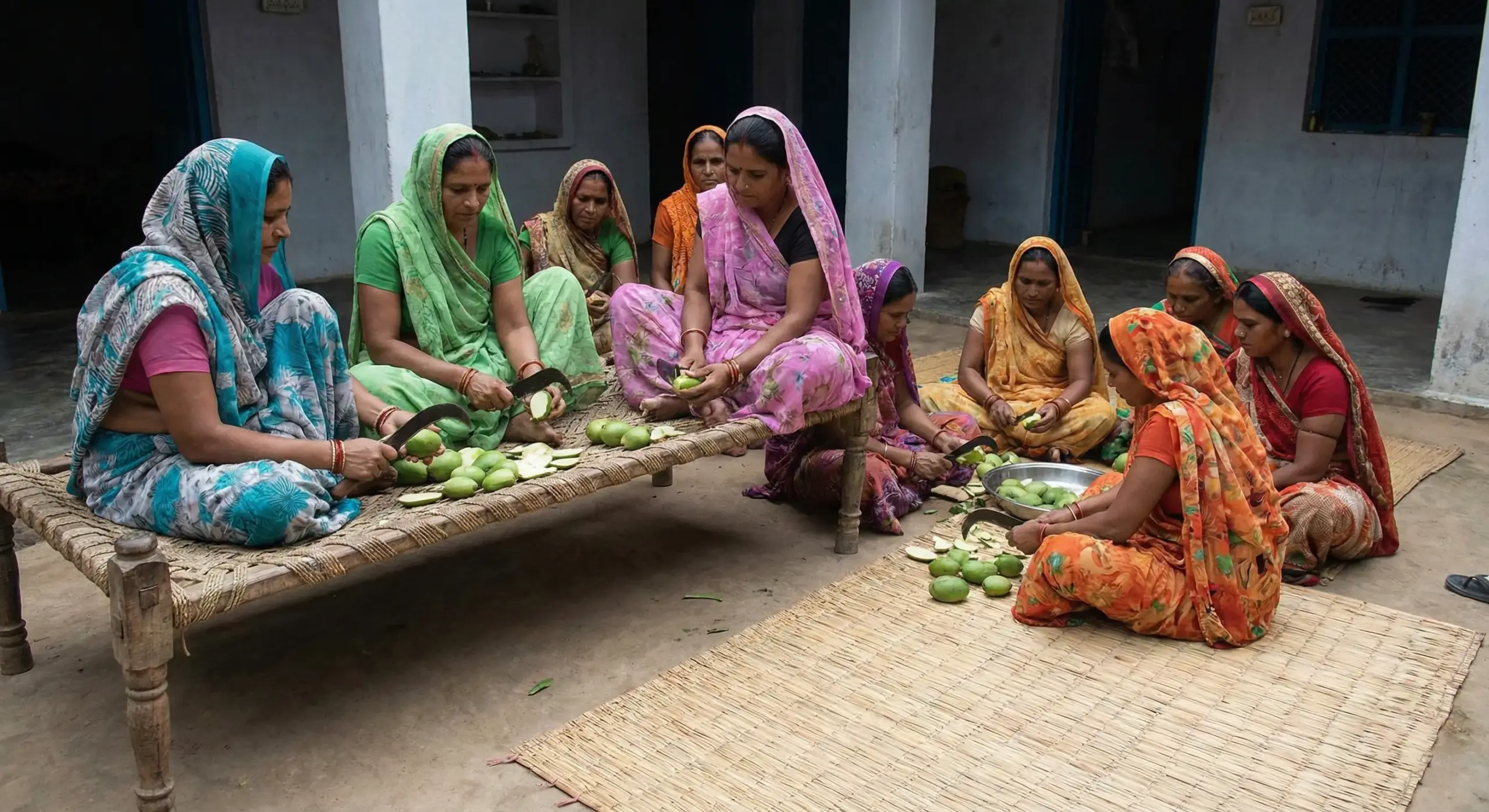
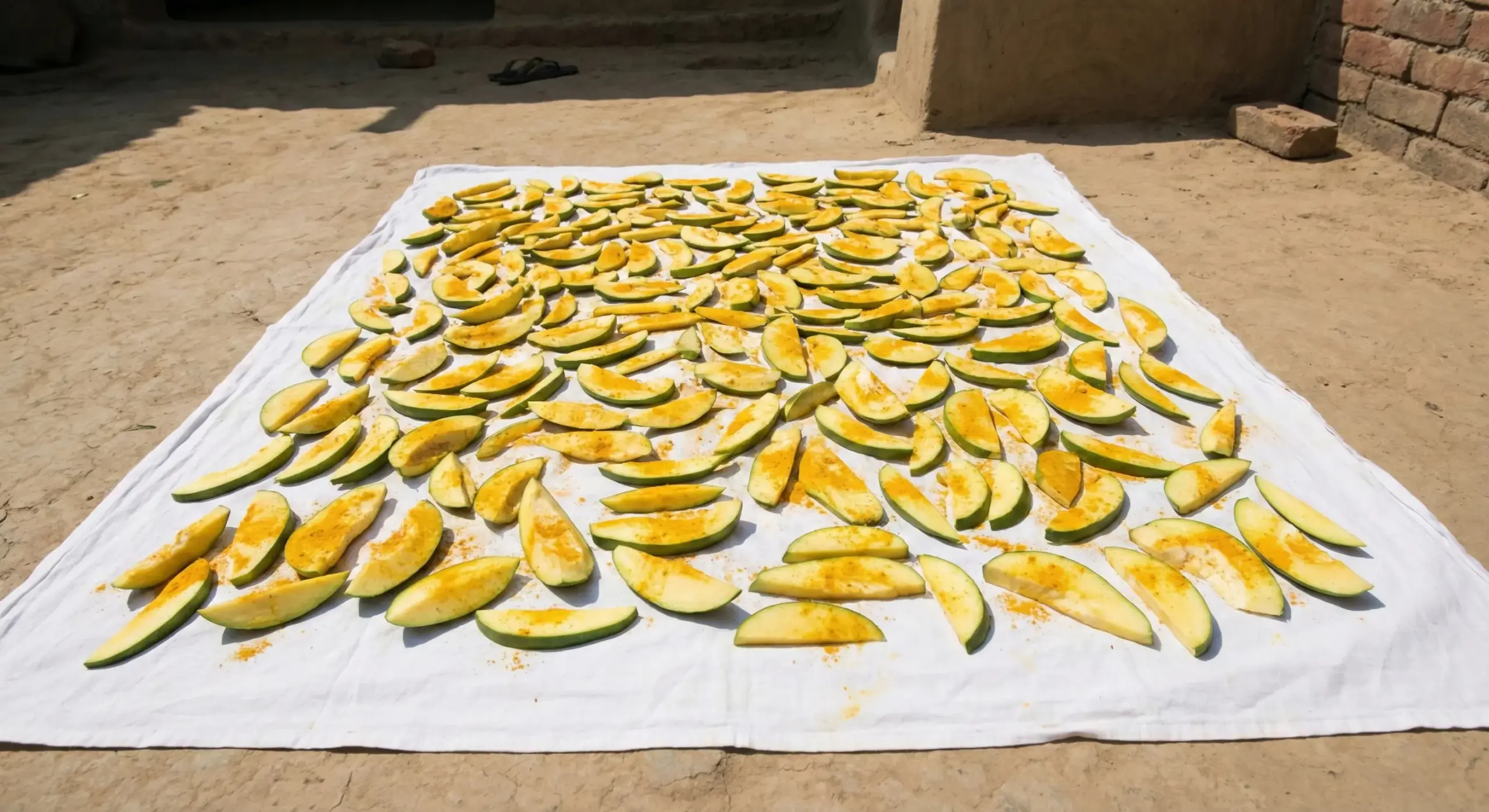
Tender jackfruit comes with it. A recipe site describes kathal as a seasonal vegetable available during the summer season, and two recipe pages note that it arrives with raw mango and is sometimes pickled together with it. The Cuisine India Society calls kathal ka achaar a North Indian pickle made with tender raw jackfruit and mustard oil. The usual method boils or steams the jackfruit until just tender, dries it, then spices and oils it, as covered in our summer pickle guide.
Summer’s sweet side: launji and galka
Not every Uttar Pradesh raw-mango preparation is a long-keeping oil pickle. Maayeka describes aam ki launji as a sweet and sour preserve of raw mango with mild spices, popular in Uttar Pradesh, and aam ki achari as a sweet and spicy grated mango pickle that, according to the same writer, stays fresh for a year or until finished. The recipe lists raw mango and sugar in equal weights for the launji.
Curly Tales describes galka as a traditional food item from eastern Uttar Pradesh made with unripe mangoes, jaggery or sugar and a handful of aromatic spices, a summer memory for many people in the state. Eastern Uttar Pradesh includes Varanasi, though the article does not mention Banaras itself, so we say only that the dish is associated with the east of the state.
Autumn into winter: the vegetable pickles
As the weather cools, the fruit gives way to vegetables. A Slurrp feature on winter pickles quotes a chef saying that gobhi gajar shalgam achar is found in every north Indian household. A Maayeka recipe for carrot, potato and radish in fermented mustard water notes that kanji is specially made during winter when purple or fresh red carrots are available, and that kanji vada is a must-have at Holi, a specialty from Rajasthan now popular across northern states.
Slurrp adds that the black carrot is a winter speciality used for a drink called kanji, and that the chef calls it a fermented drink, though we do not repeat the chef’s health characterisation. The same article gives the key practical warning for these pickles: if there is moisture in the vegetables, the pickle will get spoilt. Our own post on the mixed winter pickle is gajar, gobhi and shalgam achar, and the amla version is in amla achar in the winter season.
A caution on keeping time. A Maayeka mixed-vegetable pickle recipe says to refrigerate it after a week for a long shelf life, and that it stays well for a minimum of one and a half to two months in the refrigerator. Winter vegetable pickles are generally shorter-lived than summer mango pickles, and we state that as a trend in the recipes we read and not as a rule.
Winter’s signature: stuffed red chilli
Red chilli pickle is the winter pickle most associated with Banaras. The Veg Recipes of India site says that in India it is special to have the famed Banarasi style stuffed pickle made with fresh red chillies, which the writer tasted during a trip to Kashi. The pickle is also called bharwa lal mirch ka achar. A Homegrown list of unusual Indian pickles includes a stuffed red chilli pickle for Uttar Pradesh, describing red chillies infused with powdered spices and masalas, with fennel and mustard oil bursting out of the crisp chilli.
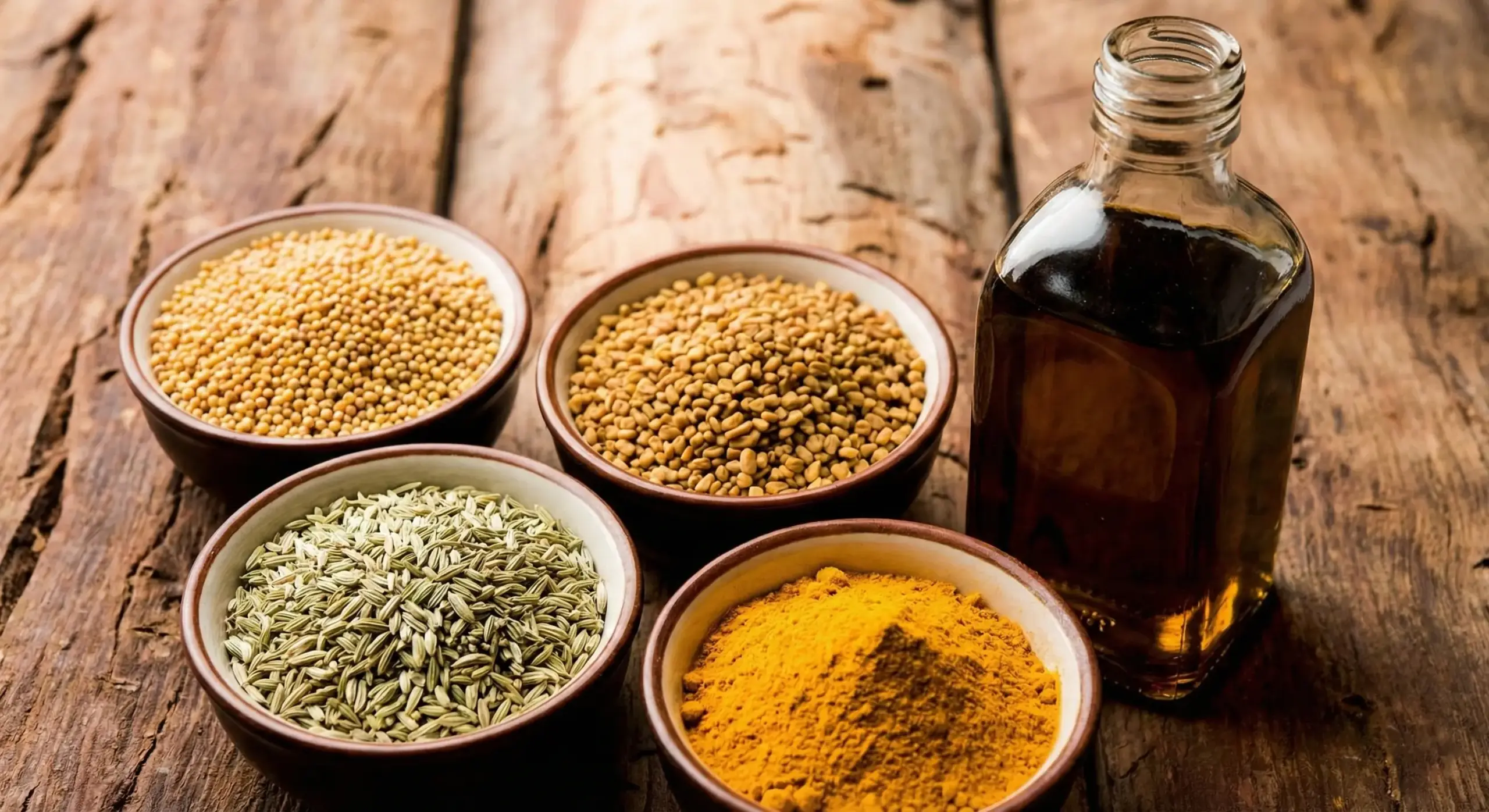
The Darbhanga seller’s page describes the same pickle as made from thick, tender, bright red chillies chosen for stuffing, often known as Banarasi Lal Mirch, with a fresh season batch from December to March. A UP-style recipe from Aahaaram lists about twenty big red chillies stuffed with powdered mustard, fennel and fenugreek, then packed into a completely dry glass or ceramic container.
Winter’s other pickles: lotus stem and methi
A recipe collection says lotus stem, or bhein, is extensively used in Kashmiri, Sindhi and Punjabi cuisines, and a winter pickle feature in the Asian Age includes a kamal kakdi achar among winter pickles, without tying it to Uttar Pradesh. Sanjeev Kapoor’s recipe has spiced lotus root mixed with mustard oil and matured in the sun. Whether it is a regular part of Banaras kitchens is not established, so we list it as a possibility and not as a fact.
The same Asian Age feature lists dana methi chane ka achar, made with fenugreek seeds and black chickpeas, as another winter pickle, with a note that it is ready after four days.
Amla and the cold-weather fruit
The winter fruit that most often becomes pickle is amla, covered in amla achar in the winter season and in the next post of this restored series. Homegrown lists amle ki launji as a Uttar Pradesh pickle. We have not found a source that fixes the month, so the calendar below uses broad seasons.
A rough calendar
| Season | What is pickled | How well sourced |
|---|---|---|
| March to June | Raw mango (kairi), tender kathal, launji, galka | Well sourced for mango and kathal |
| Monsoon | Little is made; jars are tended | Practice, see climate and pickle making |
| Autumn into winter | Amla, gajar, gobhi, shalgam, black carrot kanji | Sourced in recipe sites |
| December to March | Stuffed red chilli, mixed vegetable pickle, methi chana | Red chilli sourced by a seller’s page |
| Winter, uncertain | Lotus stem | Not confirmed for Uttar Pradesh |
The calendar is a guide. Weather moves it, as the seasonal pantry calendar for north India explains.
Frequently asked questions
What pickles are made in Uttar Pradesh in summer?
Raw mango pickle, kathal pickle, and sweet preparations such as aam ki launji and galka are the commonly sourced summer pickles.
What is made in winter?
Mixed carrot, cauliflower and turnip pickle, kanji from carrots, stuffed red chilli pickle and some methi-based pickles.
What is Banarasi lal mirch achar?
A pickle of thick red chillies stuffed with powdered mustard, fennel, fenugreek and other spices, packed in oil. It is associated with Banaras and made in the colder months.
Is lotus stem pickle from Uttar Pradesh?
It is widely made in Kashmiri, Sindhi and Punjabi kitchens. We could not confirm it as a regular Uttar Pradesh or Banaras pickle.
Do winter pickles last as long as summer pickles?
Recipes we read treat them as shorter-lived, with refrigeration advised for some. This is a trend, not a rule.
What is galka?
A raw mango and jaggery preparation from eastern Uttar Pradesh, according to Curly Tales.
Can I follow these notes as recipes?
No. They describe seasonal practice and give no safe quantities. Use a tested recipe and keep every utensil dry.
Sources used for this post:
– JhaJi Store, Lal Mirch ka Bharua Achar
– Asia Media Centre, “The Taste of Summer: Why Mango Season Matters in India”
– Maayeka, Kathal Ka Achar
– Cuisine India Society, Kathal Ka Achaar
– Maayeka, Aam ki Achari / Launji
– Curly Tales, “Aam Ka Galka”
– Slurrp, “Winter in a Jar”
– Maayeka, Kanji ka mixed vegetable pickle
– Maayeka, Mix vegetable pickle
– Veg Recipes of India, Red Chili Pickle
– Homegrown, “18 of India’s Most Unique Pickles”
– Aahaaram, UP Style Bharwan Lal Mirch ka Achaar
– Tarla Dalal, Lotus Stem Pickle
– The Asian Age, “Winter Pickles”
– Sanjeev Kapoor, Kamal Kakdi Ka Achaar