Blog
Mango Pickle Traditions in Banaras: Chaitra, Raw Kairi and the Family Signature

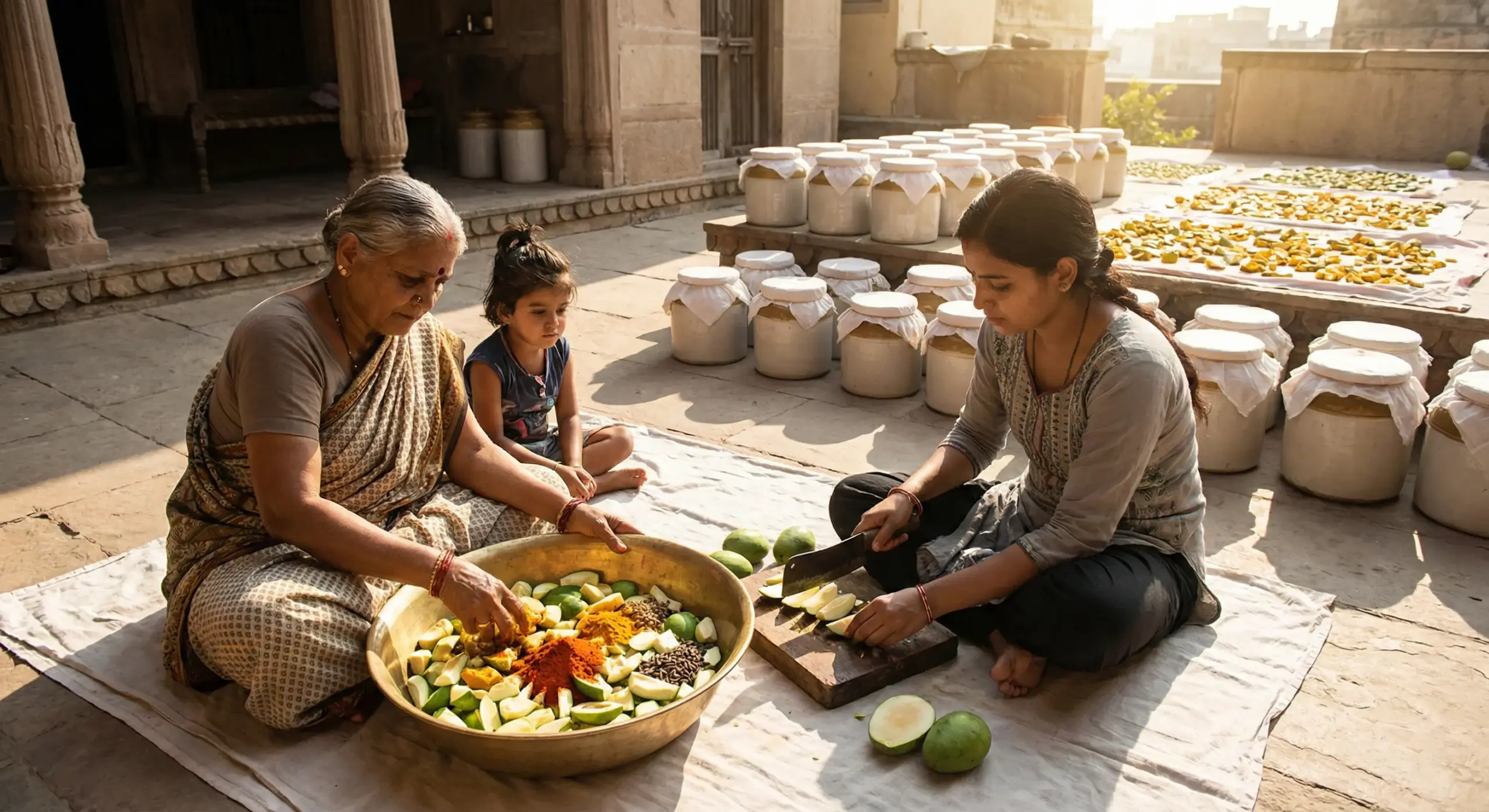
A recipe for kairi ka achaar published by the Antarman magazine starts from 5 kilograms of raw mangoes and calls for 1.5 litres of mustard oil, 250 grams each of fennel seeds and mustard kernels (rai dal) and 125 grams of methi dal, before cloves, red chillies, turmeric, chilli powder and salt are added. The list is a fair summary of the north Indian mango pickle: a lot of fruit, a lot of oil, and four whole spices doing the main work. A Banarasi version sits inside that pattern, with its own habits of cut, spice and sun.
This guide describes those habits as far as published sources allow. It covers the fruit, the spice base, the sun, what separates a Banaras mango pickle from the Punjabi, Andhra and Bengali ones, and the sweet cousins that share the same fruit.
The short answer
In short
A Banarasi mango pickle is made from raw, green, sour mango cut into pieces, salted and dried, then coated with fennel, fenugreek, mustard and nigella seeds, turmeric, chilli and mustard oil, and matured in the sun. Fennel is the regional signature in Uttar Pradesh and Bihar. Spice ratios are guarded by each family and are rarely written down, so no two households taste the same.
The fruit: raw, green and sour
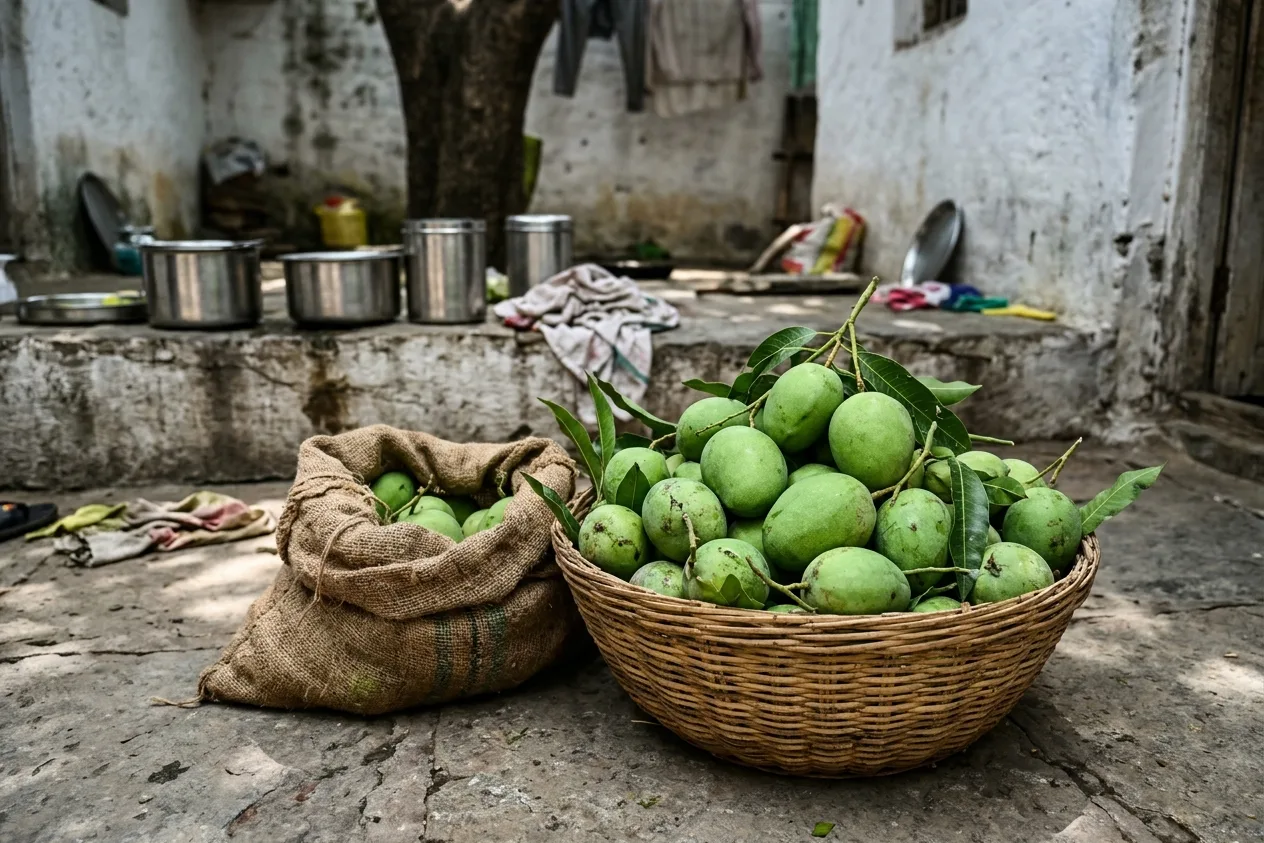
Raw mango, or kairi, is the base. The Deccan Herald describes it as India’s most popular pickle ingredient, and notes that in northern India, where mango trees flourish during hot summers, raw mangoes became one of the country’s favourite pickle ingredients. The mango is picked while hard and sour, before it ripens, so the acidity that helps the pickle is still in the fruit.
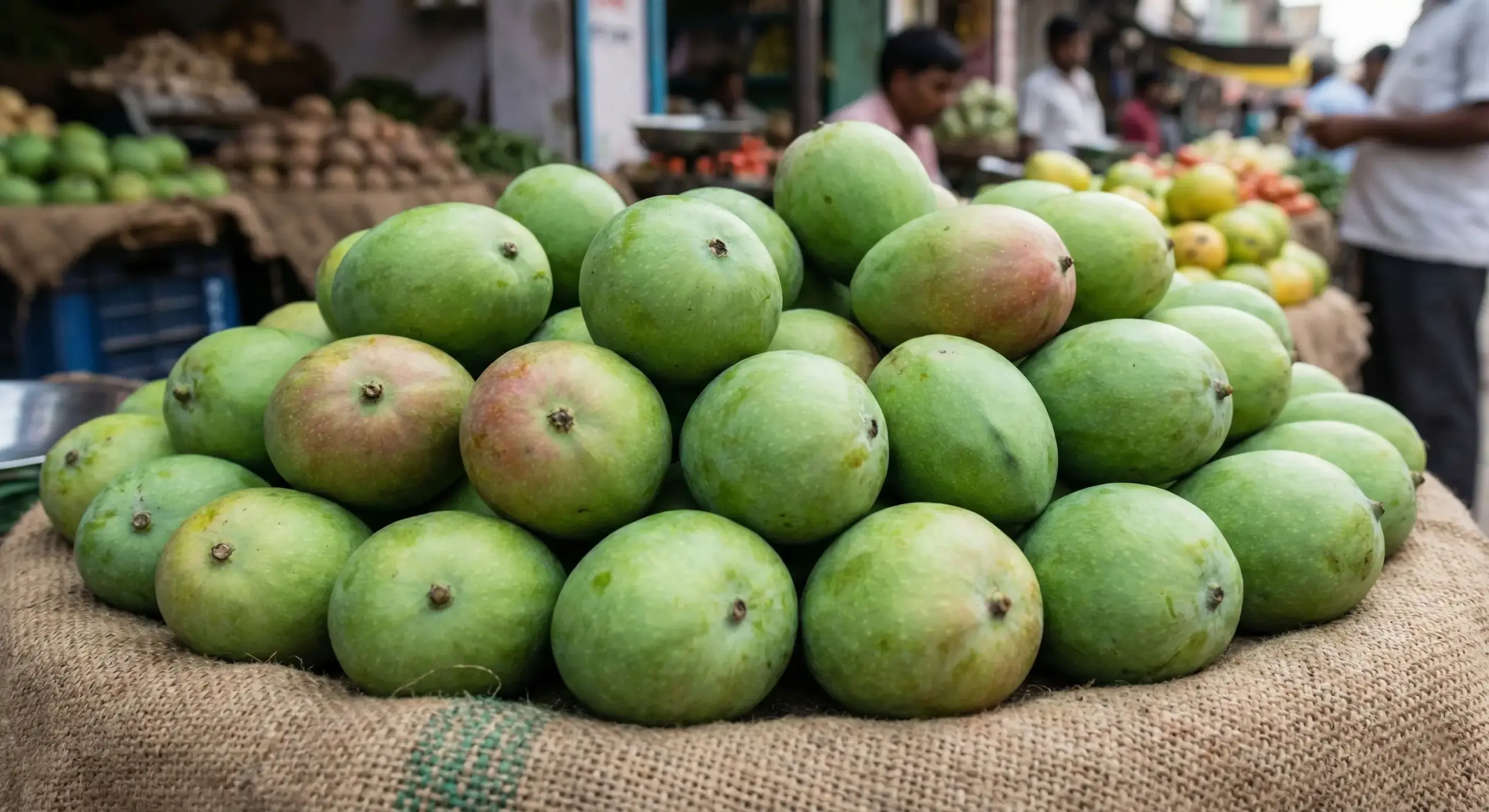
Which variety is used in Banaras is not firmly established in the sources we found. Varanasi is known for the Banarasi Langda, which Boldsky lists among the heritage mango varieties of Uttar Pradesh with a Geographical Indication, and Gaon Connection reports on its crop. The sources we found do not say that Langda is the pickling mango of choice. A seller of a family-recipe mango pickle from Uttar Pradesh says it uses Ramkela, a variety it describes as grown in the state for pickling purposes only, with a unique aroma and flavour.
The spice base
The Mishry guide to mango pickle types describes the Punjabi aam ka achar as made with fenugreek seeds, fennel seeds, onion (nigella) seeds, red chilli powder, asafoetida, mustard seeds and mustard oil. That list is close to the Banarasi one, and the line between them is a matter of proportion and emphasis. Two published sources make the Uttar Pradesh difference explicit.
First, a Scroll piece quotes a writer on regional mango pickles: mangoes are turned into a chutney with sugar in Gujarat, pickled with saunf (aniseed) in Uttar Pradesh and Bihar, and in Andhra Pradesh are often pickled with fiery chillies. Saunf is the line that points to Banaras. Second, the Deccan Herald observes that a mango pickle from Andhra Pradesh is often much hotter than one from Punjab because different chilli varieties and spice blends reflect local tastes and agricultural conditions. The same logic separates Banaras from both.
The spice-by-spice detail is in hing, methi and saunf in Banarasi achar, and traditional spice blends in Banaras covers the kitchen spices around it.
Cutting, salting and the sun
Published recipes agree on the order of work, which we follow in summer pickle rituals in Kashi households. The mango is washed, dried completely, cut and salted. An InstaCuppa method for a grandmother’s mango achaar spreads the cut pieces in direct sunlight for four to six hours, covered with thin muslin and not a lid, then mixes them with the masala and oil. It puts the sun cure of the jar at five to seven days, and says the mango is still firm and sharp at about a week.
The Masterclass guide to achar gives three to four days for spiced fruit in a muslin-covered jar, and a Uttar Pradesh family-recipe seller describes about fifteen days of sun maturation with a blend of roasted spices and wood-pressed mustard oil. These are practices and not standards. The reasoning behind the sun is in sun-curing achar, and the oil in why Banaras pickles are oil-rich.
A tip from TTK Prestige’s pickle guide agrees on the principle: cut into small, even pieces, because uneven pieces cure unevenly and give inconsistent texture. For a Banaras kitchen the tool, whether a boti or a knife, is covered in the Banarasi kitchen tools guide.
The family signature
The most repeated fact in sources about north Indian pickle is that the recipe belongs to a household. The Deccan Herald says that many households proudly guard special spice mixtures used for generations, and that grandparents pass down recipes that are often remembered and not written. A JhaJi Store tribute from Darbhanga puts the same point in the voice of someone who learned by watching, helping and being corrected: a little more salt, a smaller chilli needs less time, add more mustard oil. We treat this as testimony. The consequence for a reader is that any recipe, including the Antarman one above, is one household’s ratio and not the Banarasi standard. We follow the social side in pickle-making traditions in Banaras homes.
The map of mango pickles
Banaras is one entry on a long map. The Better India’s guide to regional mango pickles opens with Bengal’s gur aam, a jaggery-infused mango pickle, and lists Punjab’s aam ka murabba, a syrupy preserve typically made with Kesar or Langra mangoes, and Maharashtra’s kairiche lonche among others. A Maayeka post adds the line that Gujaratis make mango chunda and gor keri, Bengalis make gur aam, Maharashtrians make methamba and in the south they make aam ka murabba, though the basic ingredients are the same and every pickle has a different flavour.
Inside Uttar Pradesh, the same raw mango yields sweet preparations too: aam ki launji and aam ki achari, described in seasonal pickles of Uttar Pradesh, and galka from the east of the state. So a Banarasi household may make more than one mango preparation in a season, a long-keeping oil pickle and a sweeter one for quick use.
Dry style and oil style
One more distinction matters. A Masala Monk recipe for aam ka sookha achar calls its specialty its low oil content, made with minimal oil so there is no spilling in the plate or lunchbox, and claims a long shelf life. A Veg Recipes of India mango pickle recipe states that the pickle stays good for more than a year at room temperature in a cool dry place. Those are recipe-writers’ claims and we do not repeat them as promises. They show that mango pickle comes in dry and oil-rich forms and that both are made at home.
Frequently asked questions
What makes Banarasi mango pickle different?
The signature in Uttar Pradesh and Bihar is saunf (fennel) alongside fenugreek, mustard and nigella, in mustard oil. Each household adjusts the ratios.
Which mango is used for Banarasi pickle?
Raw, hard, sour mangoes. Which variety Banaras households prefer is not firmly established in the sources we found, so we do not name one.
How long is mango pickle sun-cured?
Sources range from three to four days to about fifteen days. The fruit, the cut and the sun decide.
Why is fennel used in Uttar Pradesh mango pickle?
It is the regional signature, according to a Scroll piece, which notes mangoes are pickled with saunf in Uttar Pradesh and Bihar. We did not find a source for the reason.
Is Langda the pickling mango of Varanasi?
Langda is the famous mango of Varanasi, but the sources we found do not say it is used for pickle, so we cannot confirm it.
Is mango pickle always oily?
No. Dry-style versions are made with minimal oil, and sweet ones with sugar or jaggery.
Can I follow these notes as a recipe?
No. They describe tradition. Use a tested recipe, dry every utensil and jar, and keep the fruit under the oil.
Sources used for this post:
– Antarman by MHC, Kairi ka Achaar recipe
– Deccan Herald, “How India’s pickles tell stories of climate”
– Boldsky, “5 Heritage Mango Varieties of Uttar Pradesh”
– Gaon Connection, Varanasi Langda mango
– Masala Monk, mango pickle listings
– Mishry, “6 Different Types of Mango Pickles in India”
– Scroll.in, pickles feature
– InstaCuppa, grandmother’s mango achaar method
– Masterclass, “All About Achaar”
– TTK Prestige, summer pickles and raw mango recipes
– JhaJi Store, “Maai ke Haath” tribute
– The Better India, “Map of Indian mango pickles”
– Maayeka, Aam ki Achari / Launji
– Veg Recipes of India, Mango Pickle