Blog
Rock Salt vs Refined Salt in Traditional Foods

Every common salt on an Indian kitchen shelf is 97 to 99 percent sodium chloride, and the sodium per gram is nearly the same across all of them, according to Organic Mandya’s comparison of rock salt, sea salt and table salt. The difference between sendha namak and the packet salt in the pantry is real, but it lies in processing, tradition and ritual far more than in chemistry.
This guide explains both sides honestly: what the old food tradition says about rock salt, why it is the salt of fasts and temple kitchens, what refining actually changes, and what a cook, a pickle maker or a person who is fasting can sensibly take from it. It is a cultural and ingredient explainer, with no medical advice.
The short answer
In short
Rock salt (sendha namak, from Sanskrit saindhava) is mined, minimally processed salt, and Hindu fasting and temple traditions prefer it because it is regarded as unprocessed and pure. Refined table salt is sodium chloride that has been purified and usually has iodine and anti-caking agents added. Chemically both are mostly sodium chloride. The choice in traditional food is about ritual purity, taste and habit, and the iodine in table salt has a real public health role.
Rock salt (sendha namak)
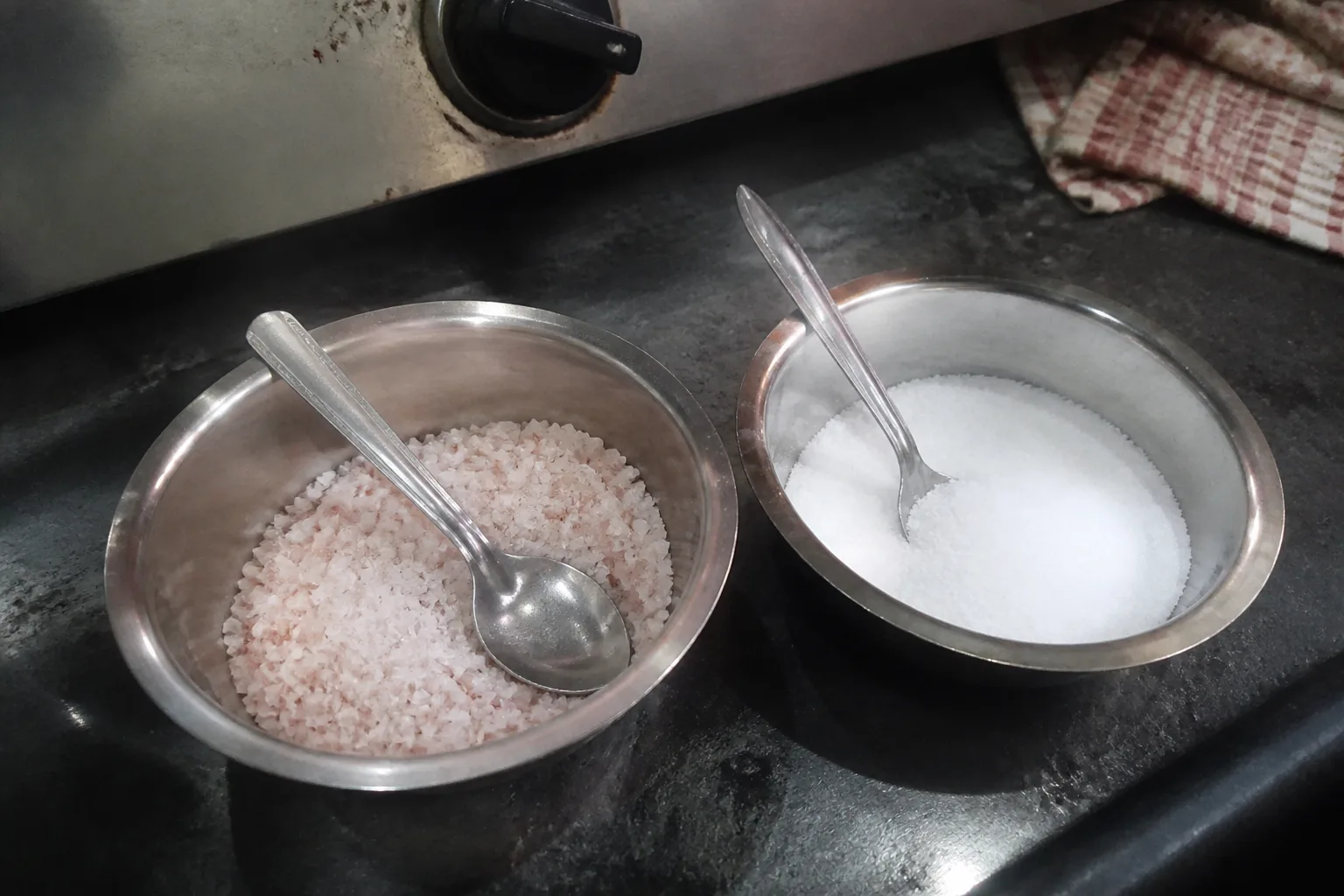
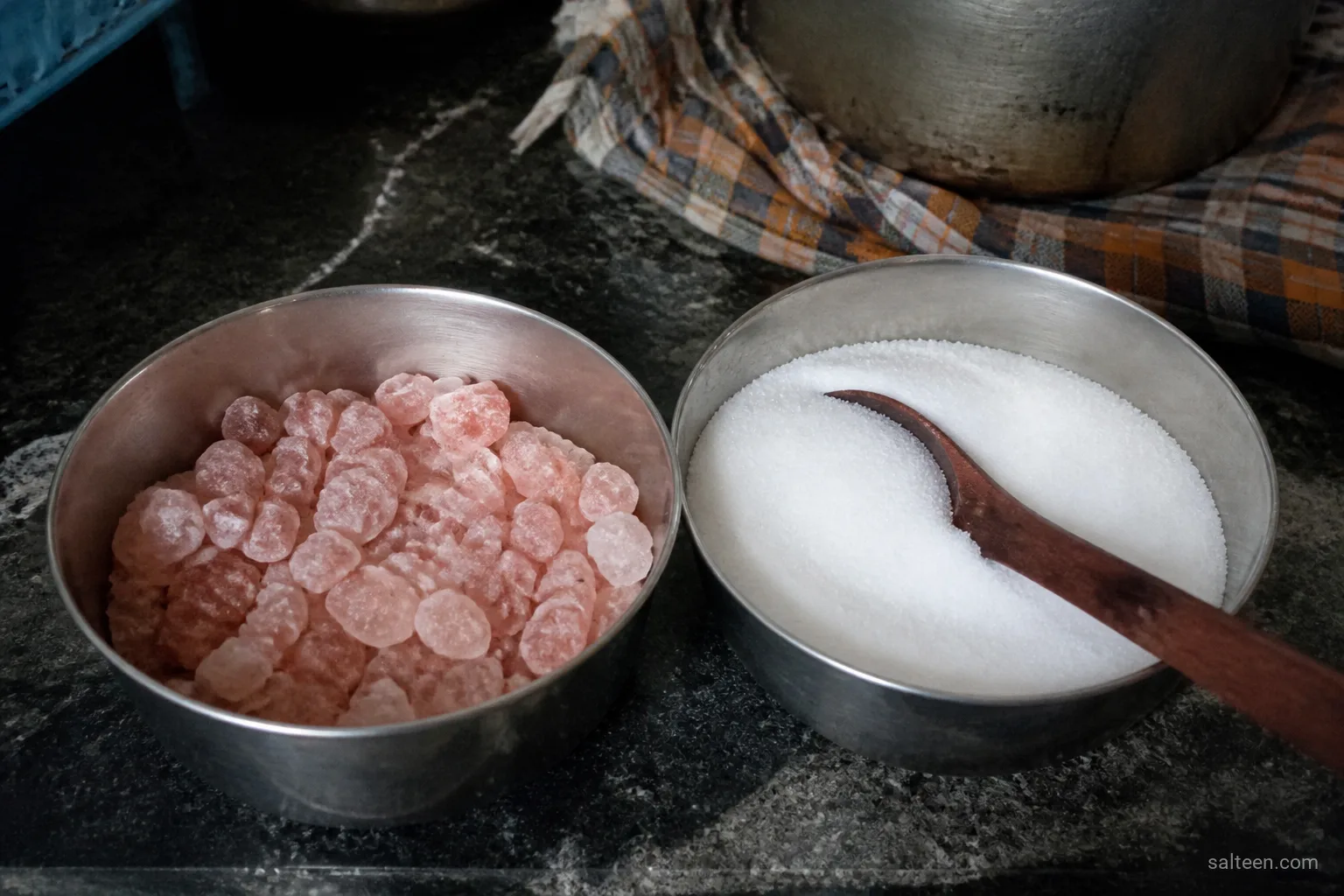
Rock salt is salt mined from underground deposits, not produced by evaporating seawater. Tarla Dalal’s glossary describes it as a naturally occurring, unrefined mineral salt, and India TV describes sendha namak as a naturally occurring rock salt, mined from salt deposits in the earth, minimally processed and retaining natural minerals. It is usually sold as coarse, off-white to pinkish crystals, and some people grind it at home. Curly Tales notes it is often mined from Himalayan regions.
The Sanskrit name is saindhava lavana, “salt from Sindhu”, and the old Ayurvedic texts treat it as a distinct ingredient.
Refined table salt
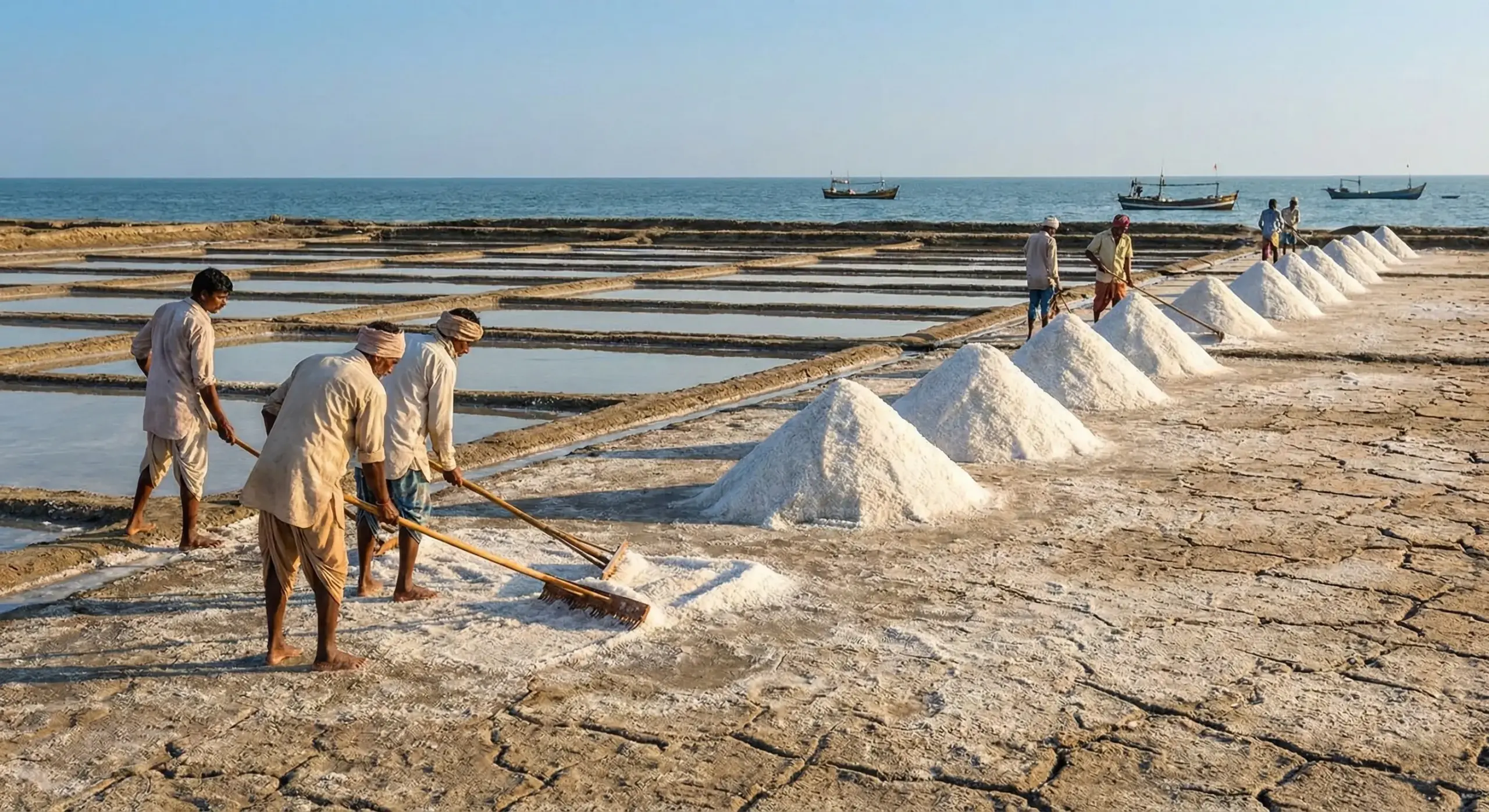
Table salt is extracted from seawater or from salt mines and then heavily processed. India TV notes it often includes additives such as anti-caking agents and iodine. Organic Mandya describes the refined result as chemically pure sodium chloride with added iodine and anticaking agents. The salt is white, fine and free-flowing, which makes it easy to measure and store.
A side-by-side look
| Feature | Rock salt (sendha namak) | Refined table salt |
|---|---|---|
| Source | Mined from deposits | Seawater or mines, then refined |
| Processing | Minimal | Heavy |
| Additives | Usually none | Iodine and anti-caking agents common |
| Texture | Coarse crystals | Fine, free-flowing |
| Taste | Often described as milder | Sharp, clean salty taste |
| Cost | Higher | Low |
| Role in vrat food | Required | Set aside |
Cost is a real factor. Tarla Dalal’s glossary says India produces little rock salt, so it costs several times more than common salt, though prices change and we do not quote a figure.
What the chemistry says
Plain truth first. Organic Mandya’s summary says all common salts are 97 to 99 percent sodium chloride, and that the sodium per gram is nearly identical across them. Refining removes most of the naturally occurring minerals, according to the same source, but those minerals are present only in trace amounts.
You will often see claims that sendha namak contains up to 84 trace elements, and that it improves digestion, lowers blood pressure or has “low sodium”. These appear on many popular sites, including India TV and The Statesman. We do not repeat them as fact. The trace minerals are real but minuscule in a pinch of salt, and a seasoning is not a treatment. Rock salt is still salt, and anyone told to limit sodium should limit it whichever kind they use.
There is one point where refined salt has a clear advantage. Iodine is added to table salt to prevent deficiency, and Organic Mandya notes that if you live in an iodine-deficient region, iodised table salt remains the most practical choice from a public health standpoint. A household that moves entirely to rock salt should know that it usually carries no added iodine, and should get iodine from other sources or ask a doctor.
Why rock salt is the salt of fasting
During Navratri, Ekadashi and other vrats, observers avoid regular table salt and use sendha namak. Several explanations are given, and they overlap.
- Processing. Fasting food avoids processed items, and rock salt is seen as unprocessed while iodised table salt is not. The Statesman describes this as the main reason, supporting the choice of natural rock salt over iodised table salt.
- Purity. Slurrp’s explainer says sendha namak is considered pure and unprocessed, in line with satvik dietary principles.
- Origin. The Statesman also says sendha namak is considered a vegetarian salt because it is not made from seawater, which makes it suitable for religious cooking.
- Convention. In practice, households follow what their families have always done, and the phrase “vrat ka namak” is common shorthand.
The effect is a second salt shelf for fast days. A household that observes several fasts a year keeps a packet of sendha namak next to its ordinary salt, along with kuttu flour, singhara flour and sabudana, as described in from ghats to homes: food life in Kashi.
Rock salt in temples and temple-style cooking
Banaras temple kitchens follow satvik rules that keep out onion and garlic and favour unprocessed ingredients, and rock salt fits that outlook. We do not have a published source naming the salt used in each temple’s kitchen, so we describe the pattern and not the detail: temple-style food in the city generally follows the same fasting-friendly ingredient list. For what temples actually offer, read food offerings in Banaras temples.
What Ayurveda says
The classical texts list several kinds of salt, and Ayurvedic tradition regards saindhava as the best of them, described as lighter and less heating than other salts, and often as suitable for all body types. Sea-derived salt is described as heavier and more heating. These are traditional classifications, and they come from a system that predates the idea of sodium and iodine. We report them as part of the tradition, not as a basis for choosing a salt for health reasons.
Black salt is not the same thing
Kala namak, the black salt used in chaat masala, raita and sattu drinks, is a different product. Organic Mandya says it is Himalayan salt that has been heated and processed with charcoal or other agents, producing sulphur compounds that give it a distinctive egg-like smell and flavour. It is eaten with sattu in Banaras summers, but it is not what a fasting household means by sendha namak. Curly Tales and others list names such as halite, Lahori namak and Himalayan pink salt for rock salt, so check labels carefully.
Salt in pickling
Salt has its own job in pickles, covered in why sun-drying is essential for Indian pickles. It draws water out of the produce by osmosis and creates an environment where few organisms thrive. Indian pickle makers use both rock salt and fine or coarse sea salt, and one published mango pickle guide suggests rock salt at roughly 80 to 100 grams per kilogram of fruit as an example. A practical point is that fine iodised table salt can cloud brines and may cake, which is why many pickle makers prefer coarse, non-iodised salt.
Choosing a salt in your own kitchen
- For fasting days: use sendha namak, and check that the packet says rock salt and not a blend.
- For everyday cooking: use whichever salt your household prefers, keeping an eye on iodine and total sodium.
- For pickles: use clean, coarse, non-iodised salt, and measure by weight, not by the spoon.
- For chaat and drinks: use kala namak where the recipe calls for it, and not instead of sendha namak.
Frequently asked questions
What is sendha namak?
Mined, minimally processed rock salt, used in India especially for fasting foods.
Is rock salt healthier than table salt?
Both are mostly sodium chloride, with nearly identical sodium per gram, according to Organic Mandya. Rock salt keeps small amounts of natural minerals, but the amounts are small.
Why is rock salt used during Navratri?
It is regarded as unprocessed and pure, and it is a vegetarian salt, while iodised table salt is considered processed.
Does rock salt contain iodine?
Usually not in any meaningful added amount, since iodine is added deliberately to table salt. People relying only on rock salt should get iodine elsewhere.
What is the difference between rock salt and black salt?
Black salt (kala namak) is a heated, charcoal-processed salt with a sulphurous smell. Rock salt is not.
Can I use rock salt for pickles?
Yes, many households do. Use clean, dry, coarse salt and measure by weight.
Why is rock salt more expensive?
India produces little rock salt, according to Tarla Dalal’s glossary, so it costs several times more than common salt.
Sources used for this post: Organic Mandya (comparison of rock salt, sea salt and table salt); India TV (sendha namak and normal salt); The Statesman and Slurrp (rock salt in fasting); Curly Tales (sendha namak and fasting); Tarla Dalal (rock salt glossary). Traditional and Ayurvedic ideas are described as such, and marketing mineral counts are not repeated as fact.