Blog
From Ghats to Homes: Food Life in Kashi

Kulhad chai early in the morning on a boat is the way to start the day in Varanasi, according to Outlook Traveller, and that single image links the two halves of this guide. On the river, food is shared, bought for a few rupees and drunk from a clay cup that will be thrown away. A few lanes back, in a home kitchen, the same city follows a much stricter set of rules about who cooks, how, and for whom.
This guide follows food as it moves from the ghats to the household: the public food of the riverfront, the temple offering that sets the standard, and the home rasoi that borrows from both. It sits under our pillar post, Banaras: a living city through its kitchens, and goes deeper on how the public and private food of Kashi relate.
The short answer
In short
Food in Kashi moves in a circle between the ghats, the temples and the home. The ghats and lanes supply public food: chai in kulhads, kachori at dawn, chaat for pilgrims waiting for the evening aarti. The temple sets the standard of purity with bhog and prasad. The household kitchen follows the same standard in miniature, sorting food into kachcha and pucca, keeping fasts with phalahar, and simplifying its table in the monsoon.
The ghats: where food meets the river
Varanasi has around 80 to 90 ghats depending on who counts, with 88 given by Outlook Traveller and 84 by Village Square. Among the best known are Dashashwamedh, Manikarnika, Assi and Darbhanga. Each has its own character, and each has its own food.
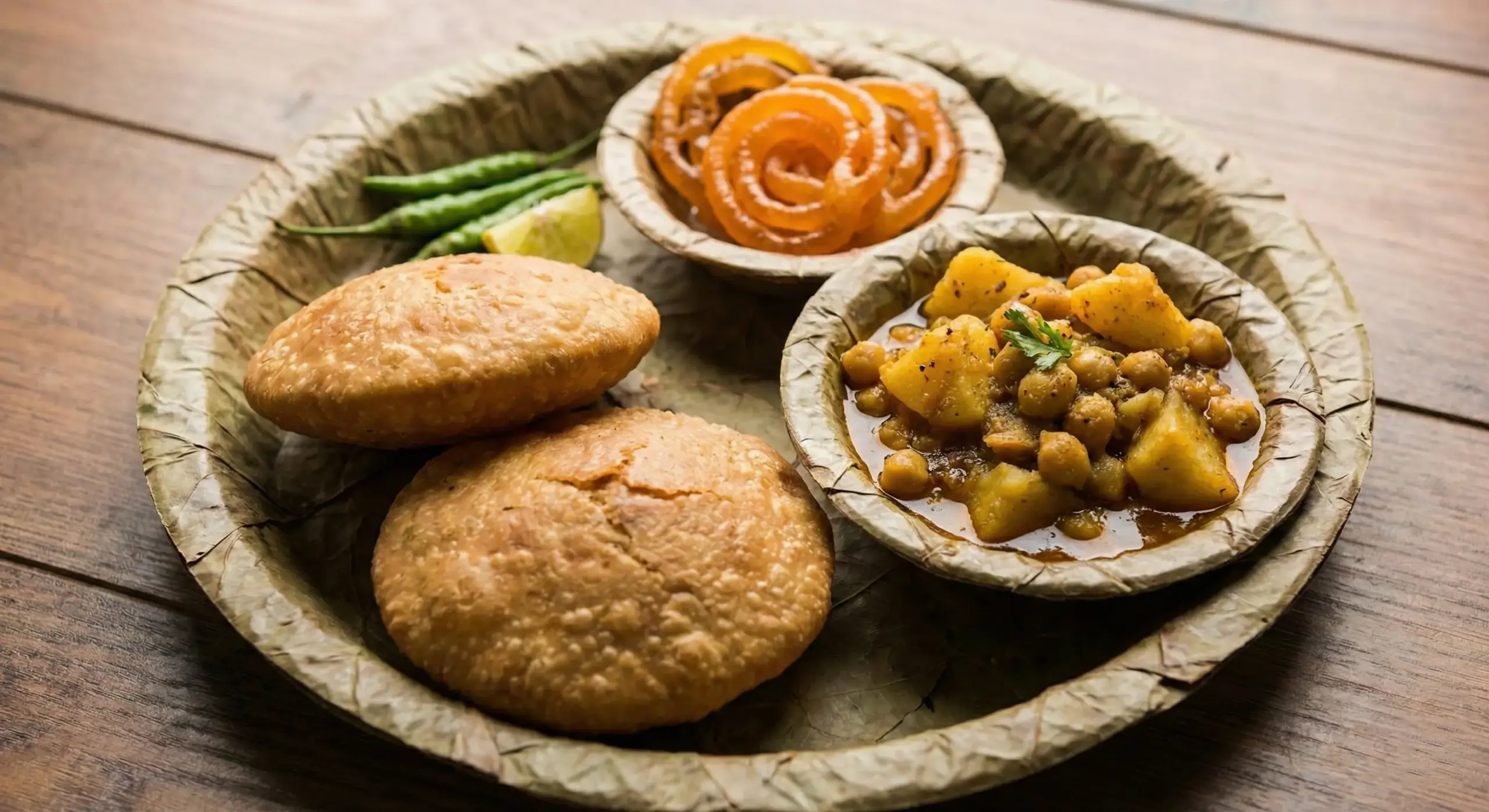
At dawn, pilgrims bathe, boatmen start work and tea vendors set up. The Assi Ghat morning programme, Subah-e-Banaras, draws an early crowd for music and a morning aarti, and Zee Zest points visitors to it for the rising sun. Travel guides note that the kachori stalls open as early as five in the morning, because pilgrims who have bathed in the Ganga need breakfast. The food follows the ritual: bathe, pray, eat.
Through the day, tea shops fill every corner. Travelling Camera calls Varanasi a city with a deep love affair with tea, with tea shops and vendors in almost every corner. Clay cups of tea, milk and lassi are the default container, and the cup is used once and discarded.
In the winter mornings, vendors in the Chowk and Vishwanath Gali areas sell malaiyo from large brass pots, as Lonely Planet describes. We cover the dish in morning food habits of Banaras households.
In the evening, the ghats fill for the Ganga Aarti, and chaat vendors near Dashashwamedh feed the people waiting for it. One travel guide to Varanasi puts the logic simply: the chaat vendors exist because pilgrims waiting for the aarti need a snack, and the kachori stalls because pilgrims who bathed at dawn need breakfast. The food follows the religious calendar of the day.
The ghat food is mostly vegetarian, fried or milk-based, quick to serve and easy to eat with one hand, which suits people on foot. It uses mustard oil or ghee, hing, and little or no onion and garlic in the traditional shops, as the Lonely Planet and 30 Stades guides describe.
The temple: the standard of purity
Behind the ghats sit the temples, and their kitchens set the standard that the city’s food follows. The detail is in food offerings in Banaras temples, but the principles matter here.
Naivedya (or bhog) is food offered to a deity, and prasad is what returns to the devotee afterwards. Temple kitchens in Kashi follow satvik rules, which exclude onion and garlic, and keep a clean, quiet working space. Offerings range from sugar crystals and seasonal fruit to elaborate spreads. At Annakut, the day after Diwali, 56 kinds of food are offered at the Annapurna and Kashi Vishwanath temples, according to UNI, with 151 quintals of mahabhog prepared at the Annapurna temple this year.
The distribution matters as much as the cooking. Hindu Blog describes the afternoon bhog at Kashi Vishwanath going first to Shiva, then to Annapurna, then to the Dand Sanyasis, and finally to devotees in the temple. The sequence turns a meal into a ritual, and everyone who receives it eats the same food in the same place.
The home kitchen: the standard in miniature
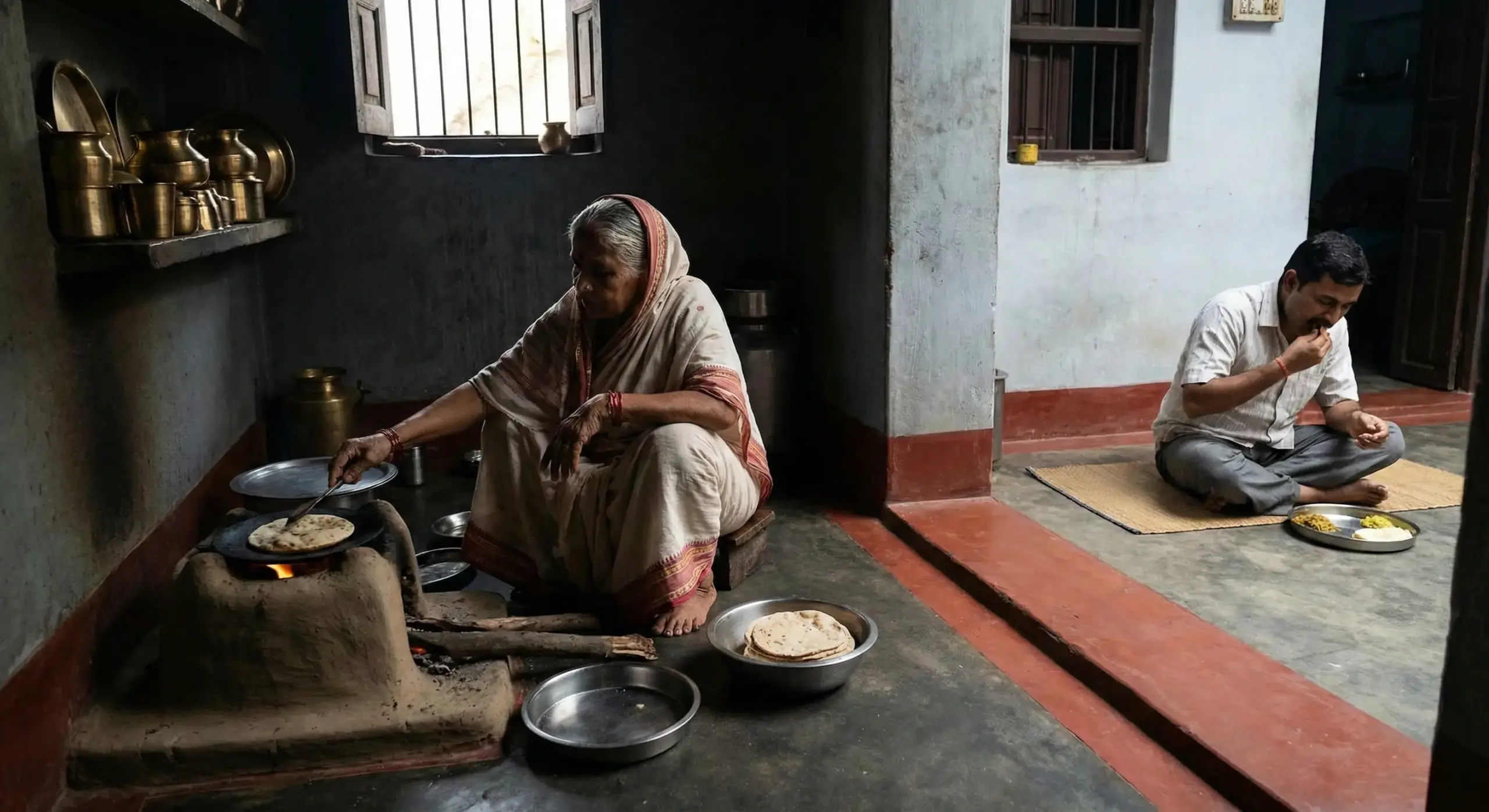
The household rasoi borrows the temple’s habits. In a traditional home, the kitchen is a clean space, often at the back or the centre of the house, away from the entrance. The cook bathes before cooking, outsiders do not walk through, and shoes stay outside. Food is not tasted until the first portion has been set aside.
Kachcha and pucca food
The most useful idea for understanding Kashi food at home is the split between two kinds of cooked food.
| Type | Cooked in | Examples | Traditional rule |
|---|---|---|---|
| Kachcha | Water | Boiled rice, dal, plain roti | Eaten at home, within the family |
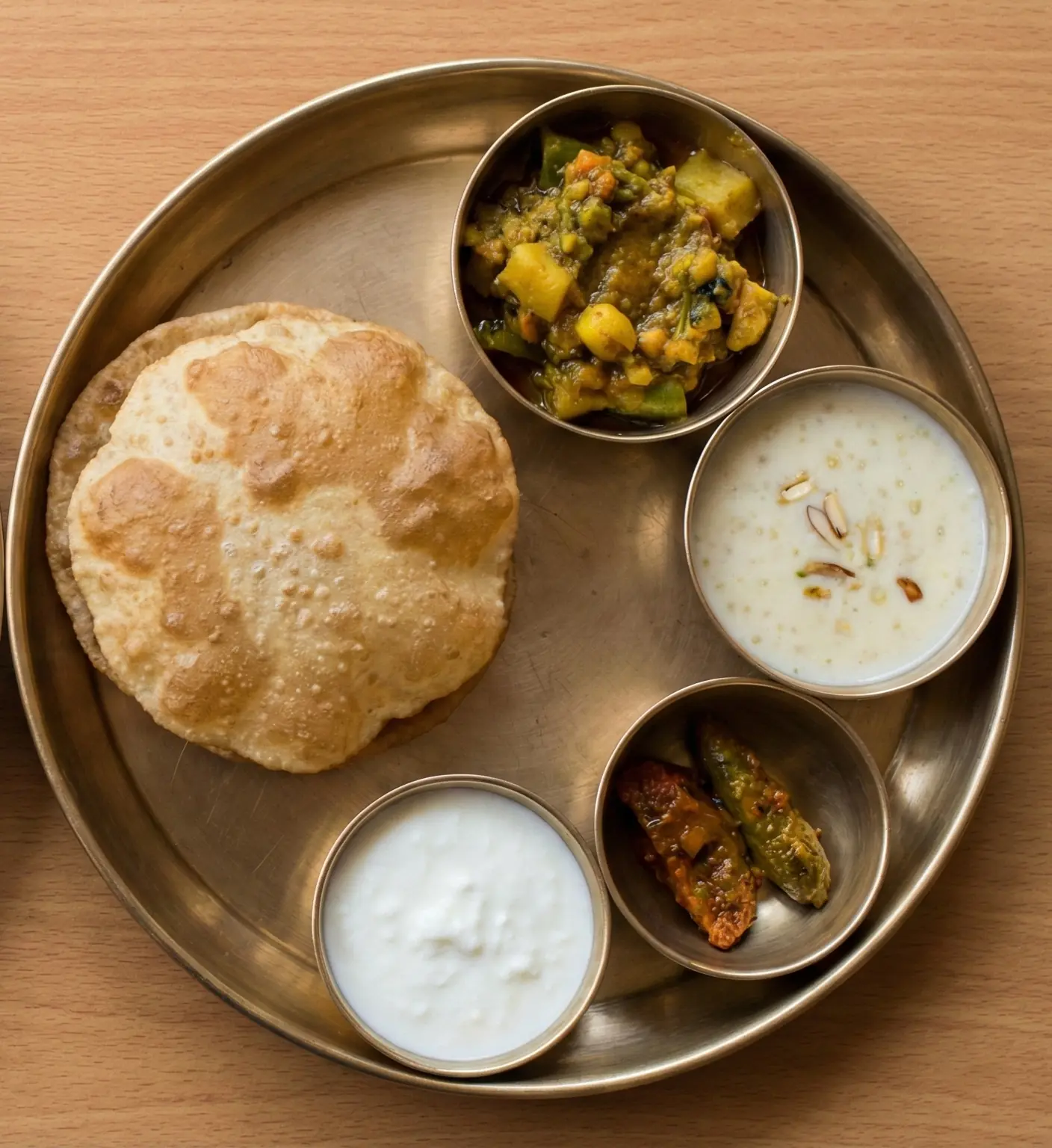
| Pucca (pakka) | Ghee or oil | Puri, kachori, jalebi, fried snacks | Can be shared, carried and served at gatherings |
Anthropologists connect the division to ritual purity and caste. A practical reading adds that fried food keeps longer in a hot climate, which we explore in how climate shaped Banaras food habits. In daily life it explains why a household cooks its dal and rice at home but happily buys puri and kachori from the halwai for guests and festivals.
The thali and the six tastes
A standard daily meal is built on wheat, rice, arhar or moong dal and a seasonal vegetable. Ayurvedic tradition prefers a plate that touches six tastes (sweet, sour, salty, bitter, pungent and astringent), and a spoon of pickle fills the sour, salty and pungent gap. See the role of pickles in the Banaras thali.
Vrata: fasting and the second kitchen
Fasting is a regular part of life in Kashi. Ekadashi, Mondays in Shravan, Navratri, Shivratri and other days bring a vow, and the food on those days follows a separate rulebook known as phalahar, which means “fruit food”.
On a phalahar day, grains such as wheat and rice are set aside. In their place come:
- Kuttu (buckwheat) flour, for puri and pakora
- Singhara (water chestnut) flour
- Rajgira (amaranth) in the form of laddus or roti
- Sabudana (tapioca pearls), as khichdi or vada
- Potatoes, sweet potatoes and seasonal fruit
- Milk, curd and makhana
- Sendha namak, rock salt, in place of ordinary salt
The salt rule has its own explanation, covered in rock salt vs refined salt in traditional foods. In practice, a household with a regular fast keeps a second set of ingredients and often a second set of pots, which makes the fast day its own small kitchen within the larger one.
The monsoon and the quiet table
When the rains arrive, the household changes its habits, and in the four months of Chaturmas many households stop eating leafy greens and cut back on fried and heavy food. The reason given is practical: wet leaves carry mud and insects. The custom also belongs to the season of religious restraint. The table moves towards gourds, stored dal and grain, roasted maize, and pickles that were made months earlier. We cover the detail in seasonal eating practices in Kashi.
Milk: the thread that joins ghat and home
Dairy runs through every layer. The city’s milk, curd and ghee come largely from pastoral families on its edges, and milk appears as the kulhad of morning tea on the ghat, the rabri at the sweet shop, the khoya in a festival sweet and the glass of warm milk at the end of the family’s dinner. The clay cup is the clearest link. It is the same container at a ghat stall and a family gathering, and it is made to be used once.
What the circle teaches
Three habits repeat across the ghat, the temple and the home:
- Food comes after a ritual. A bath, a prayer or an aarti comes first.
- Food is shared in a set order. The deity, the elder, the guest, then the cook.
- Simple ingredients, prepared with care. Ghee, mustard oil, hing, seasonal vegetables and a short spice list.
The pickle jar in a Kashi home is a small example of all three. It is made in a set season, with set rituals about cleanliness, and the first spoon is shared before the jar is closed. The craft of making it is the subject of our later posts on pickle-making traditions in Banaras homes.
Frequently asked questions
What do people eat on the ghats of Varanasi?
Kachori sabzi and jalebi at dawn, tea, lassi and thandai in clay cups, chaat in the evening and, in winter, malaiyo.
What is the difference between naivedya and prasad?
Naivedya is the food offered to a deity. Prasad is that food after it is returned to devotees.
What are kachcha and pucca food?
Kachcha food is boiled in water, such as dal and rice. Pucca food is cooked in ghee or oil, such as puri and kachori, and is traditionally easier to share and carry.
What is phalahar?
The food eaten during a fast, built from fruit, milk, buckwheat, water chestnut flour, sabudana and rock salt.
Why is rock salt used in fasts?
It is regarded as unprocessed and therefore permitted, while refined table salt is set aside. See our post on rock salt for the details.
Why are leafy greens avoided in the monsoon?
Households say wet leaves carry mud and insects, and the custom overlaps with Chaturmas. It is tradition, not medical advice.
How many ghats does Varanasi have?
Sources give figures between about 80 and 90, with 84 and 88 both quoted, depending on how ghats are counted.
Sources used for this post: Outlook Traveller (ghats, kulhad chai, Banarasi food); Zee Zest and Expedia (Subah-e-Banaras at Assi Ghat); Lonely Planet (malaiyo vendors); Travelling Camera (tea in Varanasi); UNI India (Annakut 2026); Hindu Blog (Kashi Vishwanath bhog); a Varanasi food guide on the ghat food rhythm.