Blog
Evening Meals in Traditional Banarasi Homes: Light Food, Floor Seating and Warm Milk

In a traditional Banaras home, lunch is the big meal of the day, and dinner is built to be lighter on purpose. The older generation explains it with a simple image: digestion is strongest at midday, when the sun is at its height, and weaker after sunset, so the evening plate is kept small, warm and plain.
This guide walks through what that dinner actually looks like, from the dal and phulka at its centre to the seasonal vegetables, the order of service and the glass of warm milk at the end. Everything about digestion here is traditional household belief and not medical advice.
The short answer
In short
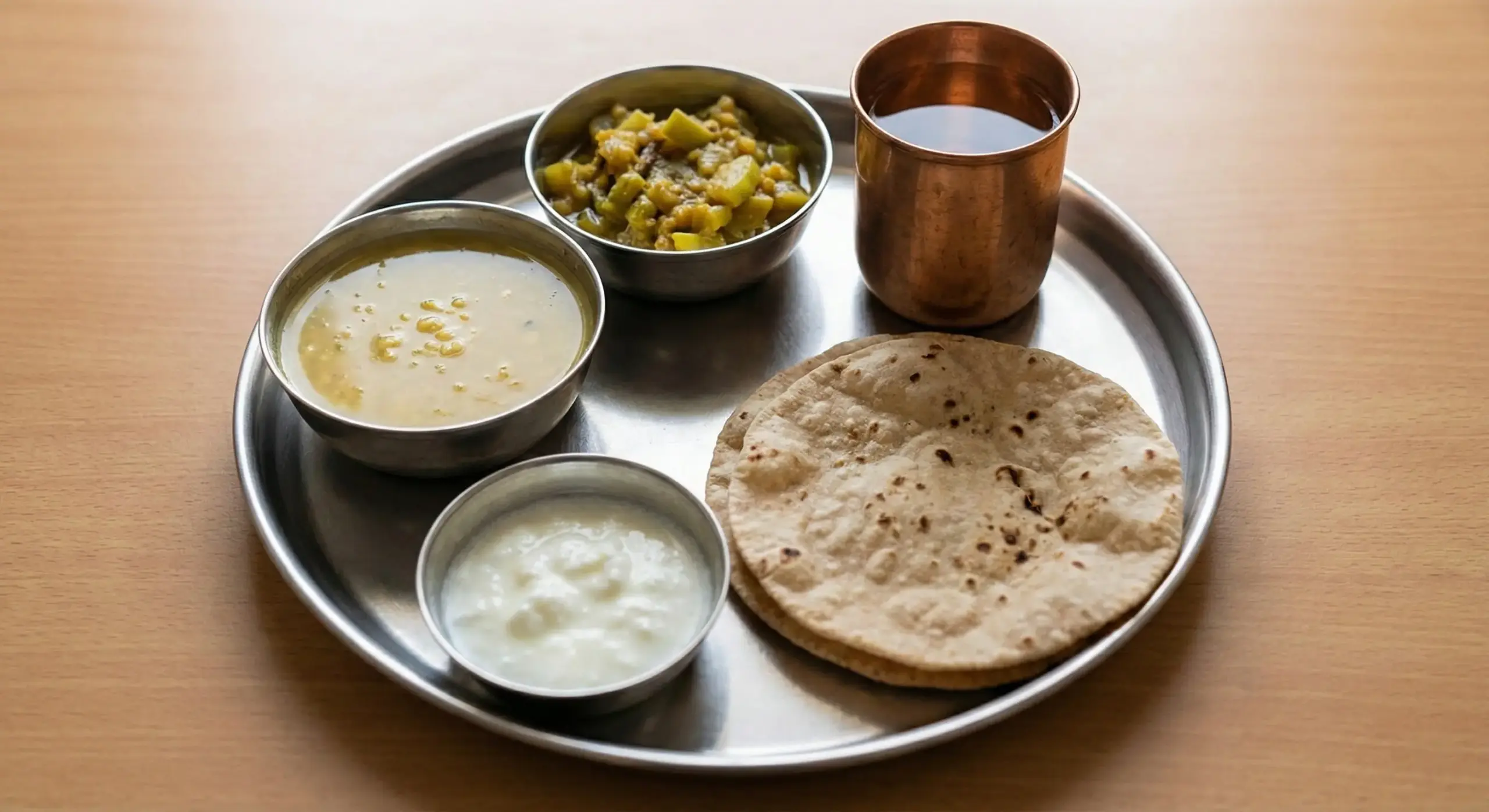
A traditional Banaras dinner is eaten early, usually soon after dusk, and consists of phulka (thin puffed roti), moong dal, one seasonal sabzi, sometimes a little rice, and a spoon of pickle. Fried and heavy foods are avoided. The family eats seated on the floor, the senior members are served first, and the meal ends with warm milk, saunf and sometimes a sweet paan. Dishes are cooked without onion and garlic in many homes.
The idea behind a light dinner
Traditional Indian food thinking, and Ayurveda in particular, speaks of jatharagni, the digestive fire, which is believed to be strongest around midday and weakest at night. The practical outcome in a Banaras home is a rule of thumb that most grandmothers will recite: eat the main meal at noon, and keep the night meal light enough that you can sleep easily.
Older households use two terms for these meals. The midday meal, madhyan bhoj, is the full thali with rice, dal, vegetables, curd and pickle. The night meal, ratribhoj, is shorter. Many families also hold a folk belief against eating rice at night, which is why dinner leans on roti, though plenty of homes serve a small portion anyway. We present this as a custom and not as a rule.
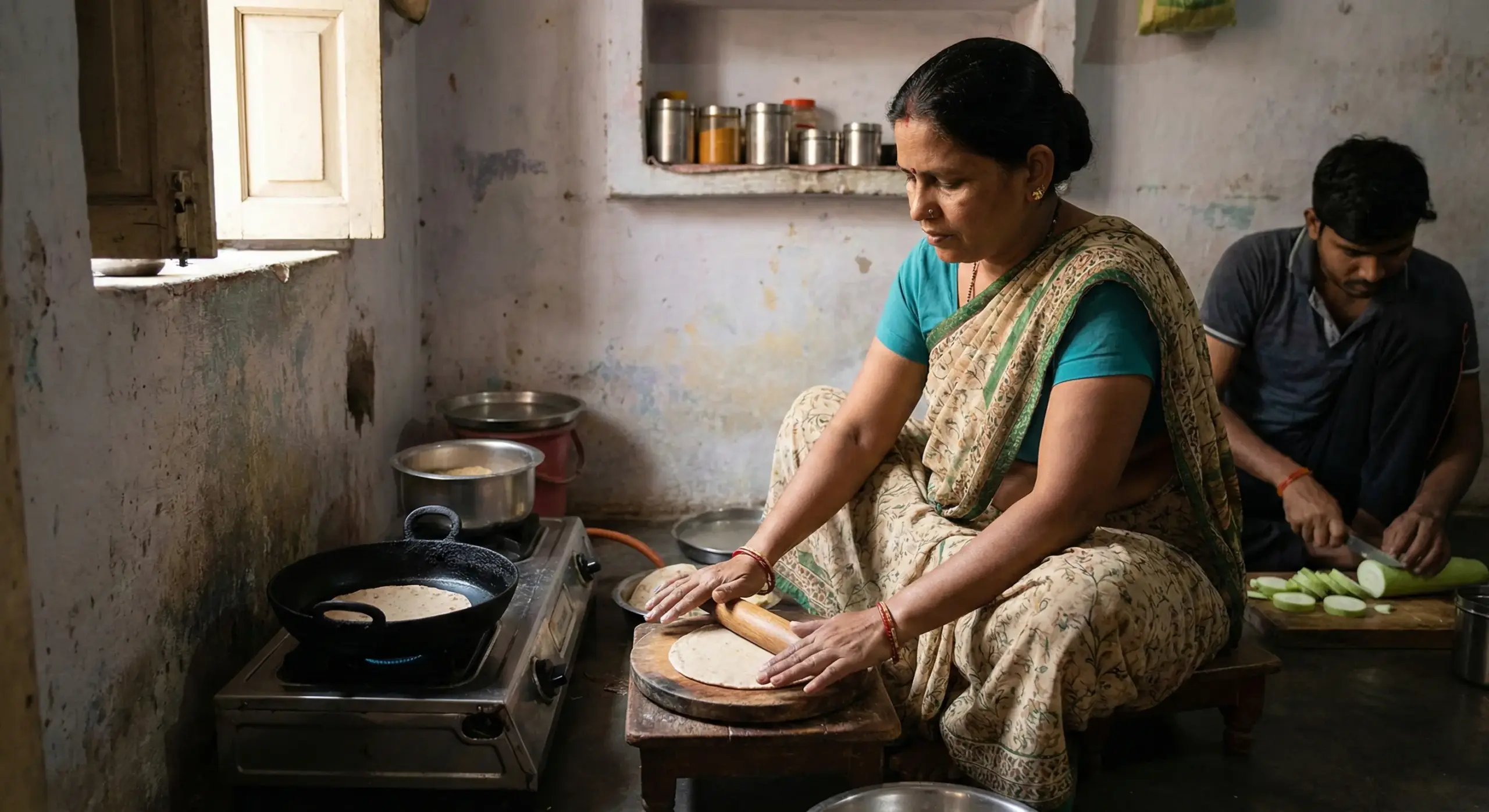
There is a practical side too. Before refrigerators, dinner was cooked fresh on the chulha (clay or brick stove) and finished before it got late, because lamps and fuel were limited. A short, quick meal fit that rhythm well.
Phulka, the thin roti
The staple at dinner is the phulka, a thin wheat roti that is cooked on the tawa and then held over open flame until it puffs. It carries less oil than a paratha or puri, since it is usually served with a smear of ghee on top and nothing more. In many homes the roti is made fresh for each person and passed straight from the stove to the plate, which is a point of pride.
Moong dal
If one dish defines the Banaras dinner, it is moong dal. Split yellow moong is considered the lightest of the dals in traditional thinking, and it cooks quickly. The usual tempering is ghee with cumin, hing and a pinch of turmeric, and in a satvik household there is no onion or garlic in it. A squeeze of lemon sometimes goes in at the end.
One seasonal sabzi
Dinner usually carries one vegetable, not three, and it follows the season:
| Season | Typical evening vegetables |
|---|---|
| Summer | Lauki (bottle gourd), turai (ridge gourd), parwal (pointed gourd) |
| Monsoon | Dry-cooked vegetables, tinda, bhindi in small quantities |
| Winter | Nimona (a green pea preparation) with wadi, cauliflower, carrot, radish |
Nimona is the winter classic of eastern Uttar Pradesh and Varanasi. It is a thick, mild curry of mashed or coarsely ground fresh green peas, usually cooked in mustard oil or ghee, often with potatoes and sometimes with urad dal wadi (small sun-dried lentil dumplings). Recipes insist on fresh peas, since the dish depends on the sweetness of winter peas, and the Varanasi version in particular is made with very few spices, with hing as the signature. Some traditional kitchens leave out onion and garlic entirely.
A small portion of rice, if any
Where rice is served, it is plain and steamed, with a bit of ghee. Khichdi is the common option on rainy or tired evenings, because it is warm, soft and easy to digest.
Pickle and curd
A spoonful of pickle sits at the edge of the plate, and curd is common in summer. Pickle at dinner is a small, sharp accent. It is there to wake up a plain meal, not to carry it. See the role of pickles in the Banaras thali for how it fits across the day.
Floor seating
Traditional homes seat the family on the floor on an asan (a small mat) or a low wooden chowki, with the food in front of them on a thali or a leaf plate. The posture is cross-legged, and some families say it helps digestion because it is a half-folded, upright seat. This is a custom, not a proven benefit, and many modern homes now use a table.
The order of service
In a joint family, service follows an order of respect. The senior men and children are traditionally served first, and women often serve and eat last. Before anyone eats, a portion of the food may be set aside, in a practice called agrasan, as the first offering. Another custom, chauka, refers to the purified cooking and eating space, which is cleaned before cooking begins. In stricter households, the cook bathes before entering the chauka and nobody else touches the food while it is being cooked. These customs vary enormously by caste, sect and family, so treat the description as an outline, not a rulebook.
The pace
Food is eaten slowly and quietly, with little conversation. The older instruction is to stop before you feel completely full.
After dinner: milk, saunf and paan
The last step in a traditional evening is a glass of warm milk, often sweetened lightly with sugar or mishri (rock sugar candy) and sometimes flavoured with saffron or cardamom. The milk is a link to Banaras’ pastoral communities, who have supplied the city with milk, curd and ghee for generations.
Many families then take a spoon of saunf (fennel seed) with mishri for freshness and digestion, and some end the meal with a meetha paan, the sweet, betel-leaf version that suits the city’s love of the form. These practices are traditional and cultural, and nothing here is a health recommendation.
Fasting nights: Ekadashi and Navratri
On fast days, dinner changes. Ekadashi, Navratri and some Mondays call for phalahar, food permitted during a fast. Typical items are kuttu (buckwheat) or singhara (water chestnut) flour puri, potato sabzi cooked with sendha namak (rock salt), sabudana khichdi, curd and fruit. Grains and ordinary salt are set aside, and the kitchen runs on separate utensils where possible.
How this differs from a restaurant dinner
A thali at a restaurant tends to carry more dishes, more oil and more spice than a family dinner. The home plate is shorter and quieter. If you are trying to recreate a Banaras evening meal, simplicity is the point: two or three items, well made, with a spoon of pickle for lift.
A simple home version
If you want to try the pattern at home, a workable evening plate looks like this:
- Phulka, made fresh, with a little ghee
- Moong dal tempered with ghee, cumin and hing
- A seasonal sabzi, lightly spiced
- A spoon of pickle
- Warm milk and a pinch of saunf to finish
Keep the portions small and eat early.
Frequently asked questions
What do people in Banaras eat for dinner?
A traditional dinner is phulka with moong dal and one seasonal vegetable, sometimes with a small portion of rice, curd and a spoon of pickle.
Why is dinner light in Banaras homes?
Traditional belief holds that digestion is strongest at midday and weaker at night, so the heavy meal is placed at lunch. This is a household and Ayurvedic idea and not medical advice.
Is rice avoided at night?
Many families hold a folk belief against rice at night, though practice differs. Where rice is served, it is plain, or in the form of khichdi.
What is nimona?
A winter curry of fresh green peas from eastern Uttar Pradesh and Varanasi, usually cooked with very few spices, sometimes with potatoes or urad dal wadi.
Why do families sit on the floor?
It is the traditional posture for eating, tied to the idea of the cleaned eating space and the shared meal. Many modern homes now use tables.
What is agrasan?
The custom of setting aside the first portion of the food before the family eats.
What is eaten on Ekadashi evenings?
Phalahar: kuttu or singhara puri, sabudana, potato cooked with rock salt, fruit and milk.
Sources used for this post: nimona and Varanasi winter cooking from Zee Zest, Slurrp, the Tribune (Pushpesh Pant) and Boldsky; Banaras satvik cooking context from Lonely Planet and other Varanasi food coverage.