Blog
Home Food Culture of Old Kashi

Civilizational Continuity and Ritual Gastronomy
The city of Kashi, known contemporaneously as Varanasi or Banaras, occupies a singular position in the cultural geography of the Indian subcontinent. It is often described as one of the oldest continuously inhabited cities in the world, a claim supported by archaeological strata and a vast corpus of Sanskrit literature. However, the significance of Kashi extends beyond its longevity; it represents a living museum of Vedic and Puranic traditions. Central to this continuity is the domestic sphere specifically, the home food culture of Old Kashi. This culinary landscape is not merely a collection of recipes but a sophisticated system of ritual discipline, seasonal awareness and a philosophy of simplicity that has survived centuries of socio-political transformation.
The Philosophical Foundation: Annapurna and the Sanctity of Sustenance
In the cultural consciousness of Kashi, the act of eating is inextricably linked to the goddess Annapurna, the deity of nourishment. According to regional Puranic narratives, particularly those found in the Kashi Khanda of the Skanda Purana, Shiva himself sought alms from Annapurna to sustain the world. This narrative establishes a foundational ethos: food is a divine gift and its preparation is a form of yajna (sacrifice).
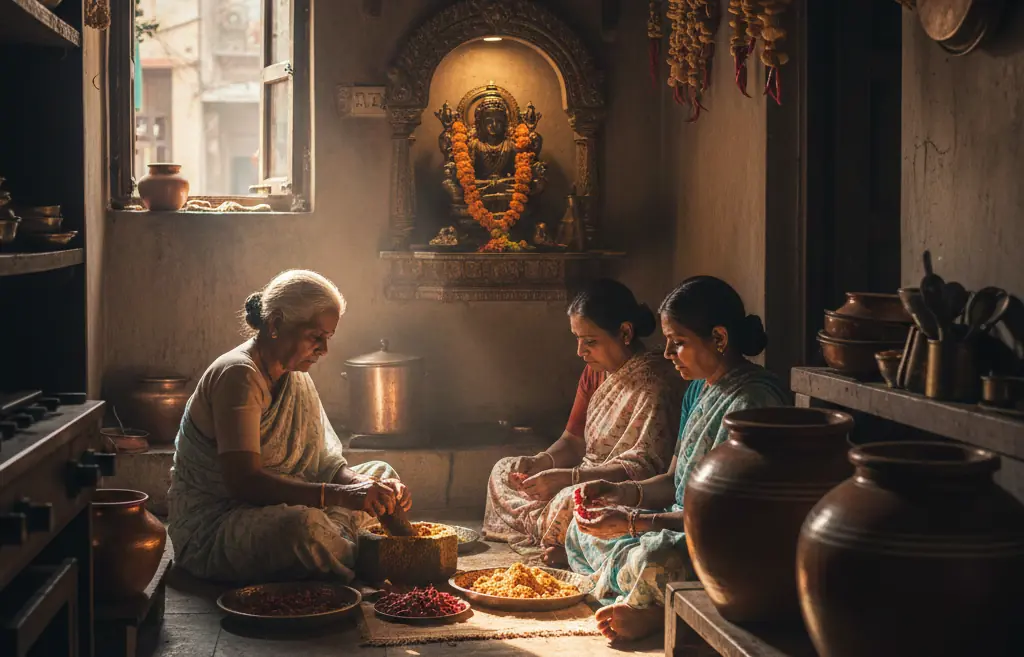
The home kitchen in a traditional Kashi household often referred to as the chauka is treated as a consecrated space. Access is traditionally restricted to maintain shuddhi (ritual purity). This emphasis on purity is not merely hygienic but metaphysical, based on the belief that the bhava (intent) of the cook is infused into the meal. Historically, the practice of Sattvic dining focusing on foods that promote clarity and equanimity has defined the upper-caste and scholarly households of the city, though these principles permeated through various social strata over time.
The Rhythms of the Chauka: Daily Cycles and Seasonal Logic
The culinary day in Old Kashi traditionally aligns with the solar cycle. The morning often begins with simple refreshments, but the primary meal is consumed in the late morning, following the performance of Sandhyavandanam or domestic deity worship.
The Midday Meal
The standard domestic meal in Kashi is characterized by a “trinity” of grains, legumes and seasonal vegetables. A typical plate includes:
- Bhat (Rice): Long-grain or medium-grain varieties, often sourced from the fertile plains of the Gangetic belt.
- Dal (Lentils): Arhar (pigeon pea) is the most common, typically tempered with cumin and asafoetida.
- Tarkari (Vegetables): Prepared without onion or garlic in strictly traditional households, relying instead on ginger, green chilies and regional spices.
The Principle of Simplicity
Unlike the elaborate “Royal” cuisines of Awadh or the Mughal courts, the home food of Kashi prides itself on a lack of ostentation. The complexity lies in the subtle balance of spices rather than the richness of fats. The use of mustard oil (sarson ka tel) provides a pungent base for many dishes, reflecting the agricultural output of the surrounding rural districts like Jaunpur and Mirzapur.
Preservation as a Cultural Practice
In a city defined by the extreme seasonal shifts of the North Indian plains blistering summers and damp monsoons the art of preservation became a necessity that evolved into a high craft. This is most evident in the tradition of pickling and the creation of sun-dried lentil preserves.
The Tradition of Achar (Pickles)
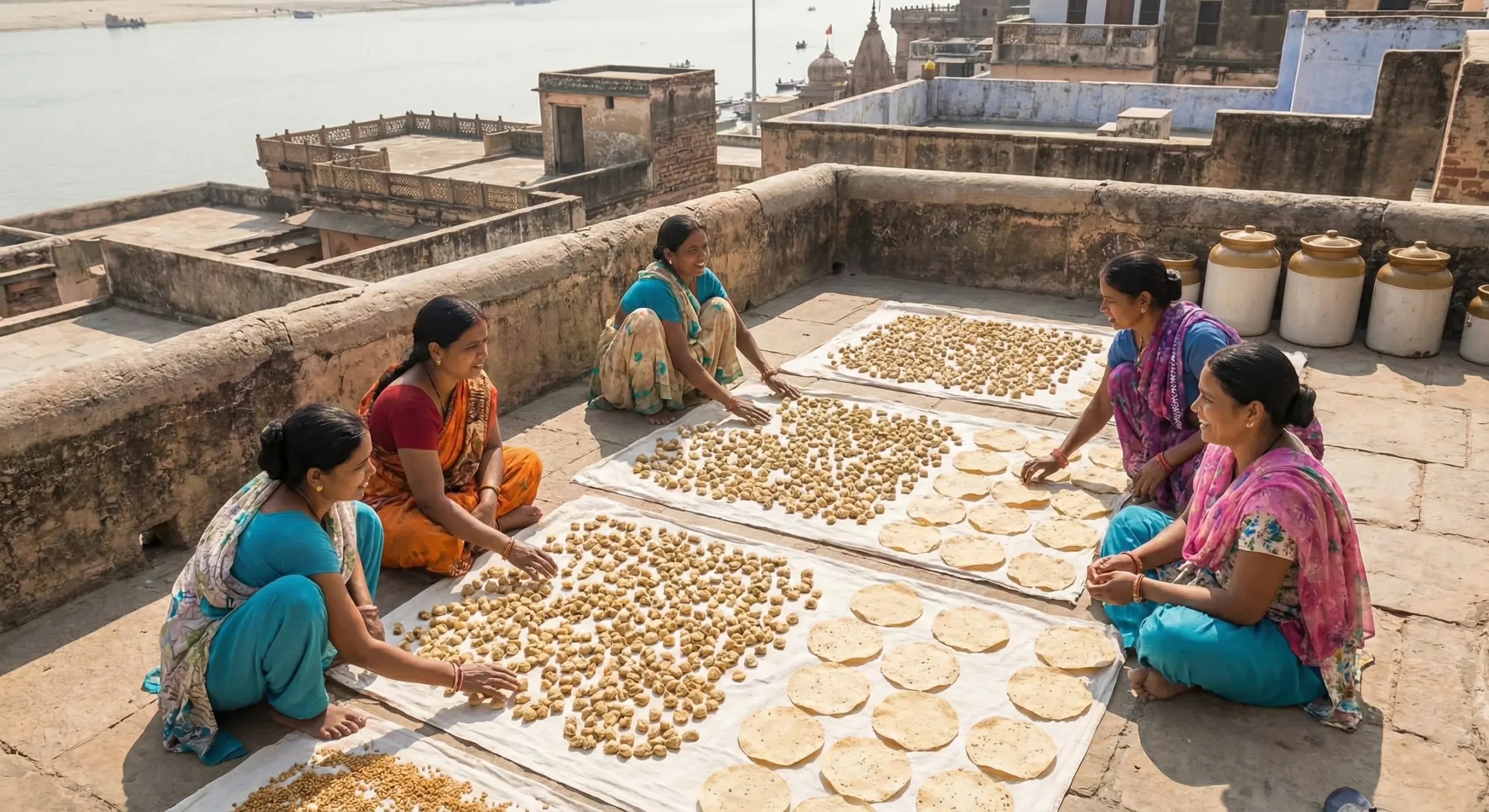
The domestic production of achar in Kashi is a communal activity, usually led by the matriarchs of the household. The process is governed by strict lunar and solar observations. Mango, lime and chilies are the primary bases, but Kashi is particularly noted for its use of the red “thick” chili, which is stuffed with a complex blend of dry-roasted spices including fennel, nigella seeds and mustard. These pickles are matured in ceramic jars (martabaan) placed on rooftops to catch the intense summer sun.
Vadi and Papar
The drying of Vadi (lentil nuggets) also pronounsed as Badi and Papad (flatbreads) represents the household’s preparation for the lean months. Kohrauri, a specific type of Badi made from grated ash gourd and urad dal, is a staple. These items are deep-seated in the oral histories of the city, often mentioned in folk songs as symbols of a well-provisioned home.
The Ghats and the Street-Home Continuum
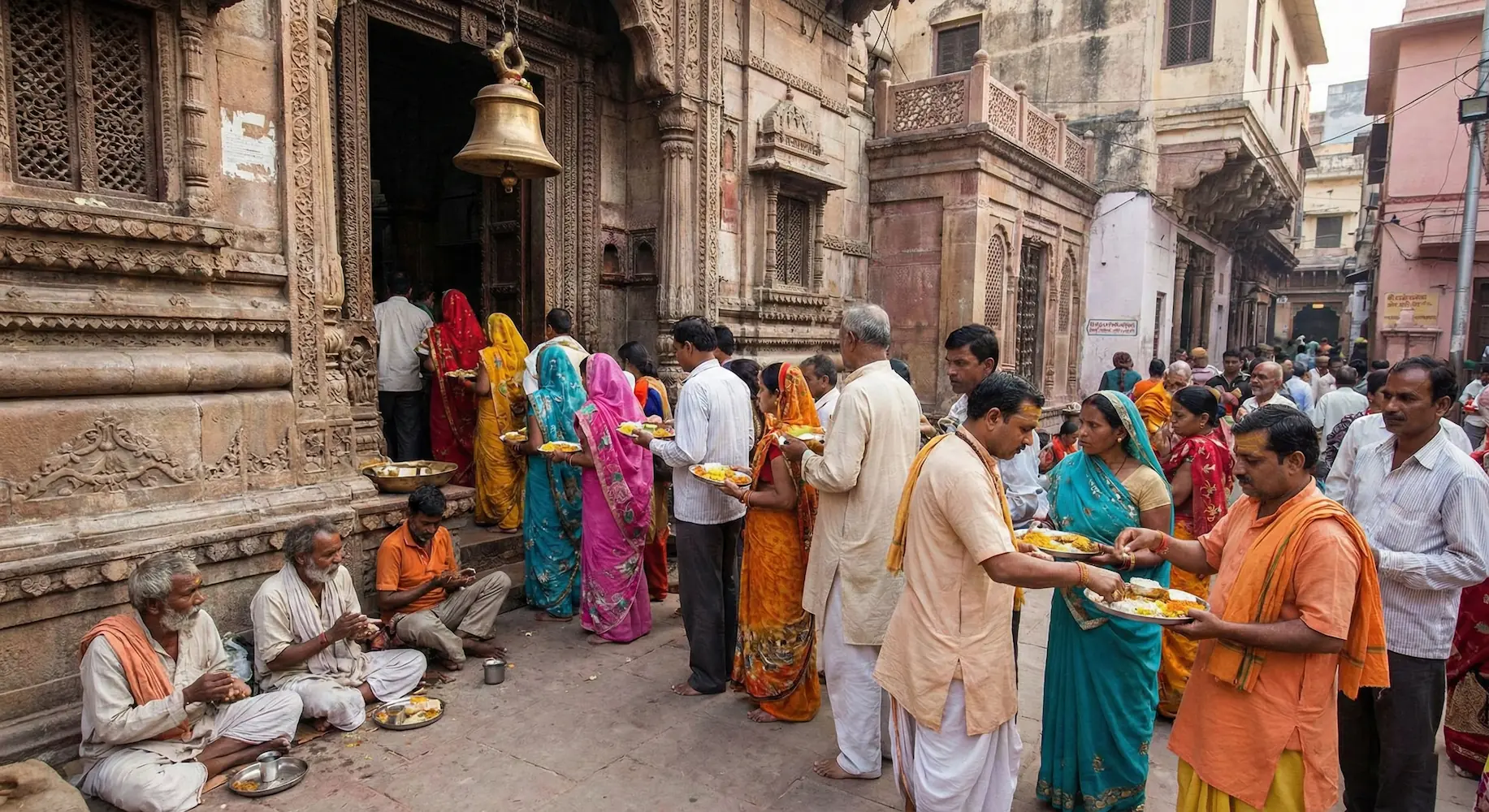
While this article focuses on the domestic sphere, the boundary between the “home” and the “street” in Old Kashi is porous. Many residents consume their morning Kaleva (breakfast) from the neighborhood halwai (confectioner), yet the preparation methods of these street vendors often mirror domestic standards of purity.
- Kachori and Sabzi: This is the quintessential morning meal. The Kachori is typically stuffed with a spiced lentil paste (pithi). The accompanying vegetable curry is often a watery potato base, heavily seasoned with black pepper and ginger, avoiding the heavy creams found in other North Indian regions.
- Jalebi: Traditionally fried in desi ghee, the jalebi serves as the sweet conclusion to the savory breakfast, a balance of flavors consistent with Ayurvedic dietary recommendations.
Ritual Discipline and Dietary Restrictions
The food culture of Kashi is deeply influenced by the Dharmashastras, which prescribe what may be eaten, by whom and when. The city follows a rigorous calendar of fasts (vrat) and festivals.
Vrat Ka Khana (Fast-Day Foods)
On days dedicated to specific deities or lunar phases (such as Ekadashi), the consumption of grains is prohibited. This led to the development of a distinct sub-cuisine using “pseudo-grains” and tubers:
- Sabudana (Tapioca pearls): Prepared as a savory pilaf.
- Kuttu and Singhara (Buckwheat and Water Chestnut flour): Used to make flatbreads.
- Sendha Namak (Himalayan Pink Salt): Substituted for common sea salt to maintain ritual purity.
The reliance on these ingredients demonstrates the adaptability of the Kashi household, ensuring that even during periods of restriction, the nutritional needs of the family are met with culinary ingenuity.
Key Concepts in Kashi Gastronomy
| Term | Definition | Role in Culture |
| Phalahar | Diet consisting of fruits and tubers | Essential for ritual fasting days |
| Satvik | Pure, clean, and balanced food | Promotes the mental clarity required for scholarly life |
| Kulhad | Unglazed earthen cup | Used for tea or lassi; represents the connection to the earth |
| Panchamrit | A mixture of five sacred liquids | Used in rituals and later consumed as a sanctified offering |
The Significance of the Ganga in the Kitchen
The River Ganga is not merely a geographic feature; it is the vital artery of the city’s food system. Historically, the water used for cooking in households near the riverbanks was drawn directly from the Ganga, believed to possess unique digestive properties. While modern filtration has altered this practice, the conceptual link remains. The silt brought by the river’s annual flooding ensures that the vegetables grown in the Diara (riverbed) lands such as various gourds, spinach and radishes are exceptionally nutrient-rich, forming the backbone of the local diet.
Historical Accounts and Scholarly Perspectives
Travelers throughout history have remarked upon the dietary habits of Banaras. The 17th-century French traveler François Bernier noted the simplicity of the diet among the “Pandits” of the city, observing their avoidance of meat and their focus on dairy and grains. Similarly, British administrators in the 19th century documented the massive imports of ghee and sugar into the city, highlighting the importance of dairy in the local economy and diet.
The sociological structure of Old Kashi, characterized by the Galies (narrow lanes), fostered a unique “neighborhood kitchen” culture. Because houses were built so closely together, the aroma of tempering spices (tadka) would drift from one home to another, creating a shared sensory experience that reinforced community bonds.
The Liquid Culture: Thandai and Lassi
In the scorching heat of the plains, hydration in Kashi became an art form. The domestic preparation of Thandai a chilled milk drink infused with a paste of almonds, fennel seeds, melon seeds, rose petals and black pepper is a hallmark of the city’s hospitality.
While Thandai is often associated with the festival of Mahashivratri, it is a regular feature of many households during the summer months. It serves a dual purpose: providing cooling relief and acting as a digestive aid. Similarly, the Lassi of Kashi, served in earthen cups (kulhads), is characterized by its thickness and the layer of malai (clotted cream) on top, reflecting the high value placed on bovine wealth in the region.
Civilizational Continuity through the Kitchen
The home food culture of Old Kashi serves as a primary vehicle for the transmission of heritage. When a mother teaches her daughter or daughter-in-law the specific ratio of spices for a Kashiphal (pumpkin) curry, she is not just passing on a recipe; she is transmitting a lineage of sensory knowledge that dates back centuries.
This culture is defined by its resistance to homogenization. In an era where globalized food trends dominate, the traditional households of Kashi remain anchored in their seasonal rhythms. The insistence on eating what is grown locally, preparing it according to ancestral mandates of purity and consuming it with a sense of gratitude to the divine, ensures that the civilization of Kashi remains vibrant and unbroken.
The Enduring Chauka
In summary, the home food culture of Old Kashi is a complex tapestry woven from threads of theology, geography and ancient science. It prioritizes the internal over the external the purity of the ingredient and the intent of the cook over the visual spectacle of the dish. It is a culture that finds depth in the mundane acts of grinding spices, sun-drying lentils and boiling milk. By maintaining these “slow” traditions, the residents of Kashi preserve a piece of human history that values the sacredness of life and the profound connection between the earth, the kitchen and the human spirit.