
Blog
Banaras vs Awadhi Cuisine

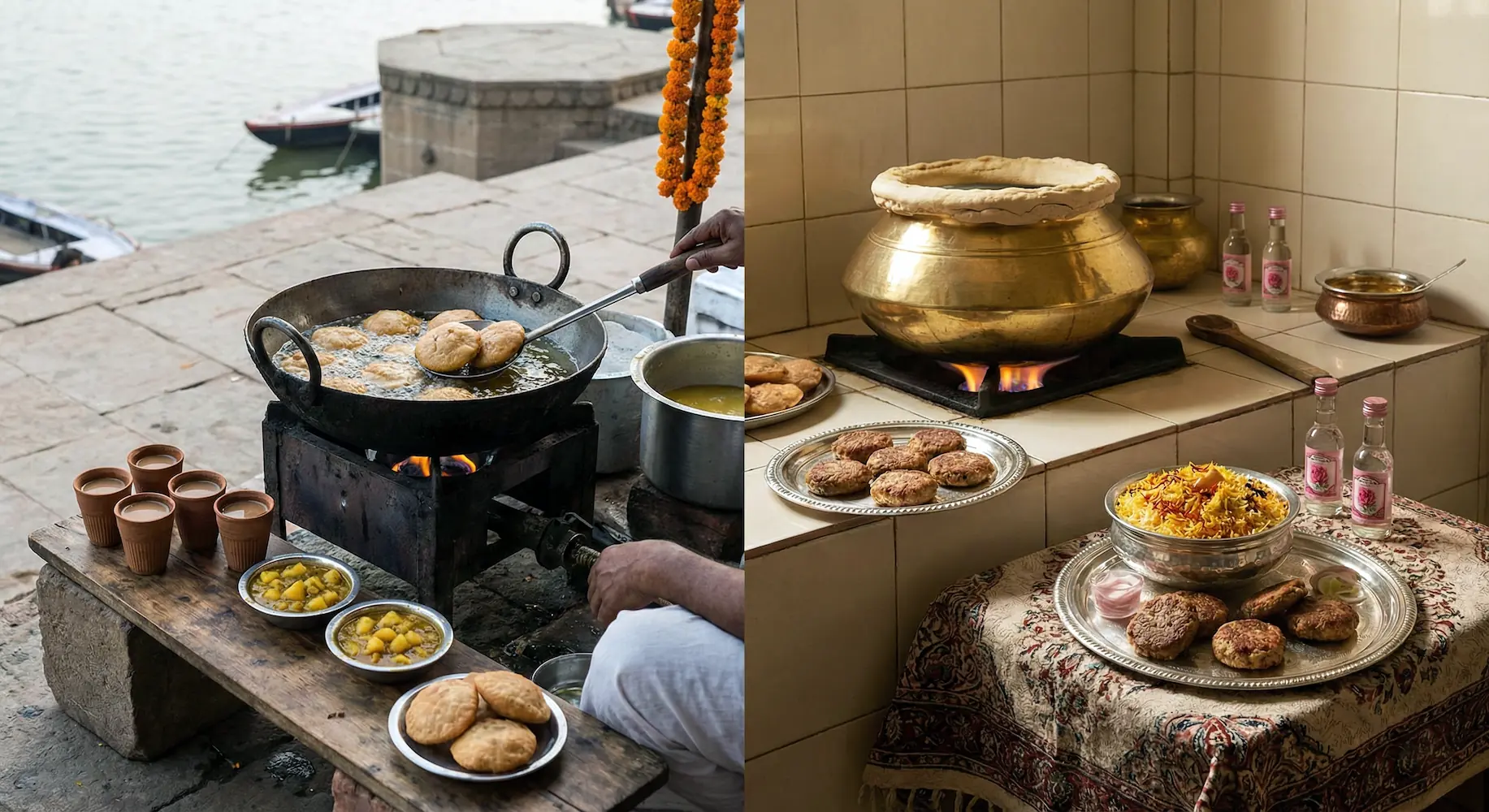
Civilizational Palates of the Gangetic Plain – Banaras vs Awadhi Cuisine Traditions
The Indo-Gangetic plain, specifically the eastern expanse of modern-day Uttar Pradesh, has historically served as a fertile crucible for Indian civilization. Within this region lie two cities, separated by less than 350 kilometers yet distinguished by millennia of divergent cultural evolution: Varanasi (historically Kashi or Banaras) and Lucknow (the capital of the Awadh region). While both cities draw sustenance from the same river systems and agricultural hinterlands, their culinary identities represent fundamentally different philosophical approaches to food.
Banaras, one of the world’s oldest continuously inhabited cities, offers a cuisine deeply rooted in antiquity, spiritual ritual and the seasonal rhythms of the Hindu agrarian calendar. In contrast, Awadhi cuisine, centered in Lucknow, is a relatively modern phenomenon in the scope of Indian history, born from the sophisticated, syncretic court culture of the Persian-influenced Nawabs in the 18th and 19th centuries. The distinction between the two is not merely a matter of ingredients, but of intent: Banaras eats to sustain the spirit and honor the divine, while Awadh eats to celebrate the refined art of living and the delicate pleasures of the senses.
Historical and Cultural Genesis
The culinary divergence begins with the foundational ethos of each city. Banaras is the quintessential spiritual center, the abode of Shiva and a destination for liberation (Moksha). Consequently, its food culture is heavily influenced by the presence of temple communities, pilgrims and ascetic orders. The concept of Bhog (food offering to deities) and Prasad (sanctified food distributed to devotees) dictates a strict adherence to purity.
Historically, the influx of widows to Kashi, who were traditionally barred from using “heating” ingredients like onions and garlic, spurred a unique culinary innovation. To compensate for the lack of alliums, Banaras cooks mastered the use of Hing (asafoetida), ginger and fennel to create depth of flavor. This resulted in a Satvik (pure/saintsly) cuisine that is robust rather than bland, relying on the intrinsic flavors of vegetables and dairy.
Awadh, conversely, emerged as a seat of power during the fragmentation of the Mughal Empire. The Nawabs of Awadh, particularly Asaf-ud-Daula and Wajid Ali Shah, were patrons of the arts, including the culinary arts. The kitchen (Bawarchikhana) was treated as an extension of the court. The cuisine here is a product of the Ganga-Jamuni Tehzeeb, a poetic phrase denoting the cultural fusion of Hindu and Muslim traditions. Awadhi food is not “home cooking” in its origin; it is specialist cooking, developed by hereditary chefs (Rakabdars) who were often salaried high-ranking officials.
Philosophical Framework: Simplicity vs. Sophistication
The philosophy of eating in Banaras is often tied to the concept of Subah-e-Banaras (the Morning of Banaras). The day begins early with prayers and a caloric, predominantly vegetarian breakfast designed to sustain one through a day of labor or worship. The approach is elemental. A potato is recognized as a potato; its texture is preserved and its flavor is heightened by mustard oil and cumin. The aesthetic is one of rustic honesty.
In Lucknow, the philosophy is characterized by Nazakat (delicacy) and Nafasat (refinement). The Awadhi cook aims to transmute the ingredient. A legendary, perhaps apocryphal, narrative suggests that the toothless Nawab Asaf-ud-Daula required meat dishes that required no chewing, leading to the invention of the Galouti Kebab, a patty so finely minced and tenderized that it melts on the tongue. Here, the visible texture of the ingredient is often surrendered to the overall sensation. The food is designed to surprise and illusion; a dish might look like bread but taste like meat, or appear as a savory course while being a sweet.
The Science of Spices and Aromatics
The olfactory profiles of the two cuisines are starkly distinct.
| Feature | Banaras (Varanasi) Cuisine | Awadhi (Lucknow) Cuisine |
| Primary Influence | Ancient Hindu / Temple / Rural | Medieval Persian / Mughal / Royal Court |
| Philosophical Goal | Purity (Satvik), Energy, Sustenance | Refinement (Nazakat), Pleasure, Illusion |
| Key Cooking Method | Frying (Ghee), Roasting (Open Fire), Boiling | Dum Pukht (Slow oven cooking), Gile Hikmat |
| Dominant Fat | Mustard Oil (Savory), Desi Ghee (Sweets/Fried) | Desi Ghee, Animal Fats |
| Aromatic Profile | Sharp, Pungent (Hing, Ginger, Chili) | Floral, Sweet, Warm (Saffron, Rose, Mace) |
| Texture | Rustic, discernible ingredients | Melt-in-mouth, homogenized textures |
| Onion/Garlic | Historically avoided in traditional dishes | Essential base for curries and stews |
The Banaras Flavor Profile
Banaras relies on the sharp, high notes of fresh spices. Green chilies, coriander leaves, ginger and the pungency of mustard oil define the palate. The “chaat” culture of Banaras savory roadside snacks exemplifies this. The distinct sourness often comes from Amchur (dried mango powder) or tamarind, balancing the heat of black pepper and chili.
A critical distinction is the use of Hing (asafoetida). In the absence of onions and garlic in traditional Brahmin and widow households, high-quality Hing became the base aromatic, providing a savory, umami-like depth that anchors the lighter vegetable curries.
The Awadhi Flavor Profile
Awadhi cuisine is defined by subtlety and fragrance rather than heat. It utilizes a class of aromatics known as Potli Masala spice bundles that are steeped with the food but removed before serving, imparting essence without grit.
Key ingredients include:
- Floral Waters: Rose water (Gulab Jal) and Screw Pine water (Kewra) are used generously in biryanis and meat curries, blurring the line between savory and sweet.
- Sweet Spices: Star anise, mace (Javitri), nutmeg and cinnamon are preferred over the sharper cumin or coriander seeds.
- Saffron: Used extensively for color and its metallic, hay-like aroma, signaling luxury.
While Banaras hits the tongue with immediate contrasting flavors (sour/spicy), Awadhi cuisine builds a lingering, monochromatic richness on the palate.
Culinary Techniques
Dum Pukht (Awadh)
The hallmark of Awadhi cooking is the Dum Pukht technique (literally “to breathe and cook”). Food is sealed in a heavy-bottomed vessel (Handi) with dough, trapping steam and aromas. The vessel is placed over a very slow fire, often with coals on the lid to provide heat from both directions. This allows meats to cook in their own juices, softening connective tissues without drying out the fibers. It is a technique of patience, rooted in the famine-relief projects of the 18th century where massive cauldrons of stew were kept simmering day and night.
Bhuna and Kadhai (Banaras)
Banaras cooking is often faster and more open. The Kadhai (iron wok) is central. Vegetables are stir-fried or roasted (Bhuna) to retain a bite. The famous Baati-Chokha, a rural staple adopted by the city, involves roasting wheat balls and eggplants directly over cow-dung cakes or charcoal. This imparts a smoky, earth-bound flavor that contrasts sharply with the perfumed elegance of Lucknow.
Another Banaras specialty is the art of deep-frying in Desi Ghee. The morning breakfast of Kachori (stuffed fried bread) and Jalebi is universally prepared in ghee, considered in Ayurveda to be a cooling fat and a carrier of nutrition, essential for the constitution of the city’s wrestlers and priests.
Meat and Vegetarianism
The divide between vegetarian and non-vegetarian is the most visible geographic marker between the two cuisines, though it is not absolute.
Banaras is overwhelmingly associated with vegetarianism due to its status as a pilgrimage site. The cuisine elevates the humble vegetable. Seasonal availability dictates the menu strictly; the winter arrival of Nimona (a spiced stew of fresh green peas) is a celebrated culinary event. Even the street food is aggressively vegetarian, utilizing dairy products yogurt, cream (Malai) and paneer to provide richness.
Awadh is famous for its meat dishes, particularly mutton (goat). The repertoire of Kebabs Seekh, Shami, Galouti, Kakori is exhaustive. However, Awadhi cuisine also possesses a sophisticated vegetarian tradition, largely developed to cater to the vegetarian court officials and financiers. The vegetarian dishes of Awadh, such as Kathal (jackfruit) biryani or Zimikand (yam) kebabs, mimic the texture and complexity of meat dishes, applying the same Dum techniques and royal spices to produce a vegetable dish of aristocratic stature.
Sweets and Confectionery
The dessert traditions of both cities reflect their primary ingredients: milk and sugar.
Banaras: The Pure Reduction
In Banaras, the sweet shop (Halwai) is an institution. The focus is on the manipulation of milk. By boiling milk for hours in large iron vats, cooks create Rabri (sweetened, condensed milk with layers of cream).
- Malaiyo: A winter-exclusive delicacy, this is a seasoned milk foam, light as air, created by churning milk exposed to the morning dew. It is seasoned with saffron and pistachios, vanishing instantly in the mouth.
Awadh: The Royal Confection
Awadhi desserts are often more processed and complex.
- Shahi Tukda: A bread pudding where slices of bread are fried in ghee, soaked in syrup and topped with rabri and nuts. It exemplifies the court’s ability to turn a staple (bread) into a luxury.
- Zarda: A sweet rice dish, colored brilliant yellow with saffron, often laden with candied fruits and nuts.
The Modern Legacy
Today, Banaras and Lucknow stand as custodians of these traditions. Banaras remains the preserver of ancient, unpretentious, community-based dining, where the “Kullhad” (earthen clay cup) is still the standard vessel for tea and lassi, grounding the consumer to the earth. Lucknow remains the preserver of the “Dastarkhwan” (the ceremonial dining spread), maintaining the etiquette and slow-cooking methods that defined the Nawabi era.
While modern transport and communication have blurred regional boundaries, the core identity of these cuisines remains distinct. One offers the flavors of the temple and the field, refined by devotion; the other offers the flavors of the palace and the garden, refined by art. Together, they represent the dual heritage of the region the sacred and the sovereign.