
Blog
Morning Food Habits of Banaras Households

A Cultural and Anthropological Examination
The ancient city of Banaras, also known historically as Kashi and presently as Varanasi, represents one of the longest continuously inhabited urban settlements in the world. Situated on the crescent-shaped banks of the Ganges River in the fertile Gangetic plains of northern India, the city operates not merely as a geographic location, but as a microcosm of traditional Hindu temporal and spiritual routines. Within this civilizational context, the morning food habits of Banarasi households offer a profound subject of study for cultural historians and food anthropologists.
The early morning culinary practices of Banaras are not driven solely by caloric requirement or modern conveniences. Instead, they function as a living archive of agrarian cycles, Ayurvedic principles and complex sociological systems. To understand what is consumed at dawn in a traditional Banarasi household is to understand a continuity of ritualistic living where the sacred geography of the river intersects with the domestic hearth.
The Ritual Dawn: Pre-Breakfast Observances
To comprehend the breakfast traditions of Banaras, one must first examine the temporal framework of the morning itself. The traditional day begins in the Brahma Muhurta, a period approximately one and a half hours before sunrise, considered highly auspicious in Vedic traditions.

The initial morning routine is defined by physical and spiritual purification rather than immediate sustenance. Historically and practically, this involves ablutions, often culminating in a bath in the Ganges for those residing near the ghats, or ritualized bathing within the household. Following this, daily prayers (sandhyavandanam) and offerings of water to the sun (Surya Arghya) are performed.
Consequently, the first intake of the day is rarely food in the conventional sense. It is typically a few drops of Ganges water (Gangajal) or a leaf of the holy basil (Tulsi), sometimes accompanied by charanamrit (a ritual offering made of yogurt, milk, honey, sugar and ghee). From an anthropological perspective, this practice bridges the physical transition from fasting during sleep to the consumption of food, setting a deeply spiritual tone for the digestive process. In Ayurvedic literature, the early morning is dominated by Vata and Kapha doshas and this period of fasting followed by light, spiritually charged liquids is believed to gently awaken the jatharagni (digestive fire) without overwhelming it.
Scriptural and Mythological Foundations of Nourishment
The culinary ethos of Banaras cannot be separated from its foundational mythologies and scriptural references. In classical texts such as the Skanda Purana, particularly within the Kashi Khanda, Kashi is definitively established as the sacred domain of Lord Shiva. However, the providence of sustenance within this territory is exclusively attributed to the Goddess Annapurna.
The mythology narrates that Shiva, representing the ascetic ideal, begged for alms from Annapurna, the personification of nourishment and domestic abundance, to demonstrate that even the divine must acknowledge the necessity of the material world and its sustenance. While this is a mythological narrative distinct from documented historical events, its cultural impact is absolute. It established a societal reverence for food (anna) not merely as fuel, but as a physical manifestation of divine grace. This reverence heavily influences the morning routine, where the preparation and consumption of the first meal are approached with a sense of duty and purity.
The Architecture of the Banarasi Breakfast: The Pucca Tradition
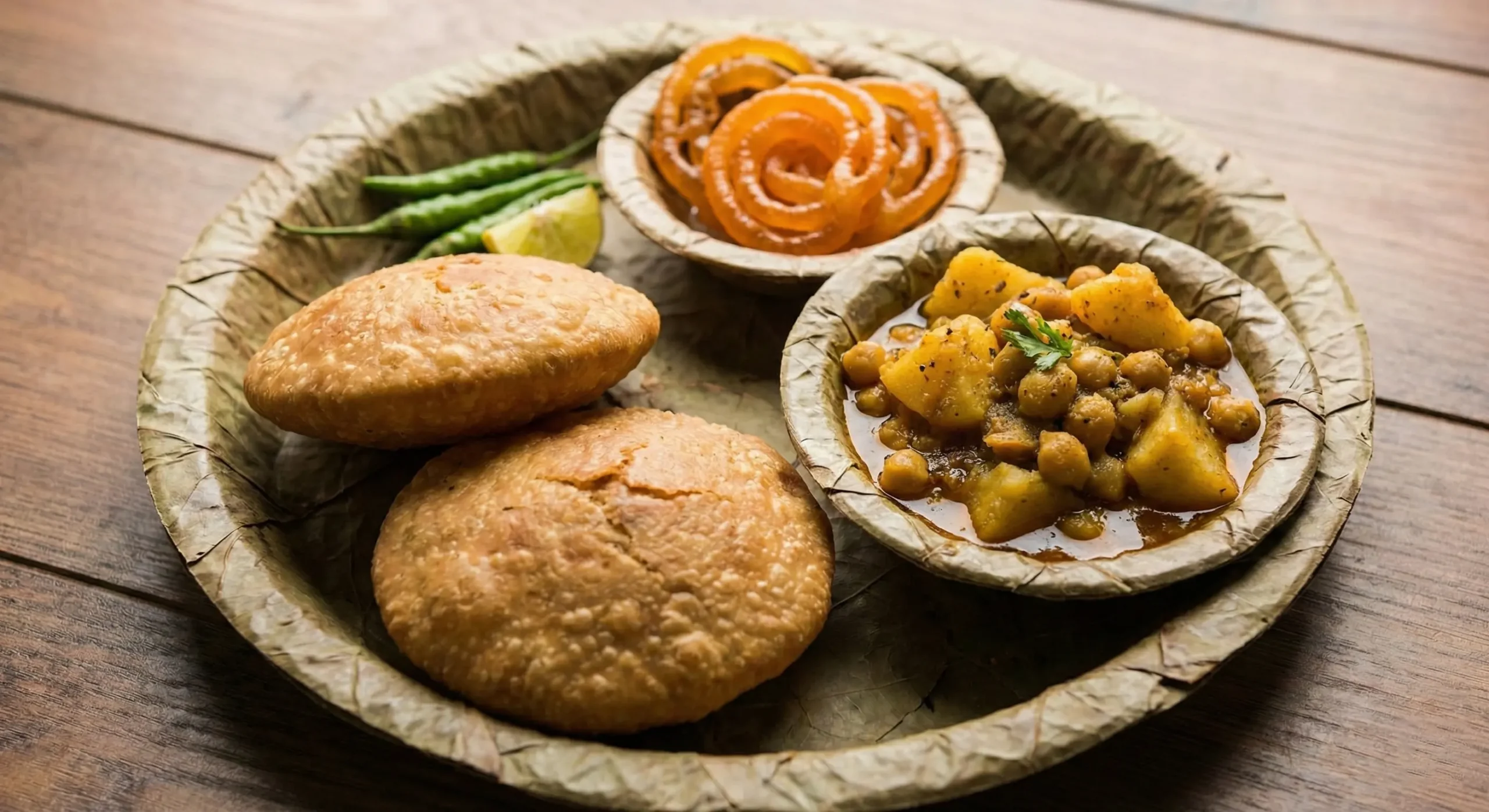
When common inquiries arise regarding the customary morning meal in Varanasi, the ubiquitous answer involves a specific combination of deep-fried breads, stews and sweets. The archetypal Banarasi morning meal consists of Kachori (stuffed, deep-fried wheat pastries), Sabzi (a spiced potato and chickpea stew) and Jalebi (a fermented, deep-fried batter soaked in sugar syrup).
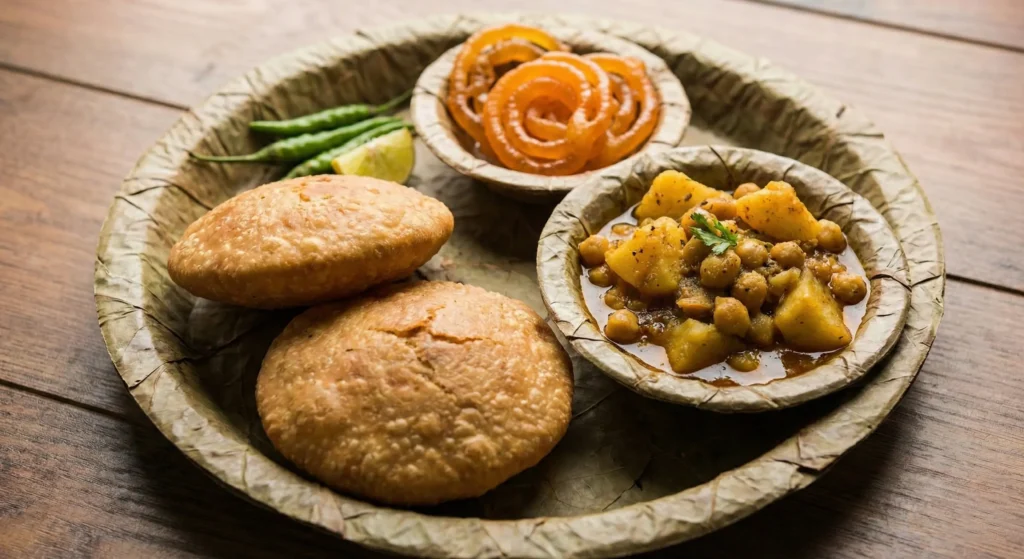
To the uninitiated observer, a breakfast consisting of deeply fried and heavily sweetened foods may appear contrary to modern nutritional paradigms. However, to understand this, one must examine the Hindu sociological concepts of Kachcha and Pucca foods.
- Kachcha Food: Food boiled in water (such as plain rice or everyday lentils). In traditional caste and ritual purity systems, water is considered highly susceptible to absorbing spiritual and physical pollution. Therefore, kachcha foods were historically subject to strict rules regarding who could cook them and where they could be consumed, usually confined to the inner sanctum of the domestic kitchen.
- Pucca Food: Food cooked in ghee (clarified butter) or oil, such as kachoris and puris. Ghee, being a product of the sacred cow, was believed to purify the food, making it impervious to ritual pollution.
Because the morning routine in Banaras involves venturing out for river bathing, temple visits and interacting with the wider public sphere, consuming pucca food became the practical standard. It allowed individuals to break their fast after their ritual ablutions without compromising their state of purity.
The Components of the Meal
The Kachori in Banaras is typically of two variations: the Badi (large) kachori stuffed with a spiced urad dal (black gram) paste and the Chhoti (small) kachori, which functions more like a puffed puri. The accompanying Sabzi is characteristically watery (rasey wale aloo), utilizing indigenous spices like asafoetida (hing), fenugreek and dry mango powder (amchur). These spices are documented in traditional Indian medicine systems for their carminative properties, strategically employed to aid the digestion of the heavy, deep-fried bread.
The inclusion of Jalebi serves a distinct purpose. The fermentation of the batter overnight begins the breakdown of complex carbohydrates, while the immediate infusion of sugar provides rapid caloric energy required for the physical labor or intensive studying (in the case of scholars and priests) that characterized traditional morning routines.
Dairy Economies and Pastoral Traditions
The Gangetic plain is supported by a robust agricultural and pastoral hinterland. Consequently, the morning food habits of Banaras are deeply intertwined with dairy consumption, historically managed by the regional Ahir and Yadav pastoralist communities.
The consumption of fresh, unpasteurized milk, boiled extensively in large iron woks (kadhais), is a staple morning practice. This milk is often consumed in earthen cups (kulhads), which impart an alkaline, mineral quality to the beverage. Additionally, fresh curd (dahi) is frequently consumed in the morning. Anthropologically, the reliance on dairy signifies the integration of surrounding rural pastoral economies with the dense urban religious center, ensuring a steady flow of high-protein, calorie-dense foods required to sustain the city’s populace.
Seasonal Rhythms: Ritucharya in Practice
A critical aspect of traditional Indian dietary practice is Ritucharya, the adherence to seasonal regimens outlined in Ayurvedic texts. The morning food habits of Banaras households undergo significant transformations based on the agricultural and climatic cycle.
Winter Observations
During the harsh winters of the Gangetic plain, the morning diet shifts to incorporate thermogenic ingredients.
- Chura Matar: A prominent winter breakfast consists of flattened rice (chura or poha) cooked with fresh winter peas (matar). Unlike the variations found in western India, the Banarasi version relies heavily on ghee, black pepper and sometimes milk or cream, omitting turmeric and onions. Black pepper is utilized for its heating properties.
- Makhan Malaiyo: A culturally significant, highly seasonal morning item is Malaiyo. Raw milk is boiled, flavored with saffron and cardamom and left exposed to the winter dew (os) overnight. In the morning, it is churned into a delicate froth. This practice demonstrates a remarkable, localized culinary technique utilizing atmospheric condensation, historically believed to infuse the dairy with cooling, celestial properties balancing the heavy winter diet.
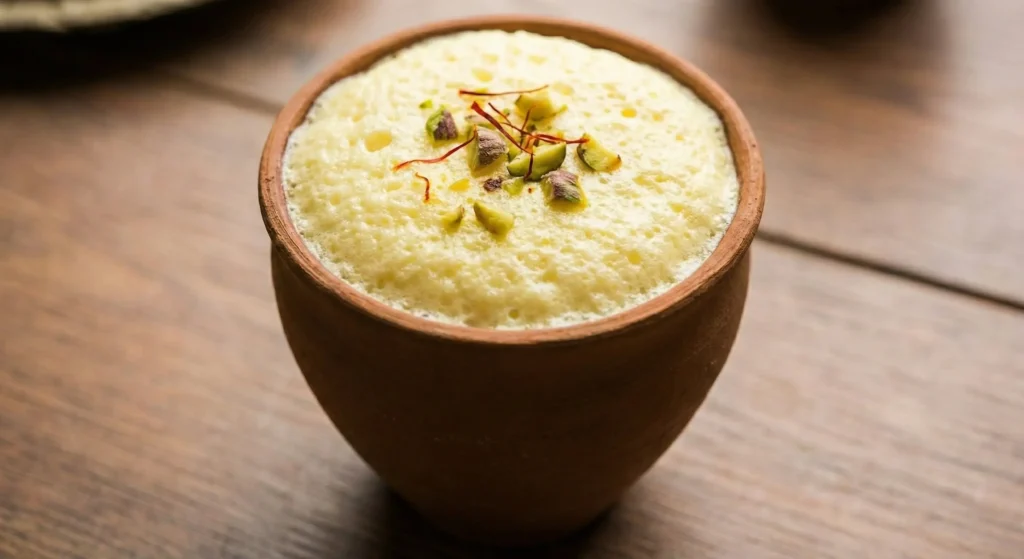
Malaiyyo – The Winter Morning Dessert of Varanasi
Summer and Monsoon Adjustments
As the intense summer heat sets in, the heavy pucca foods are frequently replaced or supplemented by Sattu a roasted gram flour. Mixed with chilled water, cumin and mint, Sattu provides instant hydration, protein and cooling properties (sheeta virya). It is historically documented as the sustenance of ascetics, travelers and agricultural laborers due to its non-perishable nature and nutritional density. During the monsoon, dietary codes dictate the avoidance of leafy greens and a reduction in heavy dairy, acknowledging the sluggish nature of human digestion during periods of high humidity.
The Blurring of Domestic Hearths and Public Alleys
A unique sociological phenomenon in Banaras is the reliance on the neighborhood halwai (traditional confectioner and cook) for the morning meal. In many traditional households, preparing the elaborate kachori-sabzi is labor and fuel-intensive. Thus, a symbiotic relationship exists where households procure their morning meals from the local artisan situated in the narrow alleys (galis) adjacent to their homes.
This practice is not categorized as “eating out” or dining at a restaurant in the contemporary commercial sense. Rather, the local halwai’s wok functions as an extension of the neighborhood’s collective domestic hearth. The artisans are known intimately by the families they serve, often catering to specific generational preferences regarding spice levels or frying times. This communal specialization allowed the women of the household to focus on interior ritual purifications and other domestic duties while ensuring the family received the culturally mandated pucca nourishment.
The morning food habits of Banaras are far more complex than a mere catalog of regional recipes. They represent a sophisticated, historically evolved system of nourishment that balances the agrarian realities of the Gangetic plain with the rigorous ritual demands of a sacred city. From the pre-dawn purification rites to the consumption of pucca foods designed for sustained energy and ritual integrity, the Banarasi breakfast is an active, daily participation in India’s broader civilizational heritage. It stands as a testament to how human populations historically organized their sustenance around their spiritual geography, seasonal realities and complex sociological structures.
