Blog
How Generations Preserve Food Traditions in Banaras

The Edible Archive of Kashi
Banaras, known variously as Varanasi or Kashi, is frequently cited as one of the oldest continuously inhabited cities in the world. While its architectural heritage the ghats, temples and labyrinthine galis (lanes) receives significant scholarly attention, the city’s culinary landscape functions as an equally vital, living archive of civilization. In Banaras, food is rarely a matter of mere biological necessity; it is a complex cultural expression intimately tied to ritual, seasonality, caste and philosophy.
The preservation of food traditions in this city does not rely on written cookbooks or codified culinary schools. Instead, it rests on a robust system of oral transmission, generational apprenticeship and a deep-seated reverence for the cyclical nature of time. To understand how Banaras eats is to understand how a civilization remembers. This article examines the mechanisms social, domestic and religious that have allowed specific tastes, techniques and food philosophies to survive centuries of political and social change, effectively freezing history on the plate.
The Sacred Geography: Annapurna and the Philosophy of Sustenance
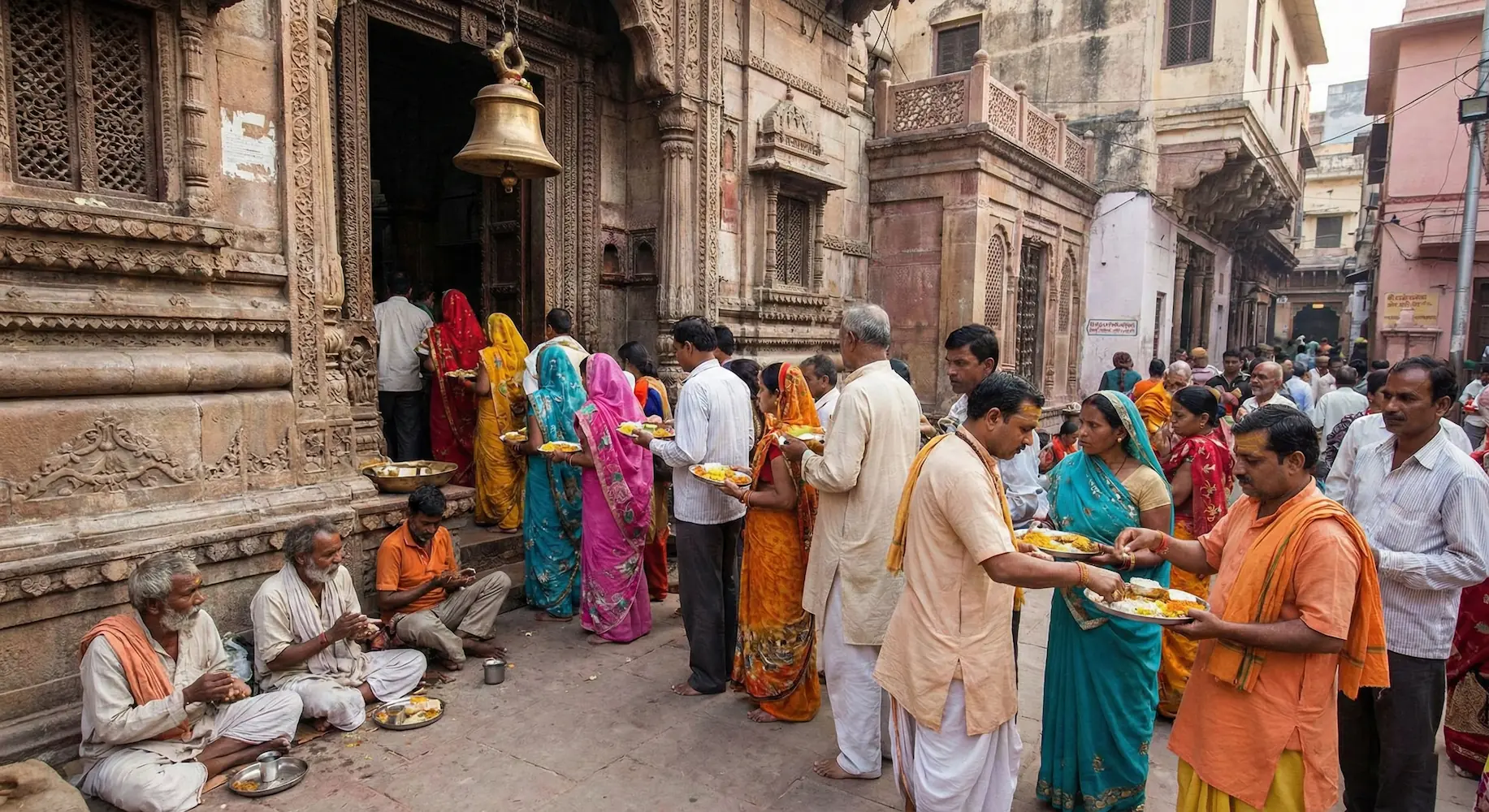
To comprehend the Banarasi approach to food, one must first locate it within the city’s spiritual geography. Kashi is traditionally regarded as the domain of Shiva, but in the context of sustenance, it is the city of Annapurna, the Goddess of Food and Nourishment. Scriptural references suggest that Shiva himself begs for alms from Annapurna to sustain the cosmos, establishing a theological hierarchy where food is sanctified.
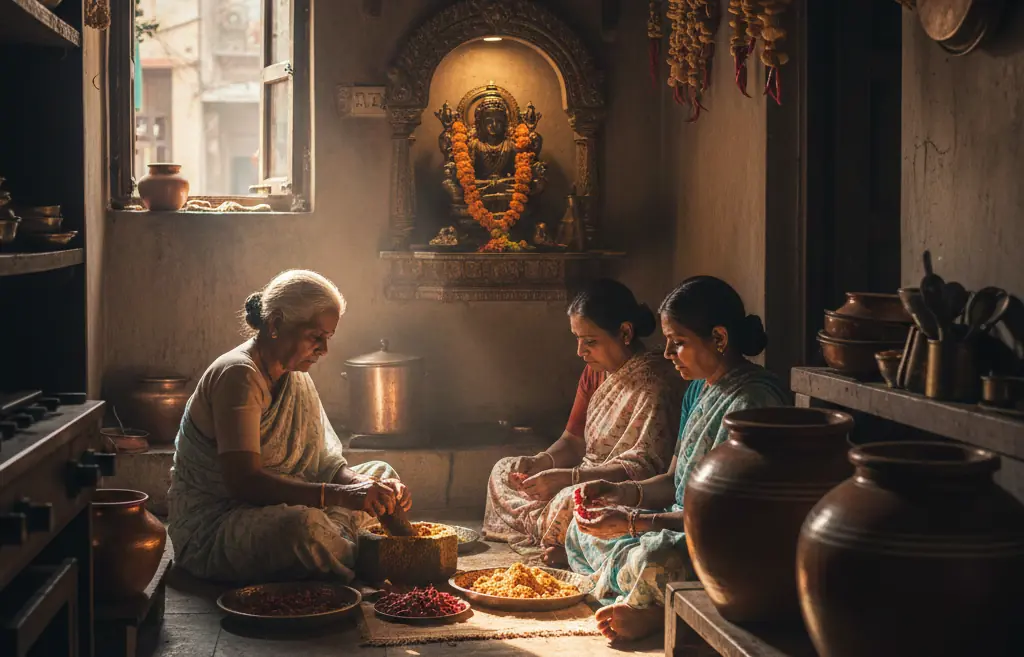
This mythological framework elevates cooking from a chore to a ritual. In traditional households, the kitchen (rasoi) is often treated with the same sanctity as the prayer room. The concept of prasad (sanctified offering) permeates daily eating habits. Food is first offered to the deity before it is consumed by the family, a practice that enforces strict standards of purity and preparation. This ritual requirement acts as a preservation mechanism; because the food is intended for the divine, recipes and methods cannot be easily altered or modernized without risking ritual impurity. Thus, the theology of the city acts as a conservative force, protecting traditional recipes from the dilution of convenience.
The Architecture of Transmission: The Joint Family and Oral Pedagogy
The primary vehicle for culinary continuity in Banaras has historically been the joint family system. Within these multi-generational households, culinary knowledge is transferred not through instruction manuals but through observation and sensory apprenticeship. This pedagogical method relies on andaz an intuitive estimation of quantity and timing that can only be mastered through repetition.
The transfer of knowledge typically occurs between the matriarch and the daughters-in-law. This dynamic is critical; a bride entering a traditional Banarasi home is inducted into the specific “food dialect” of that lineage. She learns the specific spice blends (masalas) unique to that family, the precise thickness of the roti and the seasonal pickling schedules.
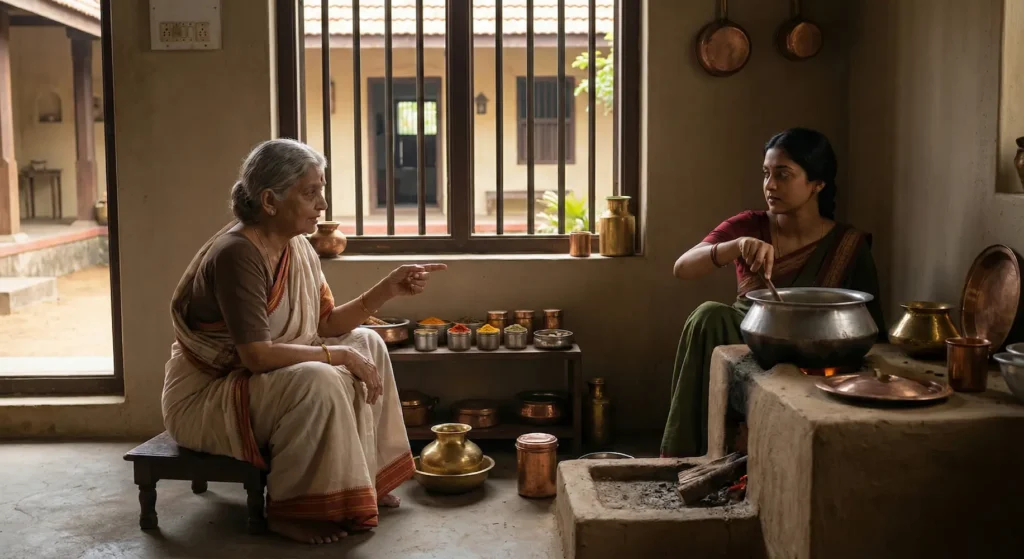
Elders play a crucial supervisory role. A grandmother may no longer cook the entire meal, but she often sits near the hearth, directing the process correcting the aroma of a tempering (tadka) or judging the consistency of a batter by sound and sight. This constant oversight ensures that the sensory benchmarks of the past are met in the present. The recipes are stored in the collective memory of the family, often accompanied by narratives about ancestors (“Grandfather liked the dal burnt with ghee in this specific way”), thereby linking food to family history.
The Guilds of Taste: Halwais and Street Food Lineages
Beyond the domestic sphere, the preservation of Banaras’s public cuisine lies with the Halwais (confectioners) and street food vendors. Unlike modern commercial establishments where staff turnover is high and recipes are standardized for efficiency, Banarasi food shops are often hereditary enterprises.
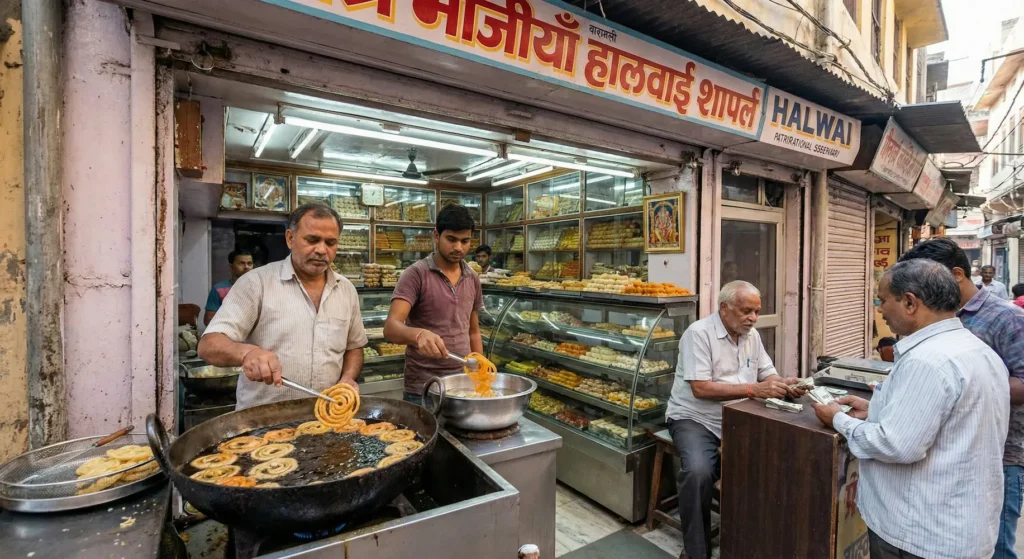
It is common to find establishments that have been in operation for four or five generations, often remaining in the same narrow lane. In these spaces, specialized skills such as the intricate twisting of jalebis or the precise reduction of milk for rabri are guarded trade secrets. The younger generation of the family is inducted into the business from a young age, performing menial tasks before being entrusted with the critical stages of preparation.
This guild-like structure ensures the survival of highly labor-intensive techniques that might otherwise be discarded by modern commerce. For example, the preparation of Malaiyyo a delicate, frothy milk dessert available only in winter requires a specific method of boiling milk, exposing it to morning dew and hand-churning it with saffron and cardamom. The viability of such a dish depends entirely on a generational workforce willing to adhere to a grueling, pre-dawn schedule established by their forefathers.
Seasonality and the Ayurvedic Calendar
The Banarasi menu is strictly governed by the seasons, a practice rooted in Ayurvedic principles of Ritucharya (seasonal regimen). The preservation of food traditions is, therefore, also the preservation of an ecological awareness.
- Winter (Shishir/Hemant): The diet shifts to heat-generating foods. This is the season of Malaiyyo, heavy ghee preparations and Chura Matar (flattened rice with green peas). The availability of fresh green peas in the Indo-Gangetic plain dictates the breakfast rituals of the city during these months.
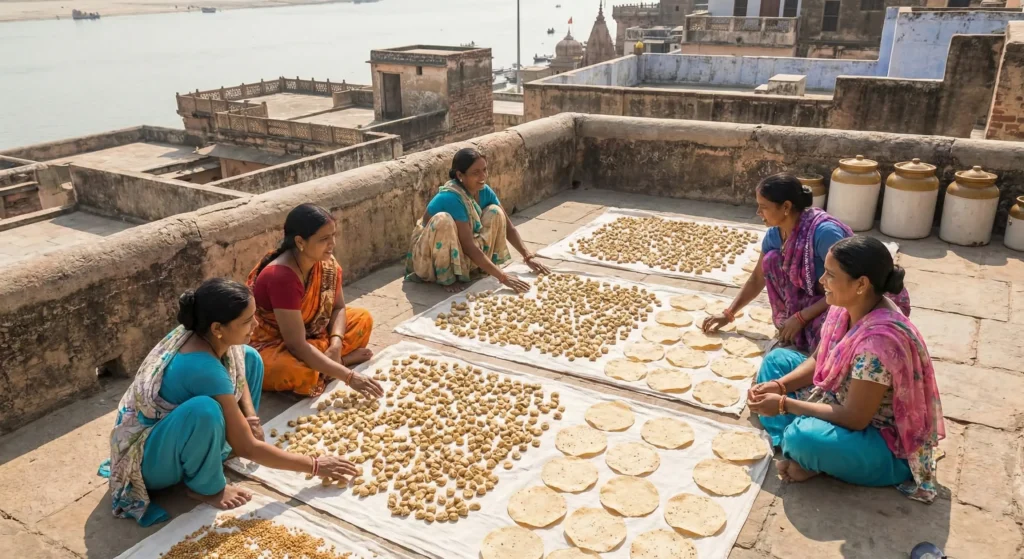
- Summer (Grishma): The diet pivots to cooling foods. Sattu (roasted gram flour) becomes a staple, consumed as a drink or a savory dough. Thandai, a milk-based drink infused with nuts, seeds and spices (and occasionally cannabis, known as bhang, in a ritual context), dominates the streetscape.
- Monsoon (Varsha): Dietary restrictions often increase, with a focus on digestion and immunity, avoiding certain leafy greens and focusing on lighter, fried savories that accompany the rains.
This cyclical repetition reinforces the food culture. A child in Banaras learns to associate specific months not just with weather, but with specific tastes. The anticipation of seasonal delicacies creates a psychological demand that ensures their continued production year after year.
Sattvic Constraints and Culinary Creativity
A significant portion of Banarasi cuisine is shaped by the constraints of Sattvic dietary laws, particularly influenced by the Vaishnava and Shaiva traditions, as well as the historical presence of widows in the city. Traditional Sattvic food excludes onion and garlic, ingredients considered tamasic (inducing lethargy or passion).
Constraints often drive innovation. In the absence of onion and garlic, Banarasi cooks developed sophisticated uses of hing (asafoetida), ginger and dry spice mixes to build flavor profiles of immense depth. The Kachori-Sabzi breakfast, a ubiquitous element of the city’s mornings, exemplifies this. The pumpkin or potato curries served with the fried bread rely heavily on the interplay of panch phoron (five-spice blend) and amchur (dried mango powder) rather than aromatics like onions.
The widows of Kashi, who historically lived in ashrams with strict dietary codes, contributed to a “temple cuisine” aesthetic that prioritizes purity and digestibility. This influence has seeped into the broader public palate, normalizing a style of cooking that is vegetarian yet rich in dairy and spices.
The Ritual of Morning: Banaras at Breakfast
Anthropologists of food often note that breakfast is the meal most resistant to change. In Banaras, the morning meal is a public ritual. The culture of the city is famously described as Subah-e-Banaras (the Morning of Banaras), which involves a routine of bathing in the Ganges, visiting a temple and then consuming a specific sequence of foods.
This sequence typically involves Kachori and Jalebi, followed by a clay cup (kulhad) of tea. This is not merely a transaction but a social communion. Locals gather at the same shops daily, often discussing politics and philosophy while eating. The shop owner knows the regulars’ preferences and the regulars act as quality control any deviation in the taste is immediately remarked upon. This intense scrutiny by a knowledgeable consumer base forces the producers to maintain high standards of tradition.
The Social Function of Paan
No discussion of Banarasi oral tradition is complete without the mention of Paan (betel leaf). In the cultural hierarchy of the city, Paan is not food, but a digestive and a social signifier. The preparation of the Paan, the folding of the leaf (the gilauri) and the specific combination of lime, catechu, areca nut and flavorings is a distinct art form.
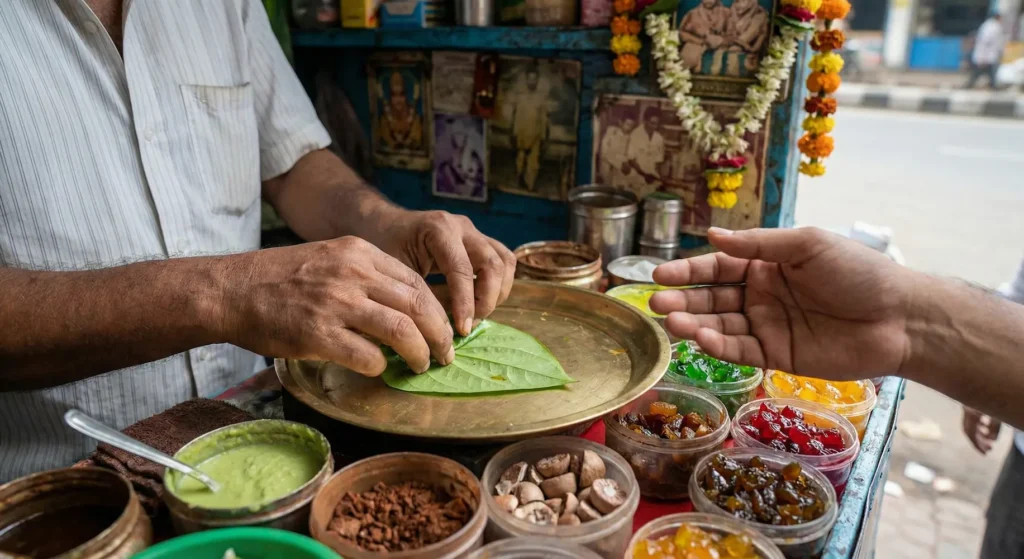
The offering of Paan marks the conclusion of a meal and the beginning of conversation. It has its own etiquette and creates a space for social interaction known as Galbaat. The continuity of Paan culture is sustained by the Paanwalas (betel sellers), who serve as keepers of neighborhood gossip and history and by the residents for whom the dissolution of the Paan in the mouth is a meditative practice essential to the Banarasi temperament of Masti (joie de vivre).
Challenges to Continuity in a Changing City
While the traditions of Banaras are resilient, they are not immune to the pressures of the modern world. The disintegration of the joint family system poses the single greatest threat to domestic culinary preservation. As families fracture into nuclear units, the “grandmother’s supervision” is lost and the labor-intensive recipes are often shortened or replaced by convenience foods.
Furthermore, the agricultural landscape surrounding the city is changing. The specific varieties of vegetables and grains that once supplied the city’s kitchens are facing competition from high-yield hybrids, subtly altering the flavor profiles of traditional dishes. The younger generation of Halwai families may also seek education and employment outside the culinary trade, threatening the lineage of the historic shops.
The Living Museum
Despite these challenges, Banaras remains a unique case study in culinary preservation. The city’s identity is so deeply intertwined with its food that the loss of a traditional dish is felt as a loss of cultural self. The preservation here is active, not passive. it is maintained through the daily demands of the residents who refuse to accept lower standards of preparation, through the religious calendar that mandates specific offerings and through the pride of families who view their recipes as heirlooms.
In Banaras, a recipe is not a set of instructions; it is a lineage. When a resident breaks a piece of Kachori or sips the froth of Malaiyyo, they are participating in a ritual that connects them to the ancestors who walked the same galis and sought the same sustenance from the city of Annapurna. The food traditions of Banaras survive because they are not merely eaten; they are lived, revered and protected as essential elements of the city’s eternal soul.
References and Further Reading
For those interested in the anthropological and historical study of this region’s food culture, the following areas of scholarship provide deeper insight:
- Food History in India: Works examining the evolution of dietary habits in the Indo-Gangetic plain.
- The Sociology of Pilgrimage: Studies on how pilgrim centers like Varanasi develop unique economic and service ecosystems, including food networks.
- Ayurvedic Dietetics: Classical texts on Ritucharya (seasonal routines) and Ahara (diet) which underpin the philosophy of the Banarasi kitchen.
- Colonial Gazetteers: 19th and early 20th-century records documenting the trade guilds and social life of the United Provinces.
This article is intended for educational and informational purposes, documenting the cultural heritage of Banaras.