
Blog
Quality Over Quantity: Salteen’s Philosophy

The city of Banaras (Varanasi), situated along the banks of the Ganges River in eastern Uttar Pradesh, is widely documented for its spiritual and architectural history. However, its agrarian and culinary traditions remain equally embedded in the geography and climate of the Gangetic plain. Among the entities operating within this historical framework is Salteen, a local food enterprise focused on traditional condiments, spices, and preserves. Rather than adopting the high-volume manufacturing models prevalent in the contemporary food industry, Salteen operates on a decentralized, process-oriented model.
This profile examines the structural mechanics of Salteen, detailing how its sourcing, production methodologies, and labor practices function as an exercise in preserving regional food systems rather than simply maximizing commercial output.
Founding Background
The contemporary food market is largely defined by industrialization, relying on standardized ingredients, chemical preservatives, and rapid manufacturing cycles to meet mass demand. Salteen was established as a deliberate countermeasure to this trend. Founded by a small collective of regional agricultural researchers and local historians, the enterprise began as an archival project aimed at documenting the declining culinary practices of eastern Uttar Pradesh.
During their initial research, the founders observed that the traditional methods of preservation specifically sun-drying, natural fermentation, and the use of unrefined oils were being rapidly replaced by synthetic alternatives, even within rural households. Salteen transitioned from a purely documentary project into an operational enterprise to ensure these methods remained in active practice. The brand’s foundational mandate is straightforward: to maintain the integrity of traditional Banarasi food processing, prioritizing methodological accuracy over scalability. There are no venture capital pressures driving rapid expansion; instead, the growth remains strictly tied to the natural limits of their seasonal supply chain.
Ingredient Sourcing Practices
Salteen’s approach to procurement relies on direct agricultural sourcing from the districts surrounding Banaras, primarily within the agricultural belts of Chandauli, Ghazipur, and Mirzapur. The organization operates on the principle that the final quality of a preserve or spice blend is dictated almost entirely by the raw agricultural input.
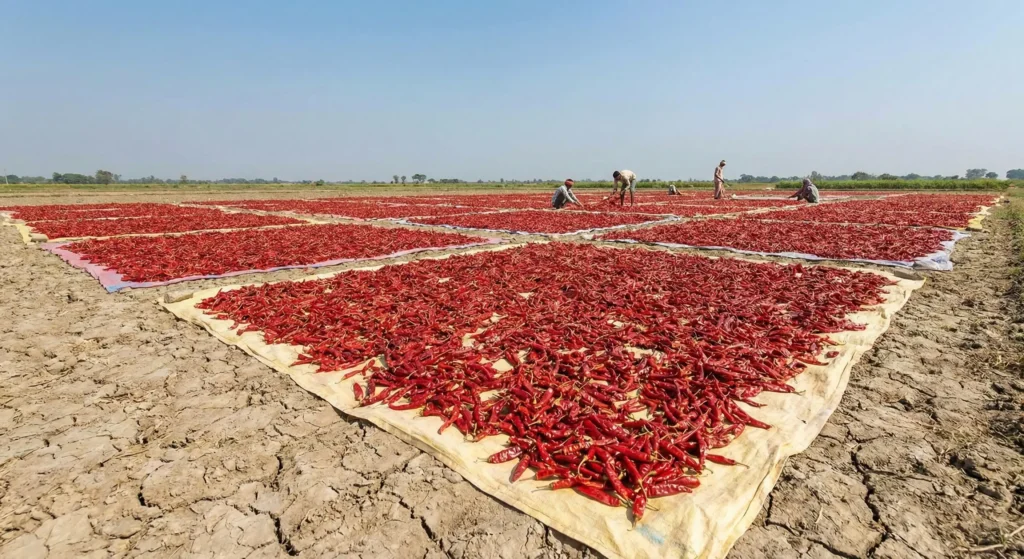
The enterprise avoids wholesale commodity markets where origins are obscured. Instead, Salteen engages in contract farming and direct purchasing agreements with smallholder farmers. For example, the mustard seeds required for their oils are sourced from specific clusters in Ghazipur known for cultivating indigenous seed varieties rather than high-yield hybrid strains. The red chilies used for their signature preserves are procured from local farmers who harvest the crop only when it has reached full maturity on the plant, ensuring the natural capsaicin and moisture levels required for long-term traditional preservation.
Furthermore, Salteen pays a premium above standard market rates. This pricing structure compensates farmers for the lower yields of heirloom crops and for adopting pesticide-free farming practices. By creating a reliable, localized micro-economy, the brand ensures a consistent supply of agriculturally sound ingredients while supporting the financial stability of regional cultivators.
Production Philosophy
The manufacturing processes at Salteen reject artificial acceleration. The production timeline is dictated by seasonality and local weather patterns rather than quarterly business targets.
Central to their production is the use of traditional cold-pressed oils. Salteen utilizes a kachi ghani a traditional wooden mortar and pestle system driven at low speeds to extract mustard oil.
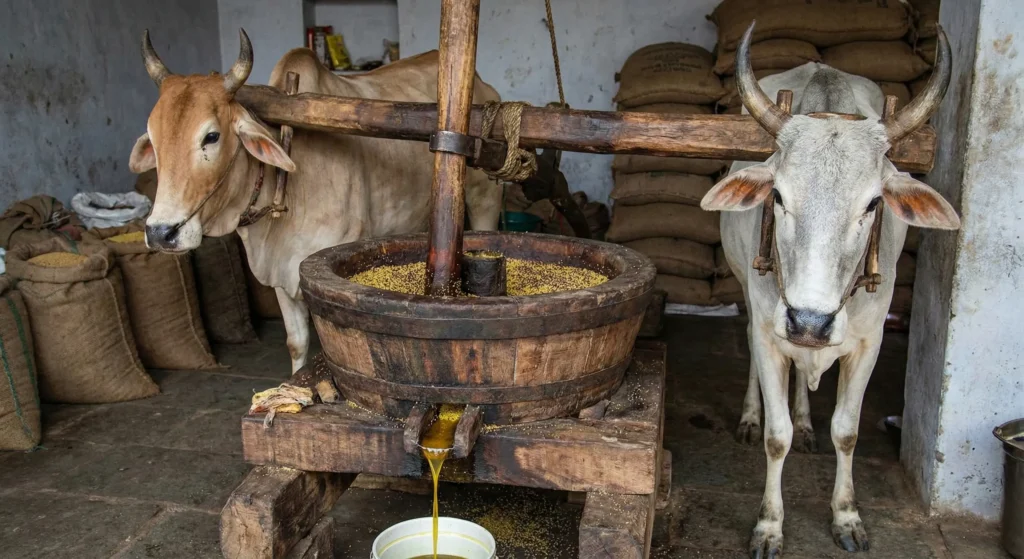
Unlike industrial expellers that generate high heat and strip the oil of its natural compounds, the wooden ghani maintains an extraction temperature below 45°C. This ensures the retention of the mustard oil’s natural pungency, allyl isothiocyanate content, and nutritional profile, which act as primary natural preservatives for their pickles.
Similarly, the processing of spices relies on ambient environmental factors. Spices are stone-ground to prevent the volatile essential oils from evaporating through friction-induced heat. Preservation techniques rely strictly on solar dehydration and natural osmosis. For instance, seasonal fruits and vegetables are treated with local rock salt and sun-dried in open courtyards for weeks. This slow evaporation process reduces water activity to a level where microbial growth is naturally inhibited, eliminating the need for synthetic additives like sodium benzoate or acetic acid. The result is a production cycle that requires significant time and physical space, inherently limiting the volume of output but strictly controlling the integrity of the product.
Connection to Regional Traditions
Salteen’s product catalog is not driven by modern consumer trends but rather serves as a physical record of Banaras’s culinary terroir. The formulations are exact replications of recipes that have existed in the region for generations, designed historically to sustain households through the harsh, non-agrarian summer months and the heavy monsoon season.
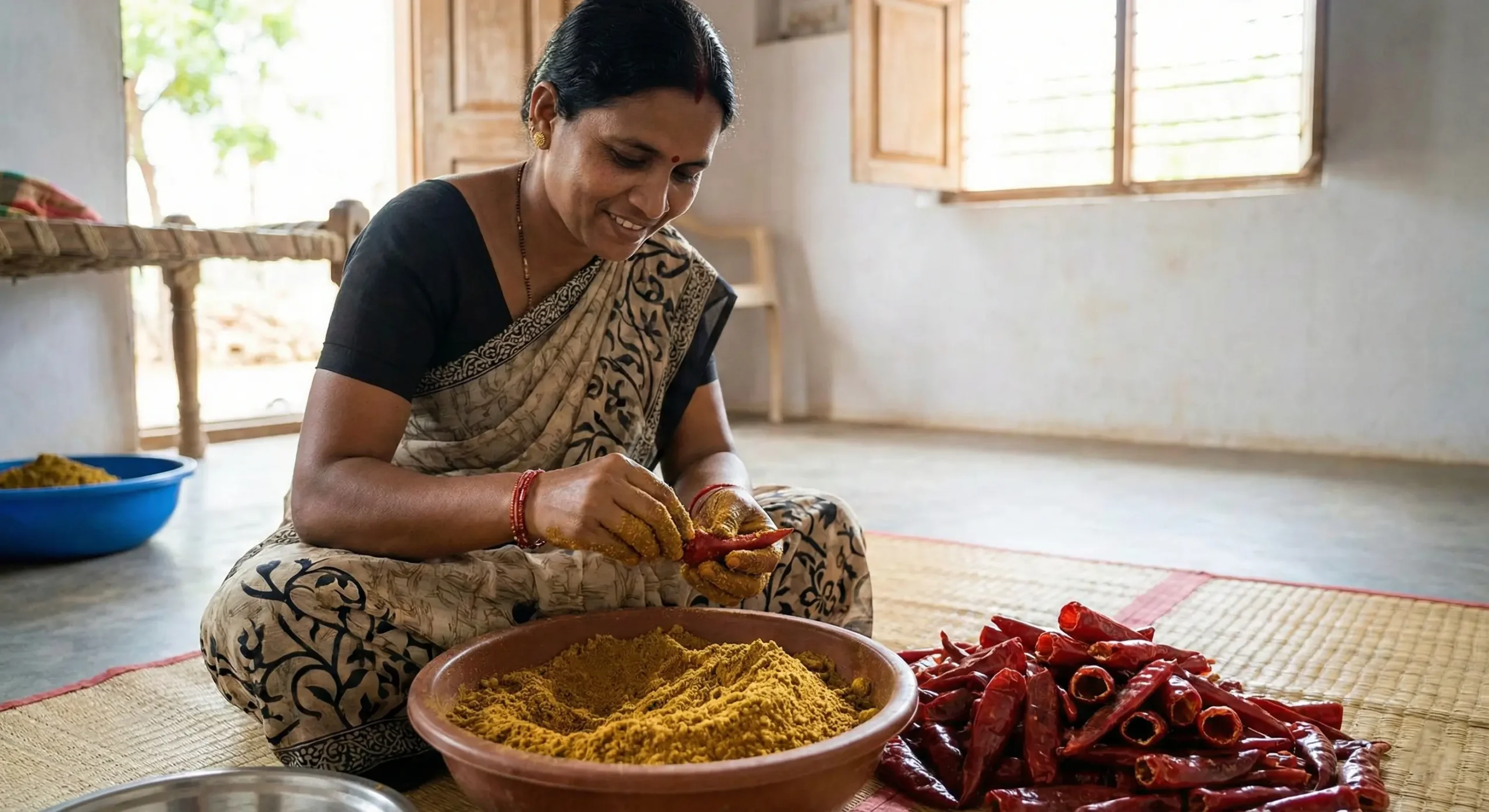
One of their primary focuses is the traditional Bharwa Lal Mirch (stuffed red chili pickle), a staple of eastern Uttar Pradesh. The preparation involves a specific regional blend of fennel, nigella seeds, fenugreek, and dry mango powder (amchoor), mixed with raw mustard oil and hand-stuffed into individual, hollowed chilies.
The brand also focuses on local variants of sirka (sugarcane vinegar), fermented slowly in earthen vats over several months. This connection to regional tradition is not treated as a marketing narrative; it is the fundamental blueprint for their operations. Salteen does not modify these recipes to suit a broader, milder national palate. The sharp, robust, and highly fermented flavor profiles characteristic of traditional Banarasi food are maintained exactly as they have been historically documented, ensuring that the regional identity of the food remains uncompromised.
Community Engagement
The physical execution of Salteen’s production methodology requires specific, localized skill sets. To facilitate this, the enterprise has structured its operational workforce around women-led production units. The processing facility, located on the outskirts of Banaras, employs women from neighboring rural communities.
This demographic focus is intentional. Historically, the knowledge of complex preservation techniques, spice ratios, and fermentation monitoring has been passed down matrilineally in rural Indian households. Salteen recognizes these women not merely as unskilled laborers, but as technical experts and custodians of traditional knowledge.
The enterprise has formalized this traditional domestic work into recognized, ethical employment. The women operate in a safe, well-ventilated environment, managing the entirely manual processes of sorting, cutting, sun-drying, and packing. Salteen ensures transparent wage structures, fixed working hours, and healthcare benefits standards frequently absent in the unorganized food sector.
By centering women in the production process, Salteen achieves two distinct outcomes: it provides a vital source of financial independence for rural women, and it ensures that the physical techniques required for authentic regional food preservation are practiced, compensated, and kept alive for future generations.
Through its strict adherence to local sourcing, slow processing, and ethical labor practices, Salteen functions as a working model of sustainable food production. The enterprise demonstrates that maintaining traditional regional culinary practices requires a fundamental rejection of mass-market shortcuts. By committing to agricultural transparency and community integration, Salteen secures its place not just as a provider of food, but as an active participant in the preservation of Banaras’s wider cultural heritage.
